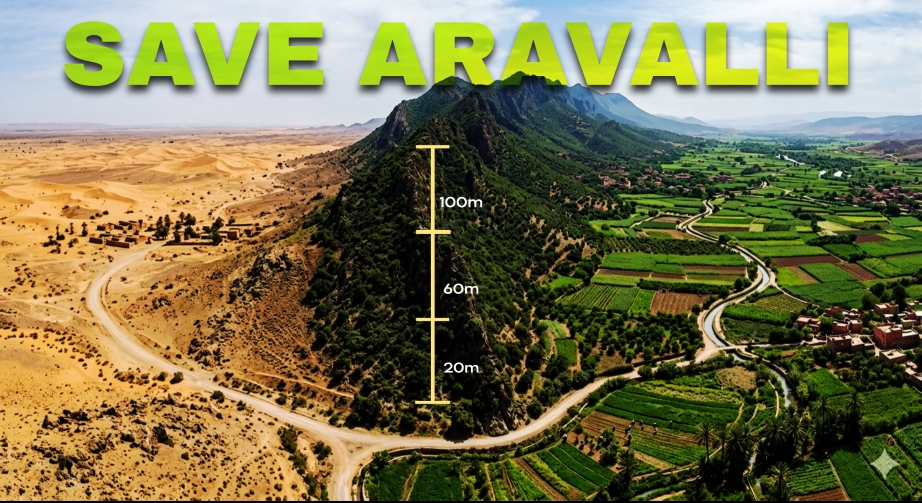
The Central Committee of the SUCI(C) in a statement issued on 24-12-25 (vide P Era dated 01-01-26) had categorically stated “The recent Supreme Court recently judgement (of 29 November 2025) accepting the new definition of the 692 kilometer long Aravalli Hills, spread across north-west India, that ‘any landform having an elevation of 100 meters or more from the local relief’ would only be reckoned as part of that Hill range, as proposed by a committee spearheaded by the Union Ministry of Environment, Forest and Climate Change, is going to be catastrophic for this already beleaguered landscape. …. new, narrow legal definition (hills >100m) would destroy natural recharge zones, disrupt underground water flow, and increase runoff, ultimately depleting aquifers that feed lakes and rivers, worsening water scarcity. As a result, more surface-water bodies will disappear, severely impacting water availability…” In that statement, our Party, “strongly protested the capitalist conspiracy of such a planned destruction …for the purpose of commercial mining in the interest of the giant corporates….”
This order was passed by the Apex Court in acceptance of the suggestions by a government led committee, and duly recommended by the Environment ministry. And within 5 days of our statement and taking Suo motu cognizance of the peoples’ protests that erupted in many areas, a vacation Bench of the Supreme Court headed by the hon’ble Chief Justice, on 29 December 2026, put in abeyance its earlier order that contained a contentious definition of the Aravalli Hills. The BJP led central government also welcomed the stay order and immediately ordered a “complete ban” on granting any new mining leases across the Aravallis in all four states that the Hill range spans.
Recapitulating History
Apparently, it would appear that the hon’ble Supreme Court has been magnanimous in reviewing its own order and that too out of volition. And the government is also quick to stop mining in the region. But if one delves into the case, it would be evident that perhaps arriving at such a conclusion would be incorrect. First of all, let us recollect briefly the historical facts. The Aravallis have endured for over a billion years because, across centuries local societies recognized their ecological worth and organized life around principles of restraint and sustainability. As early as the fifteenth century, Guru Jambeshwar–revered as Guru Jambhoji and born into the Parmar Rajput farming community articulated a moral framework that placed the protection of trees, wildlife and water at the centre of social duty. Meghrishi, regarded as the founding sage of the Meghwal community, articulated a philosophy of labour, land and restraint that bound artisanal and agrarian livelihoods to sustainable resource use–a legacy still visible among Meghwals, Jingars, Regars and other Dalit communities of the region. This tradition found its most tragic expression in 1730 at Khejarli, when Amrita Devi Bishnoi and hundreds from her community sacrificed their lives to stop the felling of Khejri trees. The order had been issued by Giridhari Bhandari, an overzealous Khatri official of the Marwar state acting in the name of revenue extraction. Crucially, the ruler Abhai Singh punished Bhandari and institutionalized protections for Bishnoi lands, recognizing unchecked extraction as a moral and political excess. And as already stated, a revised definition of the Aravalli Hills (i.e. only hills above 100 metres above the local terrain would be considered as the ‘Aravalli Hills and Ranges’) as a natural barrier protecting against the spread of the Thar Desert, stabilizing micro climates, and recharging aquifers, and thus potentially excluding from environmental protection over 90 per cent of the Aravalli range and removing its ability to act as a dust barrier for the Delhi NCR region. Moreover, for Adivasi groups such as Bhils, Meenas and Girasiyas, the Aravallis are not simply ecological assets but inhabited landscapes spaces of work, worship and memory. Forests and hill commons support subsistence agriculture, grazing, minor forest produce and seasonal migration. Mining expansion in these areas does not merely degrade the environment; it destabilizes social systems, pushing families into displacement, wage precarity and urban distress. Also, beyond livelihood loss lies cultural erasure. Sacred groves, burial grounds, hill deities and seasonal rituals tied to the Aravalli landscape face destruction when the Hills are blasted or fenced off. Weakening legal protection thus accelerates not only ecological degradation but also cultural alienation, intergenerational ties severing between communities and land.
It warrants to mention that Indian environmental law has long recognized ecological complexity. The Forest Conservation Act, 1980, the Environment Protection Act, 1986 and judicial doctrines such as the Precautionary Principle, Public Trust Doctrine and Intergenerational Equity were designed to prevent precisely such piecemeal erosion of natural resources through reckless mining and quarries.
What Prompted Elevation-Based Redefining Of Aravallis
A Centrally Empowered Committee (CEC) of the Supreme Court had, in March 2024, recommended a comprehensive environmental impact assessment of the Aravalli Hill range, a process that has yet to be carried out. It also advised not to contradict the Forest Survey of India’s (FSI) broader, slope-based definition which, inter alia, identified Aravalli Hill areas across 15 districts in Rajasthan using its 3-degree slope formula, encompassing a vast region. Despite the CEC’s opposition and the FSI’s warnings, the Supreme Court initially accepted the government’s narrower definition in November 2025, leading to significant backlash. By privileging indiscriminate extraction of mining resources over ecological function, the November ruling risked hollowing out these safeguards. So, the November verdict of the Supreme Court marked a decisive rupture in India’s environmental jurisprudence. In 2018, the CEC report revealed that 31 hillocks in the Aravalli range in Rajasthan had disappeared over the previous 50 years due to illegal quarrying.
Who Gains From Such Unscientific Tinkering With Nature
It bears mentioning that mining allocations have historically favoured dominant business groups like the Adanis, Vedanta group, JSE steels, etc., with access to capital and political patronage. 6 lakh trees were felled for a coal block of the Adani Group in the tribal district of Singrauli of MP. 9.64 lakh trees were axed in Nicobar Islands for construction of a transshipment port, an international airport, township development, and a 450 MVA gas and solar based power plant. Adani Ports is a key player interested in developing a major International Container Transshipment Terminal (ICTT) and also installation of the solar power project. Again, Adani’s mining in Chhattisgarh, primarily in the Hasdeo Arand area, involves clearing significant forest land and cutting over 3.68 trees. Even a significant portion of the extraction in the Aravalli Hills has been attributed to rampant and illegal mining by powerful “sand mafias” and other unregulated groups, particularly in states like Rajasthan and Haryana, evidently with the backing of the ruling dispensation. This illegal activity has been a major driver of environmental degradation and the focus of numerous court cases and environmental movements. It is very difficult to assume that the hon’ble Supreme Court in November 2025 was not aware of these cardinal facts nor was it informed by continuous alarm raised by the scientists and environmentalists about severe damage to natural ecosystem. The Apex Court cannot be oblivious of a number of calamitous events like flash floods, cloudburst, avalanches, landslides, mudflows, and earthquakes, which occurred in the hilly states of the Himalayas in course of the rapid pace of much clamoured ‘development’ spree that comprises construction of roads in fragile terrain, apart from hundreds of power projects, dams, urbanization and promotion of tourism including religious tourism like ‘ChardhamJatra’. One of the biggest casualties of such projects is the rich Himalayan flora and fauna since the projects reported to have cleared approximately 600 hectares of forest land.
With full respect and honour to the Supreme Court, a verdict that marks a rupture with the historical wisdom, placing the authority of law behind extraction rather than restraint is not just merely a legal error but is a civilizational choice, one whose costs will be paid not in courtrooms, but in fields, forests and land by people at large, by future generations.
Protest From Environmentalists And Human Right Activists
In a letter written to the Supreme Court Shri Rajendra Singh, Ramon Magsaysay Awardee and popularly known as Waterman of India said: “There is no 100-meter hillock along the Delhi-Haryana border. Thus, I believe it may open all those protected areas of the Aravalli for new mining and development and facilitate bringing the Thar desert to Delhi. The Aravalli is not an object; it is an ecosystem of hills with gentle slopes…. Even before our origin, the Aravalli has played a role in the formation of the Himalayas, the seas, and the Sahyadri ranges around it. At a time when climate change is afflicting the masses, when the air has become so polluted that even breathing has become difficult, can we even imagine causing any kind of harm to the Aravalli?” He also referred to the fact that in the Year 1994, based on a petition filed by him, a Bench headed by Justice M.N. Venkatachaliah ordered the closure of 478 mines in Saraiksa and thereafter stopped mining throughout Aravalli.
Also, in another letter to the Supreme Court by the Constitutional Conduct Group (CCG), a collective of former civil servants has also expressed deep anguish over its orders, which have set aside the rules and regulations put in place to safeguard the country’s environment and ecology. The Group even has not minced matters to state clearly:” mudflows, tourism Three recent orders of the Supreme Court have led us to fear that the last bastion meant to uphold the constitutional provisions to protect and conserve our natural world and the right to life of the people of India is crumbling before the onslaught of rich and powerful vested interests,…It is dismaying to learn that it is a committee of the Ministry of Environment, Forest and Climate Change (MoEFCC) that has proposed such an unscientific and destructive definition of the Aravallis, abdicating its mandate of conservation to facilitate mining. The outcome of the court authorizing this very same ministry to prepare a sustainable mining plan is predictable: large-scale mining will be taken up with the stamp of approval of the court, giving it finality against litigation.”
Members of the Aravalli Virasat Jan Abhiyaan, a movement to raise concerns by citizens under the banner of the People for Aravallis, while welcoming the interim stay by the Supreme Court mentioned that they are “very concerned” about the expert committees deciding on what is part of the Aravalli and what is not.They said: “Aravallis do not need to be defined. What they need is full protection and conservation” and wanted a “participatory and transparent process by the Supreme Court and the government”.
The Centre for Protection of Democratic Rights and Secularism (CPDRS), a people’s committee engaged in activities commensurate with its name has, in a letter to the Hon’ble Chief Justice of India has demanded, (i) Quashing any unscientific reclassification of the Aravalli Hills that allows for mining or commercial construction. (ii) Appointment of an independent expert committee to assess the damage caused by recent corporate land acquisitions in tribal forest belts and (iii) Issue an immediate moratorium on all projects in ecologically sensitive zones until a cumulative impact assessment is conducted. These are no doubt serious concerns that need to be duly taken cognizance of.
Need To Stall Such Mindless Rupture Of Ecosystem For Profit Maximization
So, there is no scope for too much elation over the stay order until the redefinition about ‘100 metre elevation threshold’ is abandoned, the demand granted for an independent, cumulative social and environmental impact study of the entire Aravalli range across all four states to ascertain the damage already done including on peoples’ health and livelihoods, by mining, real estate, encroachments and waste dumping and this impact study is actually undertaken while any move towards mining or such other projects that would threaten the very existence of the Aravalli Hills is promptly thwarted.
Let us conclude by once again reiterating what Great Engels said almost 150 year back: “Let us not, however, flatter ourselves overmuch on account of our human conquest over nature. For each such conquest takes its revenge on us.
Each of them, it is true, has in the first place the consequences on which we counted, but in the second and third places it has quite different, unforeseen effects which only too often cancel out the first… at every step we are reminded that we by no means rule over nature like a conqueror over a foreign people, like someone standing outside nature—but that we, with flesh, blood, and brain, belong to nature, and exist in its midst, and that all our mastery of it consists in the fact that we have the advantage over all other beings of being able to know and correctly apply its laws…The individual capitalists, who dominate production and exchange, are able to concern themselves only with the most immediate useful effect of their actions.
Indeed, even this useful effect… retreats far into the background, and the sole incentive becomes the profit to be made on selling…In relation to nature, as to society, the present mode of production is predominantly concerned only about the immediate, the most tangible result; and then surprise is expressed that the more remote effects of actions… are mostly quite the opposite in character.” (The Part Played by Labour in Transition from the Ape to Man)