
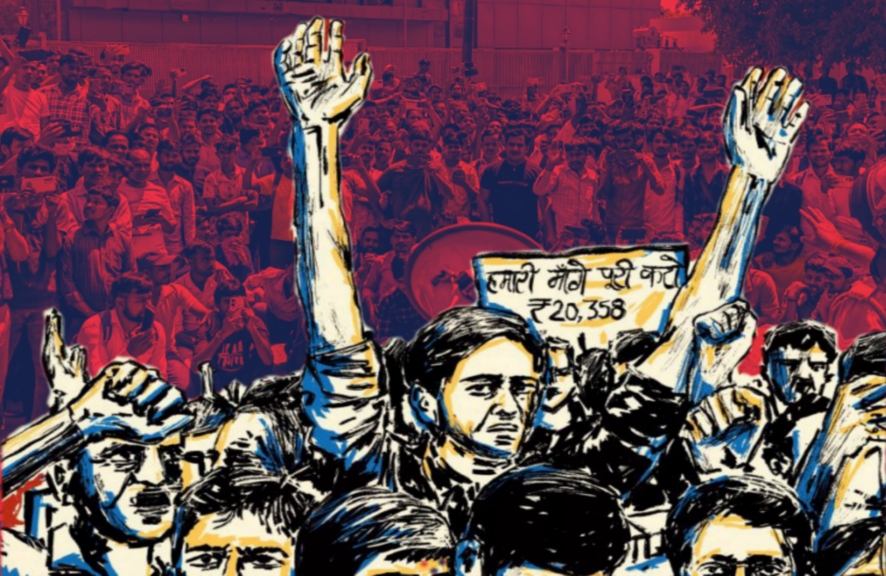
On 13 April last, thousands of workers spontaneously took to the streets at different places in Noida industrial hub in UP in demand for higher wages, better working conditions and security for women workers. This spontaneous protest by several thousand workers of Richa Global Exports, Motherson, Kent RO, Dixon Technologies, and such other industries, was not an isolated incident. In the beginning of February, several thousand contract workers of the Indian Oil Corporation Limited (IOCL) oil refinery in Barauni, Bihar, and in late February about 30,000 employees of IOCL in Panipat, Haryana, also went on strike on similar demands. Around the same time, five thousand contract workers of Larsen & Toubro (L&T) at the construction site of Arcelor Mittal Nippon Steel (AM/NS) project site in Hazira, Gujarat, stopped work and staged a violent movement on the same demands. It is worth remembering that S. N. Subrahmanyan, Chairman of L&T, in early January 2025 expressed dissatisfaction for the employees’ reluctance to work on Sundays and strongly advocated a 90-hour work week.
Noida movement
Another feature is large scale appointment of contractual labour at paltry wage and without any benefit of PF, ESI etc. Defying the law, these casual workers are being appointed even to the key functions of the industries. So, the industries are highly accident prone. Noida’s strike of over 40,000 contractual workers in the garment export automobile parts industry and manufacturing industry was a latest outburst of the highly oppressed section of labouring community.
The demand of salary increase of the protesting workers was not only from the employer but also from the state government. One of the methods to determine the value of labour in organized industry is the change in the ‘basic’ part of the salary every five years. This directive under the Minimum Wages Act, 1948, has been maintained in the new labor code (Code on Wages, 2019) as well.
But instead of recognizing that legal stipulation, the UP government has branded the workers as ‘law breakers’ and ‘criminals. State Labour Minister termed this protest a ‘conspiracy of Pakistan’. The police are alleged to have used force even on peaceful sit-in protesters and arrested the movement leaders. The UP-government’s response to the protest was marked by severe police action, including lathi charges, widespread arrests and detentions targeting not just strikers but also alleged sympathizers and organizers linked to it. Over 396 individuals were arrested, charged with rioting and violence; many were not factory workers but accused of incitement. Police targeted union members, lawyers, sympathizers via and even FIRs naming thousands. Offices of the Trade Unions were cordoned off and many leaders including those of AIUTUC were kept under house arrest. To terrorize civil societies not to come forward and protest, and even not to support or sympathize with the workers, UP STF and Noida Police, went to the extent of arresting a B Tech graduate from NIT Jamshedpur to Tiruchirappalli Railway Station in Tamil Nadu who allegedly used WhatsApp groups on the fabricated charge of spreading misinformation among the workers. A reward of Rs 1 lakh was declared for the arrests of these social media users as if they were criminals or terrorists on the run.
Although to hoodwink the people, the administration apparently blacklisted 24 factories for failing to monitor contractors and ensure statutory benefits, cancelled the license of 203 contractors for violations of wage and other norms, and issued notices to 43 plus others for failing to respond to initial inquiries regarding labor compliance and to issue recovery notices of Rs 1.16 crore for direct recovery of unpaid salaries and bonuses of workers, the steps have been very insignificant in comparison to the extent of crime committed by the factory owners at every level. However, the action at least exposed the large-scale violations of prescribed regulations going on in this manufacturing hub. What is significant that under pressure of the movement, the state government has been compelled to increase wages from 20-21%.
Vedanta Thermal Power Plant explosion
The allegations are not baseless. To what level the risk to workers’ lives could reach due to lack of regular maintenance at the workplace is amply proven by the recent death of more than twenty workers, with death toll still increasing, in a boiler explosion at Vedanta Thermal Power Plant Singhitarai, Sakti district, Chhattisgarh. In this case, too, the negligence in compliance with what is stipulated in law is squarely responsible. Labor officials who are supposed to regularly inspect the safety measures of all types of factories. With introduction of four anti-worker Labour laws, compliance with legal mandates has become even more lax. Inspection of safety measures has reduced to a mere formality. Despite squeezing the labour laws to the last straw, workers’ hard-won rights including right to protest are recklessly curtailed. Still the employers expose the life of workers to greater risks. Consequently, from large manufacturing industries, chemical industries, thermal power plants to illegal firecracker factories, workers’ security is highly compromised.
It bears recall that in 2018 the residents of Tuticorin, a port city in Tamil Nadu, had been continuously alleging that the Sterlite copper plant there belonging to the same Vedanta group had been causing significant environmental damage, including air pollution and groundwater contamination posing serious health hazard to them. The 400,000 ton capacity plant has been mired in controversy ever since it was first proposed in 1995. When the local residents flooded the streets to mark 100 days of protest against Sterlite, the months-long peaceful demonstrations took a violent turn as the police pounced upon the protesters and opened open fire on the agitators killing at least 13 and critically injuring many were. Police and state government officials sought to justify the firing live ammunition into the “unruly” crowd of protesters. However, the brutal police action sparked a national outcry with many calling the incident murder. Faced with mounting public pressure, state officials ordered the closure of the plant three days later. In fact, it was the fourth instance that the plant had to halt operations due to incidents like gas leaks, air pollution and groundwater contamination. Yet The Vedanta group has evaded all desired punitive action because of its closeness with the power that be.
A deeper insight into the matter uncovers darker facts
As far as determination of minimum wages is concerned, it has two components, basic pay and dearness allowance (normally revised twice a year based on CPI-IW to adjust for price rise). Between 2021 and 2026, the Consumer Price Index for Industrial Workers (CPI-IW) surged by nearly 25%. While dearness allowance (DA) was marginally increased, the base wage remained stagnant for years, effectively reducing workers’ purchasing power. But most of the states do not revise basic pay for years. The basic pay was last revised in Haryana in 2015 and in 2014 in UP. Various studies by ILO, RBI, Azim Premji Institute (State of Working India reports) points out at this widening gulf between corporate profitability and stagnant or declining real wages, especially in manufacturing. While in 1980s, workers’ wages accounted for around 30% of total value added, and corporate profits were only about 15 20%, the Annual Survey of Industries (ASI) 2021–2024 published by the Ministry of Statistics and Programme Implementation (MOSPI), Government of India shows that the corporate profit share has crossed 50%, while the wage share has fallen to around 10–12%, reaching to one of the lowest levels. Additionally, CPI measuring average inflation often falls short of capturing the price rise in essential segments like housing, healthcare and education. Indeed, calculations show falling real wages.
Next is working condition. With temperatures hitting 42°C in April 2026 in North India, the mandatory 12-hour shifts become physically unbearable. Researchers noted that ‘externally paced work’ (quotas/ machinery speed) pushes workers beyond physiological limits, leading to organ strain and exhaustion. In order to ensure profit maximization of the employers, the governments have ‘taken the teeth out of the laws’ through which workers used to have the minimal rights preceding the melting down of 29 labour laws into four labour codes weakening the minimal legal safety net for workers.
In the new labour law, the threshold for factories to lay off workers without government permission has been raised from 100 to 300 employees, giving large employers a license to ‘hire and fire’ and pay no attention to job security. The fear of losing job muzzle the voice of the suffering workers. The Occupational Safety, Health and Working Conditions Code expanded permissible daily working hours to 12 hours. While the weekly limit remains 48 hours, effectively legitimizes grueling daily schedules that were previously illegal under the Factories Act.
Coming back to Noida movement
The compulsive action taken by the Noida administration on the factories and contractors in the aftermath of the workers unrest itself exposes that the transition from 29 central laws to four consolidated codes has been marred by serious administrative gaps. Although the Code on Wages provides for a ‘National Floor Wage’ to prevent inter-state disparity, its implementation has been highly inconsistent. The perceptible Haryana-UP wage gap had triggered the vehement protest in Noida. Over 80% of workers in Noida’s factories are contractual or informal. The Codes were supposed to bring them social security, but the delivery mechanisms (like the Social Security Fund) are confined to paper only, leaving millions deprived of due benefits. And what about the ensuring of the implementation of the much-trumpeted labour codes? The shift from a punitive ‘Inspector to a Facilitator’ has led to a perceived lack of enforcement. Workers claim that basic amenities like clean drinking water, double rate overtime pay, and weekly offs are routinely ignored because there is no ‘fear of the law.’
New Labour Codes—totally anti-worker
The new codes mandate a 60-day notice period before a strike and prohibit strikes during conciliation proceedings. This makes ‘legal’ industrial action nearly impossible. But will it really stop the workers from protesting? No! As long as the employers keep squeezing the workers to the last drop of their blood and depriving them even of the least right to raise their voice of protest, no law of any land can keep the workers’ protest at bay for long.
Workers’ movement need to be organized, conscious, sustained and under correct leadership
The role of the labour unions is pivotal in educating the workers for well-organized, disciplined and channelized protests and thus create a formidable force, properly using the instruments of collective bargaining and strikes against all sorts of exploitation. State knows that it is easy to crush unorganized, leaderless, spontaneous outbursts. But it is not that easy to coerce an organized working-class movement premised on higher culture and morality and under a correct revolutionary leadership. Here comes the revolutionary role of the real struggling leftist Trade Union to raise consciousness of the workers and to enable them to develop sustained democratic workers movement forming workers own committees at factory level.
History has shown that despite all the efforts of the ruling class to suppress the workers, while keeping brutal exploitation going, has met with higher resistance and ultimately led to revolutions. These protests in the form of outburst are indications of the same and a ray of hope to the inhumanly exploited populace.


