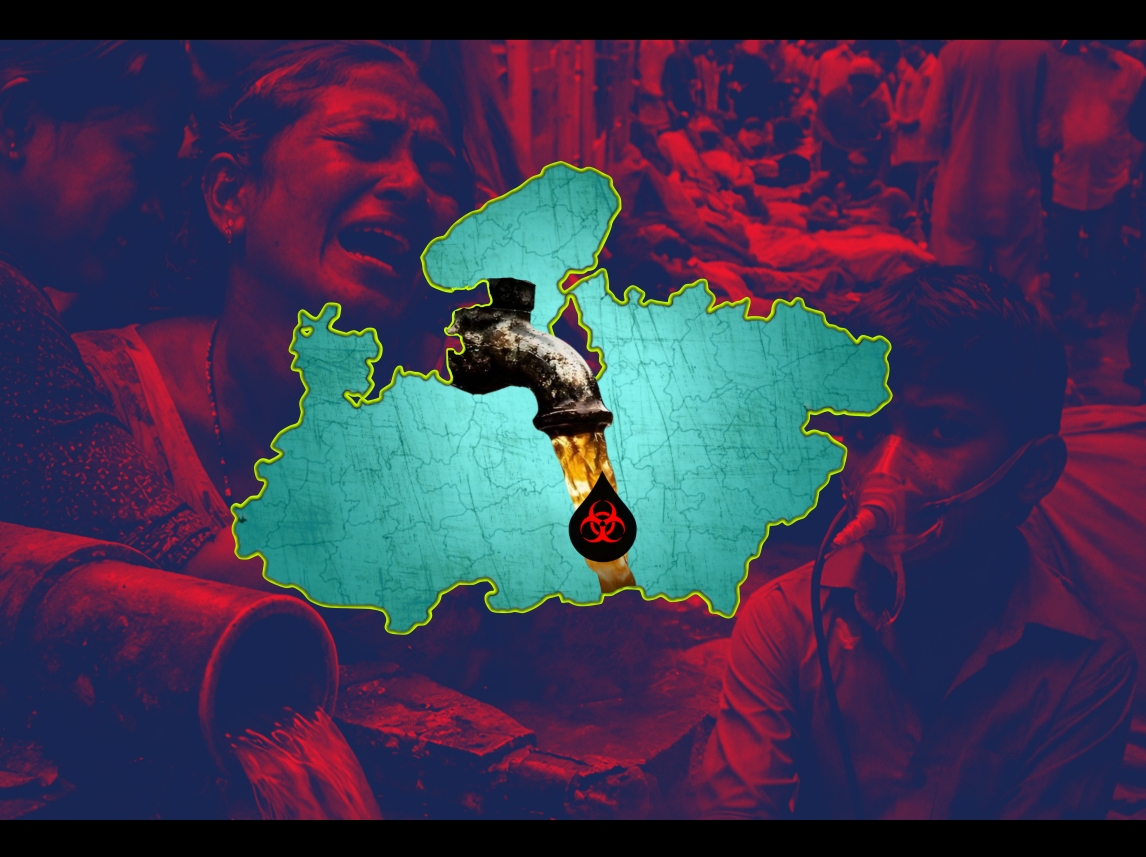
Between 24 December 2025 and early January 2026, Indore, India’s long-celebrated “cleanest city”—was jolted by a devastating public health crisis. In Bhagirathpura, one of the city’s oldest and most densely populated localities, residents reported foul-smelling, discoloured municipal drinking tap water. What followed was a wave of vomiting, severe diarrhoea, dehydration and weakness. Hospitals were receiving a large number of patients suffering from stomach diseases as drinking water was contaminated because of mixing of sewage, triggering widespread illness and deaths.
By the time the state BJP-led government woke up from its deep slumber, at least eight deaths had to be officially acknowledged and over 310 hospitalizations. 203 patients are still admitted in hospitals. Of them, 25 are in intensive care units. Over 2,800 people fell ill in just ten days. The most vulnerable section i.e. the children, the elders and those with compromised immunity were the worst victims. A mother mixed the same boiled tap water to dilute the milk for easy digestion of her 5-month-old baby boy born after 10 years of wait, but the same water took the baby’s life. Death toll rose to 28 on 26 January last when the government was celebrating Republic Day with pomp and grandeur.
On investigation, what came out bears testimony of utter negligence and maintenance of potable water supply system on the part of the government administration. A main drinking water pipeline passed under a public toilet that lacked a mandatory septic tank and absence of any connection to the sewer line with the sewage accumulating in an open pit. A leak in the ageing pipeline allowed sewage to mix directly with potable water, which was then supplied to thousands of households. Lab testing revealed that the water supplied in Bhagirathpura contained life threatening bacteria like Fecal coliform, Ecolie, Pseudomonas erugenosa, Vibrio, Klebsiella, and Citrobacter. Several distribution lines in Bhagirathpura were also found broken. Drinking water pipelines and sewage pipelines haphazardly run dangerously close. The area receives piped water for barely an hour a day. Thereafter, pressure drops soon. This shows that leakage in the pipeline could not be detected in time. By the time contamination was noticed, the damage was already done. Residents had complained repeatedly for days about water quality, running to every pillar and post, starting from government officials to their elected representatives— councilor to the mayor. But no one bothered to look into such a crucial matter. As if, it is not part of their duty.
Thus, it can be seen that the Bhagirathpura tragedy was not an accident—it was the outcome of long-standing supervision neglect. Most pipelines in the area were laid in 1993–94, under a foreign-aided slum expansion project. Many of these are asbestos-cement pipes, which, when damaged, are prone to releasing hazardous fibers. Under Project Uday (Phase III) in 2008, 360 MLD (Million Litres Per Day) of Narmada water was added to water supply system of Indore. But instead of putting in place a uniformly modernized infrastructure, the city has a bifurcated network—modern trunk lines in new areas and fatigued metal pipes in old localities. Such a dual system is incapable of handling today’s increasing pressure due to rising population load. Newly developed urban areas and the posh localities of Indore have durable, flexible, and thermoplastic corrosion-resistant High-Density Polyethylene (HDPE) pipelines designed for continuous supply. But such facilities were not granted to the older localities and habitats of poorer sections of people. A 2018 CAG audit found fecal coliform and other contaminants in most of the tested water supplied by Indore Municipality Corporation. This was alarming and warranted immediate remedial measure. But pipeline replacement in Bhagirathpura went on a snail’s pace.
It bears mention that 25–30% of the budget of Indore Municipality Corporation (IMC) is reported to be spent on water and sanitation supported by substantial funds from Asian Development Bank (ADB). The Atal Mission for Rejuvenation and Urban Transformation (AMRUT), launched in June 2015 by the BJP-government with much fanfare is a project focussed on improving infrastructure in 500 cities, primarily targeting water supply, sewerage management, storm water drainage, urban transport, and green spaces. The mission was stated to be aiming to ensure100% tap water coverage and sanitation in these areas. Moreover, SPML Infra Limited, a private company, was awarded a major project worth Rs 1,073 crore by the IMC for the augmentation of the city’s water supply system under the AMRUT. Yet there have been gaping holes in the system as borne out by the recent disaster. A Rs 2.38 crore pipeline revamp project approved in November 2022 was still incomplete when the tragedy had occurred. A 2023 National Green Tribunal NGT committee noted that Indore generated nearly 368 MLD of sewage while ignoring water extraction by 910 ‘illegal colonies’, proving the 8 year ‘cleanest city’ tag a farce. Even judicial reference has been of no avail. The state later told the High Court that 80% of the work had been completed, admitting that old lines continued to be used because laying of new lines was delayed. But the reason for delay was not made explicitly clear.
Responding to PILs the Madhya Pradesh High Court had to make a crucial constitutional observation, that ‘The Right to Life’ under Article 21 includes the right to clean drinking water. The court criticized the authorities for failing their most basic duty, directing immediate provision of safe water, free medical treatment for victims, preventive and corrective long-term measures, transparent categorization of emergency, preventive, and systemic reforms. The court’s remarks underlined what residents already knew, that this tragedy was preventable.
If the contamination reflected administrative failure, the official response revealed moral bankruptcy. Despite public assurances by the local MLA and Cabinet Minister Kailash Vijayvargiya, many families complained of not being compensated. When questions regarding this were raised, instead of admitting accountability, the minister dismissed the journalists with the remark: “Fokat questions mat poochho” (Don’t ask useless questions).
The comment itself shows how indifferent and irresponsible are these high security fenced ministers to the misery of common people. To them, deaths of citizens are immaterial and any query regarding fault of the administration is fokat (useless). And since MP is not a poll-bound state, the central government has not granted a single paisa as compensation to the victims.
However, to play to the gallery, the state government ordered some suspensions and transfers. But such cosmetic measures, people know, are of no use. Can anyone in the lower rung dare to neglect duty if the echelons at the hierarchy are not either lackadaisical in approach or acquiescing in such dereliction of duty of those?
Incidentally, Bhagirathpura a worker’s dominated settlement, presents a striking political paradox. For over a quarter of a century, the region has remained a steadfast stronghold of the BJP across all levels of governance, yet it continues to struggle with a legacy of severe water contamination. The Indore Municipal Corporation (IMC) has been under continuous BJP control for 25 years (since 1999-2000). Similarly, the Indore-1 Legislative Assembly, which encompasses Bhagirathpura, has been a BJP bastion for decades (with only a brief interruption in 2018). Currently represented by senior cabinet minister Kailash Vijayvargiya, while the local ward (Ward 10) too remains firmly in BJP hands. Yet, when people from Bhagirathpura have been jostling with death and disease, over two dozen people, including children, have been diagnosed with jaundice after drinking contaminated water in the Mhow, a sub-division of Indore which, coincidentally come under the parliamentary constituency of the same minister who miffed at the media persons for being questioned about Bhagirathpura tragedy.
The Annual Ground Water Quality Report 2024 by the Central Ground Water Board (CGWB) highlights a critical, rising trend in groundwater contamination across India, with 440 districts—nearly 56% of the 779 districts analyzed— reporting excessive nitrate levels in groundwater as of 2023. Major findings include widespread fluoride contamination in states like Rajasthan and Haryana, and significant arsenic, lead, uranium and iron contamination in various regions. Across India, 66 million people suffer from fluorosis, Arsenic exposure in the Gangetic belt has led to cancer clusters, Nitrate contamination has caused a surge in infant “blue baby syndrome” and Uranium and heavy metals threaten long-term organ and neurological health. From Budhpur in Uttar Pradesh to Bhubaneswar in Odisha, groundwater has become a silent killer. And the downtrodden millions pay the highest price.
The Bhagirathpura tragedy has shattered the myth that award of cleanest city does not mean guaranteed safety even over purity of drinking water. Clean streets and glossy rankings cannot compensate for corroded pipes, ignored warnings, and callous governance. Indore’s crisis is a national mirror. It asks a simple question: What is the value of development if citizens cannot safely drink water from their taps? Is it not akin to applying snow-powder on face to hide the festering sores?
Safe drinking water is not a luxury, not a favour, and not a market product. It is a constitutional right, and the non-negotiable responsibility of the government. The BJP top brass wax eloquent about double engine government. Indore water tragedy is a glaring proof of what is in store for the citizens if a double engine government is operative. How hollow is the hype of ‘Viksit Bharat’ is borne out by the Indore water scandal. In ‘Amritkal’ which, as claimed by the BJP leaders, has commenced after 75 years of independence, urban residents are deprived of not just pure water but supplied with poisonous water. Its wake-up time for the citizens and questioning the government about the applications of the rights given in the same constitution on the Republic Day. Pressure can be created on the government-administration for remedy only if the suffering people close their ranks and build up a united, sustained, powerful movement in demand for the basic facilities to subsist.