Union BJP Finance Minister (FM) in her Budget speech for 26-27 said: “Since we assumed office 12 years ago, India’s economic trajectory has been marked by stability, fiscal discipline, sustained growth and moderate inflation. This is the result of conscious choices we have made, even in times of heightened uncertainty and disruption. Our government, led by Hon’ble Prime Minister Modi, has decisively and consistently chosen action over ambivalence, reform over rhetoric and people over populism.” Then she added: “Our Government’s ‘Sankalp’ (Pledge) is to focus on our poor, underprivileged and the disadvantaged”. To deliver on this Sankalp, the Budget, she said, has been prepared in Kartavya Bhawan (Duty House). Last year, the BJP Finance Minister had started with a clarion call of “Viksit Bharat”—a developed India by 2047. The rhetoric was one of high ambition. Yet, a cold analysis of macroeconomic data reveals not a breakthrough (toward an upper middle-income economy) by 2032, but the consolidation of a narrow, exclusionary growth model which would make the rich richer and the poor poorer. The speech was non-transparent since it gave no idea whatsoever of budgetary allocations for key programmes and schemes. One had to dig out the figures through number crunching from the annexures. In fact, the entire budget which has now become more ritualistic than realistic, is only a narration of over-promising and shrewd camouflage of under-delivery.
Earning Side
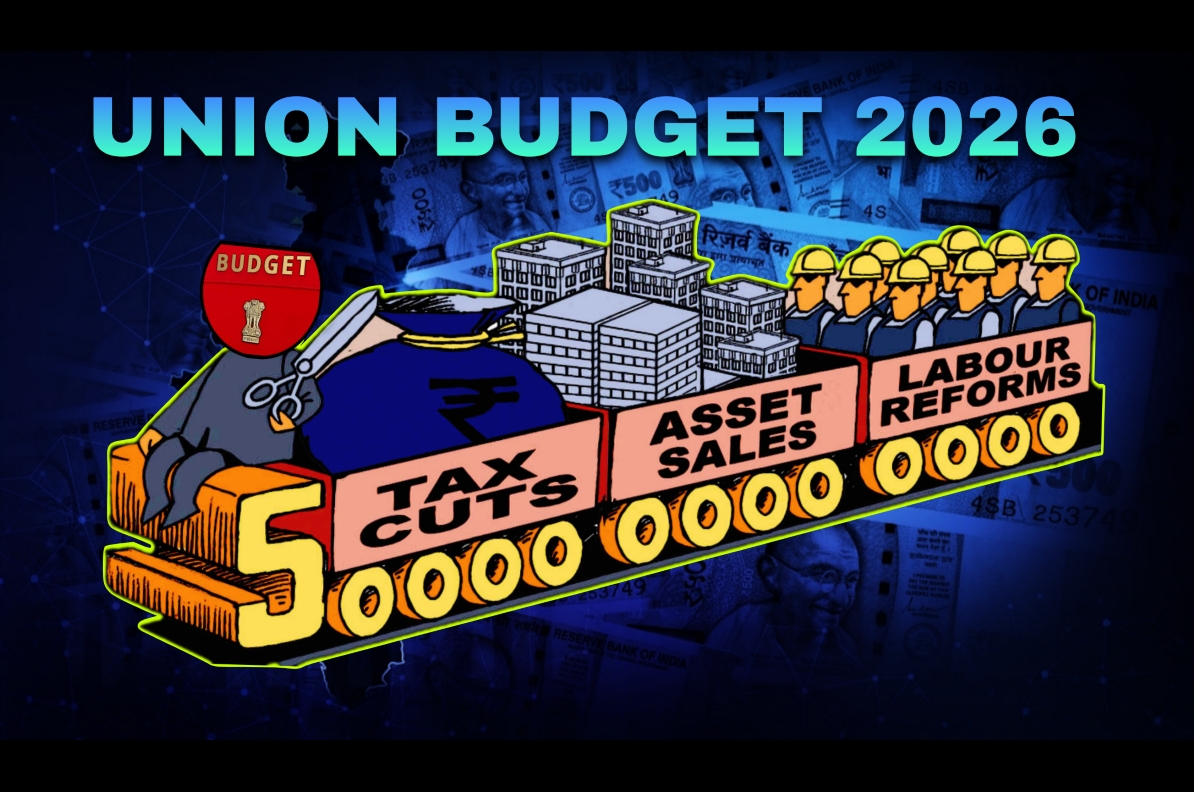
Before entering into some details, let us dwell on one fundamental aspect. In budget, people need to know how much money the government has for spending and where is that money coming from. The budget 26-27 is of Rs 53.47 lakh crores, marginally higher (around 5 %) than last year. But what are the sources where the government expects to earn from? 24% of the earning would be from borrowings. 21% of the income will be from personal income tax. GST and other indirect taxes would bring 15%, while corporate tax would account for 18% of revenue. Who pays GST and other indirect taxes? The common people. The bottom 50% of the population pays 64% of the total Goods and Services Tax (GST), while the top 10% contribute only 4%. Rest is from non-tax revenue such as fees, fines, dividends from public sector undertakings (PSUs), interest on loans, and royalties. So, the government extracts 36% (21+15) of tax from the toiling masses whereas corporates bear half of that as tax liability. That means corporates enjoy more concessions and waivers while the common citizens are made to feel good at stagnated relief.
Spending Plan
Now we turn to expenditure side. 22% of the tax revenue goes to the states. And, as high as 20% (Rs 14 lakh crores) is spent as interest on the borrowings. Rest 58% is available with the government for spending. With projected borrowing amount at Rs 17 lakh crore this year, the total borrowings would cross Rs 214 lakh crores (55.6% of GDP) as against Rs184.56 crores last year. This shows how prudent fiscal management is! If 1% additional tax is imposed on those earning Rs 20 lakhs or more a month, government revenue could increase by Rs 15,000 crores. On the other hand, if corporate tax is marginally hiked from 22% to 25%, government could net additional revenue of around Rs 1.2 lakh crores. Why not then tax the rich more and give some breathing space to the common people back-broken by unbridled price rise and non-availability of means of income? Only then, the claim of focus on “marginalized and disadvantaged” could have some substance. But that is not to happen because target audience of the government is different. To state clearly, fiscal consolidation now functions as a credibility device to reassure monopoly houses, foreign investors, supports sovereign ratings (Country’s creditworthiness) and reinforces the government’s self-image as a competent economic manager of theirs.
Claim of Lifting 25 Crore People Above Poverty
Now about the claim of “inclusive growth”. The FM has reported that close to 25 crore people have come out of multidimensional poverty due to the government’s efforts over a decade. Achievement par excellence! But does the claim match with reality? Multidimensional poverty means identification of poverty beyond just low income by assessing overlapping deprivations in health, education standards. It and living captures how individuals experience items of essential need simultaneously—such as lack of clean water, poor nutrition, healthcare and proper education — to provide a more comprehensive, person-centered picture of poverty than income alone. Now, let us turn to reality.
Who does not know that retail inflation is skyrocketing whatever may be the spruced-up figure released from the self-styled experts mandated to show night as day? Being unable to manipulate data any further, the government had to admit of late that retail inflation has shot up. But the figure of increase has been pegged down at 1.33% through customary sleight of calculation. But food inflation is stated to be 8%. So, consumption expenditure is dipping, particularly in rural areas, driven by high food inflation, plummeting real wage, and increased debt. Does it indicate any upliftment in the life standard of common Indians?
The government’s decision to give free ration to 80 crore poor itself indicates that over 60% downtrodden do not have the means to afford even bare minimum food items. India ranks 105th out of 127 countries in global hunger index. According to the UNICEF report, 8.8 lakh children under five years of age lost their life due to starvation in recent years. Over 20 crore Indians sleep on empty-stomach every day. More than 7,000 Indians die per day due to hunger. Over 500 children die every day because of malnutrition and health issues. 48 peasants commit suicide every day. Over 50% of the population still lacks reliable access to safe drinking water. 66% of rural Indians lack access to minimum healthcare and critical medicine, 31% travel over 30 km for obtaining rudimentary medical treatment. Only 3.4% of the 1.55 lakh Health Sub Centres are functioning as per Indian Public Health Standards (IPHS). A lowly 13% (3278) of the 24,918 Primary Health Centres, and 8.4% of Child Health Centres adhere to basic standards. Approximately 90 crore people lack adequate financial protection from the much-touted health insurance schemes. What purpose would insurance cover serve if basic healthcare facilities elude people, particularly the rural people, constituting about 70 % of the population? Can the have-nots approach high-priced private hospitals for treatment? So, how could 25 crore people come out of multi-dimensional poverty? Is that not mere waffle!
Agriculture and Peasants
In a public speech, our hon’ble PM Modi had stated that his heart breaks to see the misery of the peasants. If welfare of the peasants was truly the concern, policy would focus on irrigation, price stability, and input support. But such is not the case. Further, how was it that three Black Farm Laws were brought in to facilitate unrestricted ingress of giant multi-nationals and monopoly houses in agriculture? When the peasants’ organized a historic protest movement for one long year in the outskirts of Delhi, the BJP government took every possible administrative measure at the borders of states adjacent to Delhi to stop the marching peasants from coming. Water cannons were turned on the agitators in wintry cold, tear gas shells fired, and lathi charge resorted to brutally injuring countless peasants. Multiple layers of barricades were put up with fences, coiled wires, containers filled with sand, big trucks, and trenches dug on the streets, boulders dropped on the roads with the help of cranes, inter-state borders sealed and curfew as well as Sec 144 imposed in many places to stop the peaceful marchers. Over 700 protesters lost their lives. Though under pressure of movement, those four laws were abrogated, a move is afoot to bring them back through backdoor. The government has not yet approved long standing demand of legitimizing Minimum Support Price (MSP) based on scientific formula of C2+ 50. While the crop procurement market is already handed over to private operators who merrily fleece the peasants by not giving them remunerative price for their produce, now, with invocation of a new Seed Act and other measures, the entire agricultural input market is opened up to the profit-hungry agri corporates. In other words, the agricultural sector is now in private hands and there is no tax on agricultural income. So, it is now a most lucrative agricultural hunting ground for the behemoths.
In this perspective, look at the budget figures. Expenditure on agriculture and allied activities had been cut from an estimated Rs 1,58,838 crore to Rs 1,51,853 crore in 25-26. For the next year, it is increased only by about 2%, which barely covers inflation. For rural development, Rs 2,65,817 crore was planned in 2025-26 but expenditure was 20% less at Rs 2,12,750 crore. For the next year, it is raised to Rs 2,73,108 crore – just 3% more.
Moreover, in keeping with the law of capitalism, land is being increasingly concentrated in the hands of a few. According to the published NSSO data a few years back, the extent of landlessness has been extremely high like 54.4% in Andhra Pradesh, 49.3% in Bihar, 46.3 % in Punjab and 42.5% in Telangana, to cite a few states. NSSO data further shows that the top 20 per cent of the rural households owned 76 per cent of all land. These figures can easily be assumed to have increased manifold in the subsequent years.
Next, the rural employment guarantee scheme MGNREGA has been rebranded as VB-GRAM G, coupled with a shift to a 60:40 Centre-state funding ratio. It thus transfers a major responsibility of funding to resource-crunched states while undermining the Act’s legal guarantee. MGNREGA has long been structurally and fiscally tied to agriculture. Since 2014, it has operated under a binding mandate that at least 60 % of all works must be linked to agriculture and allied activities. What distinguishes VB-GRAM G from MGNREGA in its treatment of agriculture is not the kinds of work it permits, but the timing of work itself. Agriculture— allied work such as water conservation and land development was already central to MGNREGA. The decisive break lies in the withdrawal of the employment guarantee precisely when agricultural labour demand peaks. What the new law ultimately legislates instead is a statutory reconfiguration of rural labour markets that prioritizes labour availability over income security. VB–GRAM G Act, the experts say, is more centralized and does not offer a legal guarantee of jobs. Section 5 of the Act states that it will apply only in areas notified by the central government. This immediately ends the universality that was central to MGNREGA. The guarantee no longer applies everywhere by default. In 2020-21, Rs 1.1 lakh crore was allotted to MNREGA. But that came down to Rs 86,000 crores in 2025-26. Now, VB-GRAM G got Rs 95,692 crores which is, by any count, drastically short of providing the distressed rural unemployed a wage befitting to eke out a bare living.
Migration of landless peasants and agricultural labourers to other states for earning a pittance as contract labour in unorganized sector is on an alarming rise. And now with the reported opening up of agricultural market to US would virtually wipe out Indian peasants from the scene. This is how the government is shedding crocodile tears for the peasants.
Workers are Equally Distressed
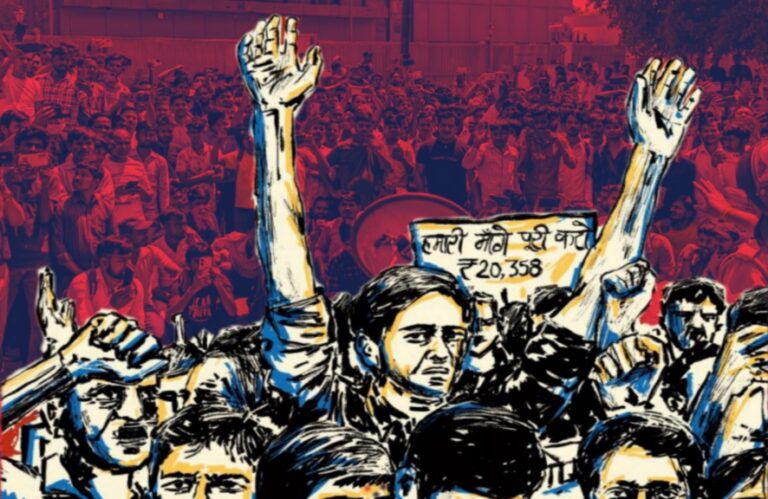
Similarly, what about the workers? Permanent employment has become a tale of yester years. Now, it is an age of contractual, casual and fixed term employment at a throwaway compensation. Even the government is appointing workers and employees on contract basis for undertaking permanent nature of jobs. According to data provided by the Indian government to the Lok Sabha in December 2025, over 2.04 lakh (2,04,268) private companies closed down in India over the past five financial years (spanning FY21 to FY25). So, a large number of workers have lost their job. Regular employees in central public sector enterprises (CPSEs) decreased by 1.08 lakh within five years (from 9.2 lakh in 2019-20 to 8.12 lakh in 2023-24) due to disinvestment. According to the latest Annual Survey of Unincorporated Enterprises (ASUSE) for 2021-22 and 2022-23 released by the Union Ministry of Statistics and Programme Implementation (MoSPI), nearly half of the Indian states and three Union territories saw informal sector job losses over seven years. Over and above, four Black Labour Codes passed recently are slated to remove whatever little safeguards the workers had so far and give a free hand to the employers to do whatever they want—hiring and firing workers, snatching away existing labour protections and infringing upon their right to strike. On the other hand, the Codes roll out red carpet to the profit-hungry corporate sharks under the garb of ‘ease of doing businesses.
Unemployment is Mounting
So, unemployment is mounting. India’s official unemployment rate is stated to be fluctuating between 6% 8% in recent years (PLFS). This is again a carefully knit camouflage. The bigger issue is informal employment, where nearly 90% of workers are engaged in low-paying, insecure jobs. Youth unemployment remains high, especially among educated youth over 18% urban youth unemployed (PLFS 2023). India also faces widespread disguised unemployment in agriculture, where too many workers share limited farm output, keeping rural wages low and perpetuating poverty. Underemployment and informal work dominate the labour market, with ~92% of workers in informal jobs, often earning below minimum wages and lacking job security. Though the latest Economic expressed Survey concern has about employment, it has been completely ignored in the Budget. Incidentally, in 2024 budget, the FM announced a new ‘Prime Minister’s Internship Scheme’ aimed “at providing internship opportunities to youth in top 500 companies of India. The programme was stated to be offering youth exposure to real-life business environments across sectors, helping them gain valuable skills and work experience”. But then in two subsequent budgets, no reference has been made to the outcome of the scheme. Based on data provided in Parliament, around 16,000 to 16,060 candidates had joined the internship, which as of late November 2025 was experiencing low uptake (claim was of recruiting 1crore in 5 years) and high attrition. As of mid-2023, there were approximately 9.64 lakh vacant positions across various Central Government departments in India. But most of those posts are either still lying vacant or extinguished. As of mid-2023, more than 2.74 lakh (274,580) non gazetted, Group C posts were lying vacant in the Indian Railways, according to an RTI reply. These vacancies include crucial safety positions, with over 1.7 lakh in the safety category. No one knows what is the present position. The budget allocated Rs 2.9 lakh crore to the Railways for the fiscal year 2026-’27. But will that be used for filling up permanent vacancies, improving safety of journey, bettering public amenities or drained in running high-cost Amrit Bharat and Vande Bharat expresses, affordable only by a handful of rich?
Defence Expenditure Increased and Social Welfare Allocations Cut
Budget 2026 trimmed food, fertilizer and fuel subsidy outgo by 4.47%. But it has increased military expenditure / allocation to Rs 7.85 lakh crore, the highest among all Ministries. This once again proved that dying capitalism cannot but go more and more for militarization of economy. On the other hand, allocations towards social welfare schemes have been reduced. For example, in ‘25-‘26, in the Jal Jeevan Mission, instead of budgeted Rs 67,000 crore only Rs 17,000 crore was spent. For housing scheme (PMAY) instead of Rs 54,832 crore, Rs 32,500 crore was spent. Like this, for dozens of centrally sponsored schemes and major central sector schemes, expenditures were less than allocations. The overall education budget as a percentage of total outlay has dropped over the last few years. As against recommendation of National Education Policy 2020 for allotting 6% of GDP to education, the central government’s expenditure on education is estimated at 0.6% of GDP. Concurrently, a 92% cut in minority education funds has been noted, shrinking from Rs 678 crore to Rs 55 crore. Moreover, the Budget proposes an Education-to Employment-and-Enterprise (E2E) standing committee to align education outcomes with labour market needs and expand India’s share of global services exports, thereby confirming its objective to strip education of its essence.
Delivery Timeline – A Shifting Goalpost
Another point is noteworthy. In 2014, PM Modi requested to give him a few years to change the lot of the people. In 2016, after announcing ruinous demonetization, he pleaded for 50 days to show the positive results pending which, he stated he was ready to face any punishment meted out to him by people. He also said in 2017 that by five years (i.e. from 2017 to 2022), farmers’ income would be doubled. So, his timeline for delivery was akin to shifting goalpost. Now, he and his government have extended the timeline to 2047. So, one would not be able to hold him responsible for reneging on his promises in next 20 years. Incredible indeed!
One highlighted feature of the budget is the continued expansion of central capital expenditure, now exceeding Rs 12 lakh crore. Infrastructure dominates— transport networks, flyovers logistics corridors, energy systems, and industrial clusters. This reflects a deliberate development model. This budget has allowed products in tax free Special Economic Zones to be sold in domestic market. Who are benefitted by these? The monopoly houses and big contractors who bag the orders. But what about those living under the flyovers, the hungry footpath dwellers evicted from their home and hearth? No answer would be forthcoming. Rather than stimulating demand directly through consumption or transfers, the government channels resources into physical and productive assets, hoping to crowd in private investment and raise long-term productivity.
Some Thrive, Some Stick in the Gap
Wealth inequality has reached, according to some reports, a hundred-year high. Combined wealth of 248 billionaires (as of the 2025 report), is approximately Rs 98 lakh crore i.e. 1/3rd of GDP. The top 10% of the Indian population holds 57% of the national income. Corporate profits in India have experienced a remarkable surge, nearly tripling from Rs 2.5 trillion in FY21 to Rs 7.1 trillion in FY25, according to Reserve Bank of India. The BJP-led Union government has waived loans to the tune of Rs 16.50 lakh crore for 100 corporate giants, mostly from Gujarat. Also in the current budget, tax defaulters have been decriminalized and offered prospect of paying monetary compensation in place of going to jail.
So, the so-called growth trajectory projected in ‘Amritkal’ to be a Rs7 trillion economy by 2030 is to benefit the business tycoons. Right now, net-worths of Ambani and Adani are Rs 9.10 lakh crore and Rs 8.14 lakh crores respectively. Reports and analyses from several media outlets indicate a strong correlation between PM Modi’s foreign visits and the subsequent acquisition of projects by the Adani Group in those countries. For example, following PM’s visits to Bangladesh in 2015, the Adani Group signed an MoU for a 1,600 MW coal-fired power plant in Jharkhand to supply power to Bangladesh. Likewise, the group partnered with Elbit Systems in 2018 to manufacture drones and later acquiring Haifa port in 2022 after PM Modi’s sojourn to Israel in 2017. Adani bagged a 30-year concession to operate a terminal at Dar es Salaam port in May 2024 after Tanzanian President ‘s visit to Delhi in October 2023. Similar has been the saga with Kenya, Egypt, Vietnam and Ethiopia. So, whom the BJP government is working for? The suffering multitude or a handful of business magnates?
Final Words
To what conclusion do the two contrasting scenarios lead to? The government is glaringly comfortable with rising inequality so long as opportunity narratives can be sustained. This future-oriented model is distinctively uneven and mocks the slogan “saab ka saath, saab ka vikas” (development for all) often reiterated by the BJP leaders and ministers including PM Modi. The budget only sells16 dreams without any real intent to fulfil them.
As stated in our Central Committee statement, “Ease of doing businesses glaringly prevailed over showing any concern about ‘ease of living’ of the citizens.” In this perspective, the high-sounding words of “growth and prosperity” of Sankalp budget and “economy is in a Goldilocks moment flagged the many challenges that it faces” in Economic Survey sound like prattles.