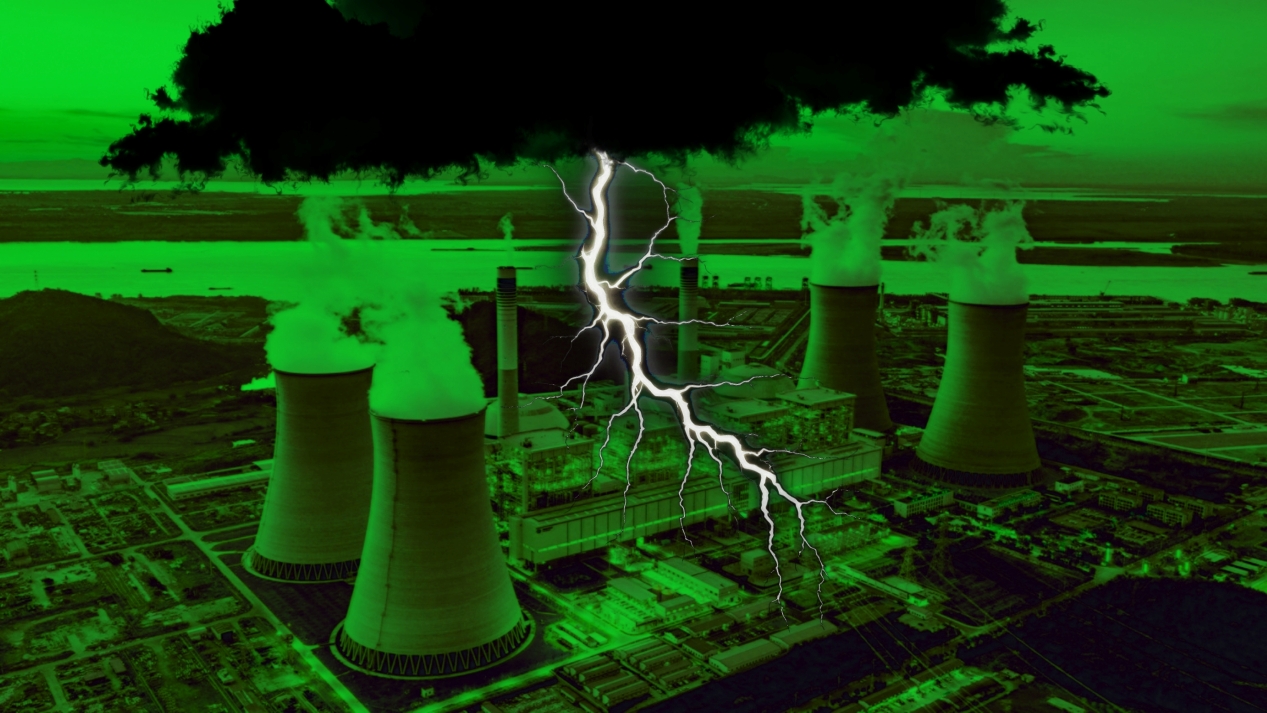
PM Modi is very fond of acronyms. So, whenever the BJP government led by him brings out a scheme, the naming is done in such a way that when abbreviated, the first letters of the words form a Hindi word. POSHAN, G RAM G, MUDRA, UDAY, SATAT and now SHANTI. Yes, the names are a mouthful, but the imports behind are fraught with insidiousness. What is meant by Shanti? Peace. What is Shanti Bill which has been hurriedly passed in the Lok Sabha and the Rajya Sabha on 17 Dec and 18 Dec 2025 respectively without any debate or discussion amid a walkout by most of the opposition members, and then granted assent by the President of India on 20 December 2025? “Sustainable Harnessing and Advancement of Nuclear Energy for Transforming India (SHANTI) Act, 2025.” What is it meant for? It proposes to build 700 Mega Watt and 1000 Mega Watt reactors through international cooperation; the capacity is projected to rise to over 22 Giga Watt by 2031-32- and 100-gigawatt nuclear energy capacity by 2047.
Socio-Political-Economic Context Needs To Be Taken Into Account
But, is it not that a host of associated issues and problems need to be addressed before we decide to go for large scale nuclear power generation? Can any use of science or technology be examined in isolation from the given socioeconomic-political context? These are the fundamental questions. We know that in an imperialist-capitalist state, the political system and structure is geared to protect the capitalist economic system and to serve the vested interest of the capitalist class. People’s needs cannot be met within the framework of capitalist system. When we approach any question from the people’s point of view, we cannot afford to be guided by the bourgeois thought process or influenced by the economic-political interest of the reactionary exploitative bourgeois class. This is equally true for resolving issues of science and technology and for utilization of scientific discoveries for the benefit of mankind as a whole.
Hence, the production of power, like production of everything else, in capitalist India is governed by the motive of profit maximization. Hence it is futile to expect that the ruling monopolists and their servitor BJP government will take any initiative in adopting hazard-free scientifically tested production processes. What is the reason for this governmental emphasis of nuclear power generation, even though it is clear there are less hazardous and economically more viable options for power generation? While country after country has abandoned breeder reactors as unsafe and uneconomical, why is the Department of Atomic Energy (DAE) stubbornly insisting on the same technology for power generation? To seek an answer to the question, one has to keep in mind the link between nuclear reactors and nuclear armaments production and the character of the Indian bourgeois state controlling the production process. For brevity’s sake, let us come straight to the answer avoiding other details.
Insights Into Shanti Act
Shanti Act 25 has repealed two previous Acts, the Atomic Energy Act, 1962 and the Civil Liability for Nuclear Damage Act, 2010. A major change under the Bill is the entry of private enterprises into civil nuclear operations, which was, till now, reserved for government entities. It said that the sensitive operations such as uranium enrichment, spent fuel handling and heavy water manufacturing will still remain exclusively under the control of the Central government. Similarly, oversight of radioactive materials and radiation-producing equipment will also continue under the Centre to ensure that safety standards are maintained. But how far these private companies will be able to keep the enriched Uranium-235 safely or of the weapon grade Uranium, is anybody’s guess. It means that the responsibility of the nuclear plant’s builders will be to construct, own and operate, and supply power to the grids and earn profits, and the rest of the work will be done by the Central Government.
It may be noted that Section17(b) of the ‘Civil Liability for Nuclear Damage Act2010 (CLNDA)’ states: “grants the nuclear operator of the nuclear installation shall have a ‘right of recourse”- where” the nuclear incident has resulted as a consequence of an act of supplier or his employee, which includes supply of equipment or material with patent or latent defects or sub-standard services”. This clause is entirely deleted in the new Shanti Act to favour the nuclear supplier companies.
Again, the Section-46 of (CLNDA) of 2010 reads: “The provisions of this Act shall be in addition to, and not in derogation of, any other law for the time being in force, and nothing contained herein shall exempt the operator from any proceeding which might, apart from this Act, be instituted against such operator.” In other words, this stipulates responsibility on the part of the operator. But, section 81 of the new Shanti Act 25, shuts the door on that possibility by barring the jurisdiction of civil courts in the event of a nuclear accident. This change in the new Shanti Act 25 has, therefore, been done to save the nuclear plant operators from other liability that may arise because of any other laws in force.
Thus, Shanti Act 25, has removed the clause related to the liability of suppliers of nuclear equipment and gives US nuclear suppliers a free pass even in the event of an accident caused by defective equipment, and camouflages its diluted liability provisions within a new version of India’s. We have the past experience of the Union Carbide Bhopal tragedy, whereby the victims had to suffer for decades to get compensation. When India passed the Civil Liability for Nuclear Damage Act in 2010, it did so under the shadow of Bhopal. The law accepted global norms of no-fault operator liability and capped compensation. But it also introduced two departures that reflected political memory rather than technocratic conformity. It preserved a statutory right of recourse against suppliers whose defective equipment or services caused an accident. And it refused to extinguish victims’ access to other civil and criminal remedies. In fact, under the previous (CLNDA) of 2010 the operator of a nuclear installation was liable for any damage caused by a nuclear incident or by faulty equipment as per a no-fault principle. Now this clause stands amended in favour of foreign suppliers. According to Shanti Act 25, the Central Government will establish a fund to be called the ‘Nuclear Liability Fund’ and be liable to pay compensation out of this fund, where the liability exceeds the amount of liability of an operator. In effect, public funds, i.e., taxpayers’ money, will be used for all the damages caused by private facilities. It is nothing but dilution of corporate accountability for systemic failures, occupational safety and health of the people in case of nuclear accidents. It shows that the Central Government is least bothered about public safety and environmental protection but more interested in protecting the interest of profit hungry foreign and Indian nuclear supplier companies.
Operators Limited Liability
Section-13(1) of the Shanti-Act 25, the maximum amount of liability of the Operators in respect of each nuclear incident shall be “the rupee equivalent of three hundred million Special Drawing Rights (an international reserve asset created by the International Monetary Fund the value of which is determined and allocated by it to the member countries) or such higher amount as the Central Government may, by notification, specify.” However, the Second Schedule of this Act specifies the maximum amount of liability of an operator in respect of each nuclear incident for different categories of nuclear installation. But, where the liability exceeds the amount of liability of an operator specified in the Second Schedule, to the extent such liability exceeds the liability of the operator; the Central Government may assume full liability for a nuclear installation not operated by it if it is of the opinion that it is necessary in the public interest to do so. (Section-14(1) of Shanti-Act 25). It means the compensation would be paid by the Central Govt from the taxpayers’ money. Why should the people of India pay for actions or failures of Nuclear Plant operators? India’s nuclear regulator lacks statutory independence. Safety oversight is opaque. Public participation in siting and emergency planning is minimal. Courts are inaccessible to mass tort victims. In such a context, weakening liability law is not harmonization. It is abdication.
Extinguish Period For Compensation
As per Section-64 (3) of Shanti Act 25: Every application for compensation shall be made within a period of three years from the date of knowledge of nuclear damage by the person suffering such damages. However, “the right to claim compensation for nuclear damage shall extinguish, if such claim is not made within a period of 10 years, in the case of damage to property and 20 years, in the case of personal injury to any individual.” (Section-67 of Shanti Act 25). Now, given the long latency periods of radiation-related diseases, cancers that can appear 20 or 30 years after exposure and intergenerational genetic impacts, it means that no claims can be raised for personal injury after 20 years. These limitation periods are very restrictive and go against the studies of science on radiation effects on human beings.
Nuclear Sector Liberalization Is A Boon For Booming Arms Industry
The government authorities have a readymade argument. Since thermal power plants are causing large scale environmental pollution through emission of greenhouse gases and since other sources of generation of power are grossly inadequate to meet the growing demand of electricity, setting up nuclear power plants is the only option. They aver that opposing nuclear power generation is infantile and, in a sense, refusal to reap benefit from latest scientific inventions.
Does it look that liberalization of nuclear sector is meant for power generation? Or, is it a bonanza for the corporate goliaths? Indian corporate behemoths like the Tata, Adani, Mahindra, Larsen and Toubro are already in in arms manufacturing business. Tatas have collaboration with Lockheed, a US multinational giant. And Boeing, also a US aerospace behemoth. UK based BAE System has joint venture with the Mahindras. Seven Indian private companies, including KaleidEO, EtherealX, and Aadyah Space, have been selected for an India-US space and defense collaboration program. They will partner with the US Defense Innovation Unit and other agencies, gaining access to the US defense and space market, mentorship, and paid opportunities.
In March 2025, the US Department of Energy granted ‘Holtec International’ an export license to sell its SMR-300 technology to Indian firms. The US and Indian governments have agreed to fully implement the Indo US Civil Nuclear Agreement (123 Agreement). In fact, several US companies have been lobbying for a long time to supply nuclear power plants and technology to India, such as Holtec International, Westinghouse Electric Company (WEC), and GEHitachi.
This new Shanti-Act 25 also enables “private companies and joint ventures to build, own, operate, decommission, a nuclear power plant or reactor and the fabrication of nuclear fuel including conversion, refining and enrichment of uranium235 up to such threshold value, or production, use, processing or disposal of other prescribed substance, as may be notified by the Central Government, under a license from the government.” In other words, the sector of nuclear energy is now opened up by PM Modi-led BJP government for the Indian as well as the foreign monopoly houses and multinationals who have found this business segment a lucrative one because of increased militarization of economy in the imperialist-capitalist industries.
Claims Do Not Stand On Facts
PM Modi has called– “the nuclear energy as a clean energy”. How can one call “nuclear energy as clean energy”, when it completely neglects the serious, massive, and irreversible risks from radioactive leaks and long-lived nuclear waste? Also is it not associated with nuclear radiation hazards in cases of leaks and accidents? The impact of nuclear radiation varies wildly, from hours/ days to centuries or millennia for long-lived isotopes in case of reactor accidents or waste storage.
PM Modi also on X handle has called” the passing of the SHANTI Bill by both Houses of Parliament marks a transformational moment for our technology landscape”. But the main question is for whom? The suffering Indians or a handful of arms manufacturers and nuclear input suppliers? What conclusion would one draw in view of the foregoing discussions?
Concluding Remarks
Hence, SHANTI Act is not at all for Shanti (peace) in the world, but to produce enriched uranium (weapon grade) for manufacturing nuclear weapons in future, since India is one of the emerging nuclear powers in the imperialist world. The main object of this Shanti Act 25 is to serve the interests of the Indian monopoly class, which is eagerly waiting for joint ventures with foreign nuclear suppliers. Thrust on nuclear power generation is not by any stretch of imagination aimed at mitigating the problems of power generation, nor is driven by any urge whatsoever for meeting people’s need of energy. Rather, under the subterfuge of responding to growing need of power, it is a sinister bourgeois design to boost nuclear armament development programme. SHANTI (peace) act is aimed at serving the bourgeois class design of creating more ASHANTI (disorder) through war-mongering