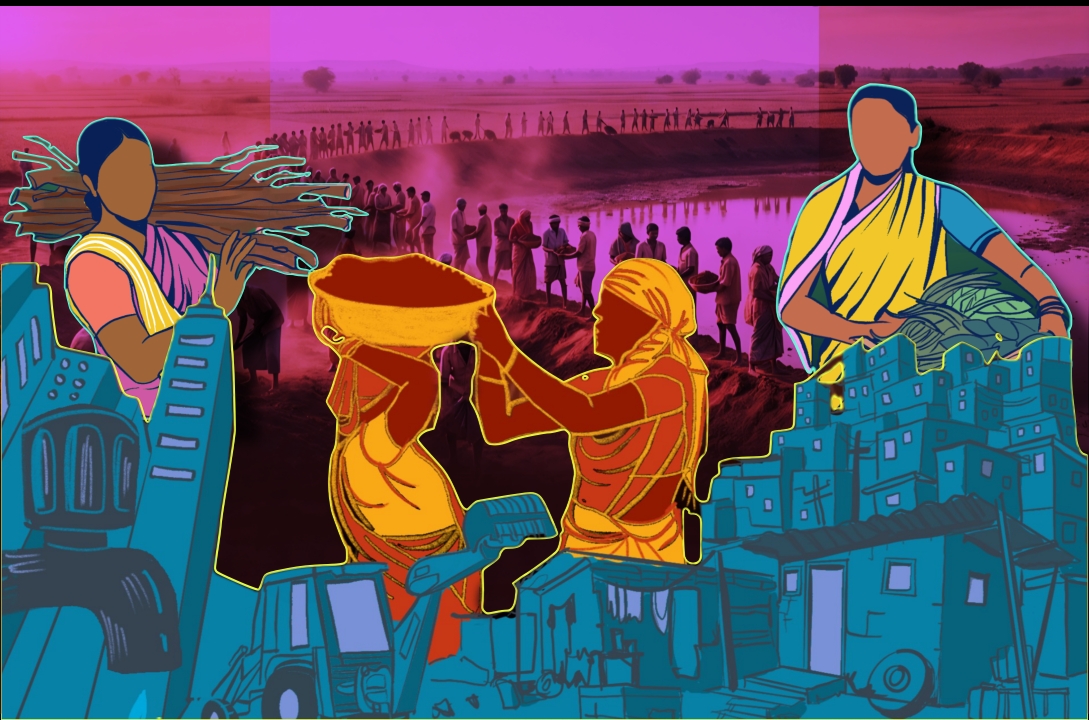
After forcing through four draconian Labour Codes that snatched away whatever little vestiges of hard-earned rights, including trade union rights from the workers had remained, the PM Modi led BJP government has turned to further pauperize rural India. The proposed Viksit Bharat – Guarantee for Rozgar and Ajeevika Mission (Gramin) Bill — VBG Ram G—that aims to repeal the Mahatma Gandhi National Rural Employment Guarantee Act (MGNREGA), which ensured at least 100 days of work to the rural unemployed at a meagre wage.
Sold as a modern upgrade promising “125 days of work” and faster infrastructure, the Bill in reality dismantles the hitherto available guarantee of a token employment envisaged in MGNREGA and craftily shifted control of the scheme from the states to the Centre. The name has been so reframed that the acronym contains the name of Lord Rama in commensuration with the arch communal Hindutva doctrine. This is not just an administrative tinkering or cosmetic change of name. It is a political project to replace entitlement to favour and authorized claim to bureaucratic rationing.
MGNREGA was announced in 2005 during Congress rule as a palliative to the mounting unemployment particularly in rural area as a fallout of the economic laws of capitalism where maximization of profit for the capitalist owners prevails over all other considerations. Naturally, there has been an accumulated grievance in the minds of people particularly the unemployed millions. As trusted representative of the ruling monopolists and implementer of the prescripts of capitalist globalization, the Congress government felt the pressure of anyhow soothing the frayed temper and hence was launched the MNREGA as if it was slated to change the landscape of rural unemployment.
It was claimed that it would reduce rural poverty, help augmenting earning of poor families and, in the course, create some useful public assets like roads and ponds. However, the scheme had never reached its full potential, either during the Congress rule or in the BJP regime. On average, most families received only about 50 days of work in a year instead of 100. And even then, disbursement of wages was either delayed abnormally or did not take place at all. Moreover, there has been rampant corruption by the lackeys of the ruling dispensation to embezzle MNREGA funds by depriving the declared beneficiaries. Why has it been so? Because any government subservient to bourgeois class interest in this phase of decadent moribund reactionary capitalism, cannot be free from corruption.
From Entitlement To Discretion
The core of MGNREGA lay in its demand driven design. Any rural household could demand work, and the state had a statutory obligation to meet that demand. Funds were supposed to follow workers’ claims. This architecture transformed welfare from charity into entitlement. Later, job cards were issued as proof of entitlement.
G Ram G reverses this logic. Under the new Bill, the Union government will fix “normative allocations” for states—ceilings that determine how much work can be generated, regardless of how many people demand it. Any expenditure beyond these limits becomes the responsibility of state governments. In plain terms, the right to work has been transformed into a budgetary privilege. Employment is no longer something workers can claim as citizens, but something they must compete for within the centrally imposed expenditure caps.
The Bill converts the programme into a centrally sponsored scheme with a 60:40 Centre–state funding ratio for most states, while also making states liable for unemployment allowance if work is not provided on time. What is framed as fiscal discipline is, in reality, the legalisation of denial. The burden of unemployment is no longer to be treated as an outcome of the faulty system but as an individual misfortune, managed through rationing rather than guaranteed relief. The poor are turned from rights bearing subjects into supplicants in a queue.
Hindutva Branding
The ideological thrust of the Bill is announced in its name. By erasing Mahatma Gandhi and inserting the language of “Viksit Bharat” and the resonant “Ram G,” the BJP government has sought to attach a tag of Hindutva to a proclaimed welfare scheme.
In this new narrative, the poor are invited to see themselves not as fixed term workers with claims, but as grateful beneficiaries of a “Viksit Bharat” defined from the perspective of the monopolist owners of the state. One of the most regressive provisions of the Bill prohibits work during peak agricultural seasons, supposedly to ensure labour availability for farming. In practice, it openly serves the interests of landlords and rich peasants.
From Demand To Allocated Budget
MGNREGA enjoined the Centre, at least in principle, to confront unemployment as a social obligation. Even when budgets were squeezed and payments delayed, the legal right remained a site of political struggle. G Ram G seeks to foreclose that struggle by making ceilings the law itself. G Ram G abandons even the formal commitment to such standards. It gives the Centre unchecked power to fix wages, without linking them to any law, index, or floor wage. There is no guarantee of revision, no protection against erosion by inflation. Instead of setting a wage floor for rural labour markets, the scheme risks becoming a mechanism to normalise depressed wages—with the state acting as a direct agent of wage repression.
Burdening States, Centralizing Power
In a post GST order where states have lost revenue autonomy and face chronic transfer delays, this shift is devastating. The Centre keeps control over design and priorities, while states carry the fiscal burden and political blame for failures. This is not cooperative federalism. It is centralisation by stealth, hollowing out the constitutional balance while deepening regional inequalities —especially for poorer, labour exporting states.
Illusion Of 125 Days
The BJP government’s headline promise of 125 days of work is pure spectacle. Even under MGNREGA’s year-round framework, average employment, as mentioned above, had rarely crossed fifty days. With budget caps, seasonal bans, fiscal burdens on states, and centralised controls, there is no material pathway to expanding real work. The number functions as propaganda — a symbolic surplus masking a substantive erosion.
The Design Behind
As Comrade Shibdas Ghosh, Founder General Secretary of the SUCI(C) and an outstanding Marxist thinker of the era, fascism has become a common feature of all capitalist states, whether advanced or backward. He further elaborated that “…historical conditions impart to fascism some common characteristics which are its distinguishing features. They are mainly economic centralization, maximum concentration of political power in the state, rigid firmness in administration—all this leading to more and more identification of the interest of the monopolists with that of the state—and cultural regimentation.” (SW Vol II)
GRamG is a typical example of that. On the one hand, the central government has vested on itself the right to decide which state is to get how much support, financially as well as from the perspective of deciding the number of beneficiaries in each state.
Thus, both economic and political powers are concentrated in the hands of the central government. This is how; fascist autocracy is firming up its grip on the country with the BJP government working as a handmaiden.