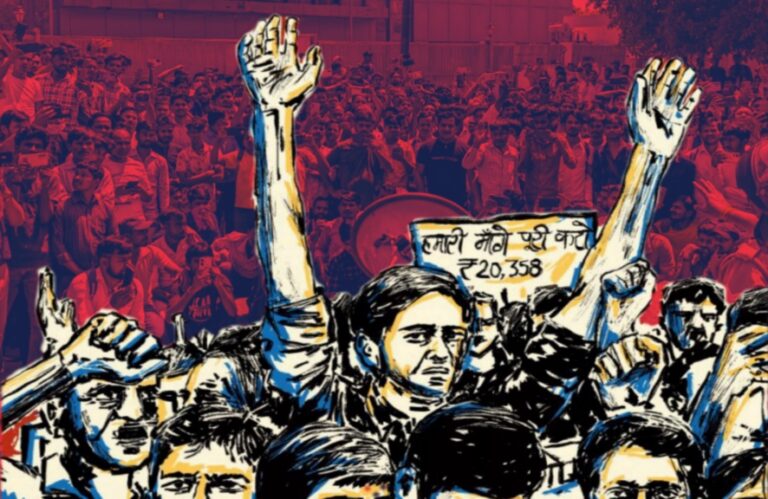
24 January 2026. A historic day! It witnessed an unprecedented event in the 80 years after independence. Hitherto, the governments had prepared education policies according to their political design. People had to either accept it or protest against it. In 1989 the document ‘Towards a People’s Education Policy – An Alternative to NPE 1986’ was adopted in first All India Convention of AISEC held in Chennai. Before that hundreds of seminars, symposia and discussion were held throughout the country based on the draft.
But the then government took no cognizance of that. But this time, raising a far louder voice of protest against the National Education Policy 2020 (NEP-20) formulated by the BJP government to virtually ruin the education system and hand it over to the private operators to sell as a profitable commodity, education loving people, eminent educationists and personalities adopted the People’s Education Policy 2026 (PEP-26) through the People’s Parliament in Bangalore! The All India Save Education Committee (AISEC) had convened the People’s Parliament.
Two Education Policies; NEP-20 and PEP-2026
NEP-20 was introduced during the pandemic-hit period, when the entire country was under total lockdown and the door for any meaningful exchange of opinion was shut. But PEP-26 has been adopted through free exchange of ideas and opinions across the country. The former promotes all-out privatisation, commercialisation of education; but PEP-26 advocates for free universal public education. One encourages vocational education; another speaks for value-based secular scientific democratic education which aims at man-making and character-building. One promotes online, blended or distant mode, while the other emphasises classroom or formal education assisted by modern equipment, including information technology. One declares mythology is history; the other stands for evidence-based history. One introduced unscientific obscurantist ideas in the name of Indian Knowledge System (IKS) and deleted basic theories of science like Darwin’s Evolutionary concept and Mendeleev’s Periodic Table; the other strongly pitches for scientific curricula. One is trying to impose Hindi through the three-language policy; the other firmly declares the two-language policy (mother tongue and English). One is funding Sanskrit education to take the country back to the ages of darkness; the other discards Sanskrit learning as an outdated one. Two education policies, thus, stand just at opposite poles.
The NEP-2020
The NEP-2020 was implemented without taking any opinion from the common people, educationists, and teacher/student organisations. It handed over the responsibility of education for the first five years of a student to the Anganwadi centres, which have no proper infrastructure or faculty, thus indirectly pushing the guardians to send their wards to the private institutions. It discouraged textbooks at the elementary level. It silently introduced the ‘no detention policy’ at the school level and abolished the 10th-level and 12th-level board examinations.
It introduced the semester system from the secondary to the highest levels of education. It emphasized vocational education and so-called professional courses when the unemployment rate of the youths is the highest after independence. It distorted history to create communal division and deleted the Mughal period, liberal, democratic and secular ideas from the syllabus. It introduced unscientific courses like astrology. It changed the period of undergraduate education from 3 to 4 years (FYUGP). It initiated the Academic Bank of Credit (or, ABC) and implemented a course credit system which is based on learning hours and not on learnt contents.
It promotes a multi-disciplinary approach in education that is detrimental to acquiring proper knowledge. It prescribed a multiple exit and entry system in the graduation course and encouraged the cafeteria approach, which means that a student must not study in a particular institution during a particular course. It reduced the importance of major/honours subjects which would pose hindrance before grasping the essence of the topics. It dismantled all regulatory bodies like the UGC, AICTE, MCI, etc., and created a single regulatory organization— the Vikshit Bharat Shiksha Adhishthan (VBSA), a highly bureaucratic body to be totally controlled by the central government. NEP-20 partially shifts the research work from the universities to the colleges without any stipulated development of the required infrastructure and providing the necessary faculty and funding. It makes MPhil a pre-condition for going for PhD, a totally unnecessary proposition. It had curtailed the rights of the higher secondary institutions to select their students and introduced the National Testing Agency (NTA) to do that.
People’s Education Policy 2026
All these highly devastating propositions of the NEP-2020 were replaced, and a universal, inclusive, secular, scientific, democratic, and holistic people’s education policy was drafted and published on 22 May 2025, the birthday of Raja Rammohan Roy, the pioneer of the Indian Renaissance. This draft based on Alternate Education Policy of 1989 was rendered in 12 languages, and more than fifty thousand copies were printed and distributed among the students, teachers, professors, educationists and people of all strata. Innumerable meetings, indoor and outdoor, were organised on it. Opinions from all levels were collected. Huge number of amendments streamed to the screening committee, who improved the draft PEP-26 incorporating them. Preparations for People’s Parliament in Bangalore was made ready in this way.
People’s Parliament Went to Session
The venue of the People’s Parliament was Ramiah Institute of Technology, Bangalore. Delegates from 25 states and union territories took part in it. They travelled a long distance to attend the Parliament for finalising the People’s Education Policy 2026. Their journey was strenuous as they had to travel in overcrowded trains. The excessive crowd was because of common people working outside their home state and rushing to their homes to appear in SIR hearings. The delegates were college and university students, research scholars, primary and secondary teachers, professors, scientists, jurists, doctors, engineers, litterateurs and the education-loving people.
The speakers, dignitaries and the leaders of the AISEC were on the dais. It was a galaxy of luminaries. Prof. A Murigeppa, the former VC of Hampi Kannad University and the Chairman of the Reception Committee, formally welcomed all dignitaries, guests, speakers and delegates. Shri Prakash N Shah, eminent journalist, intellectual and the President of AISEC, presided. He said that after being released from jail in January 1977 following end of Emergency, they thought that it was a second freedom struggle. But now he finds that struggle did not end then and there. All of them are now in the midst of an ongoing struggle to save public education, humanity and civilization.
Professor Tarun Kanti Naskar, General Secretary, AISEC, in his address, said that our freedom fighters struggled for an independent India to ensure an exploitation-free society where development of all the citizens would be guaranteed. But all the governments, irrespective of hue, have brought down attack on life, particularly education. The heinous NEP-2020 is an onslaught on education and that ought to be combated in every possible way.
Dignitaries and Speakers Rejected NEP-20 and Stressed on Implementation of PEP-26
Prof. Sukhdeo Thorat, former Chairman of UGC, said: The Central Government has threatened the states and educational institutions that funding would be stopped if they do not implement NEP-2020.
Mr. Jawahar Sircar, former Union Cultural Secretary, Government of India, former head of Prasar Bharati and an ex-MP, said: ‘This huge gathering of most scholastic intellect of India is a fitting reply to those who have introduced the heinous NEP 2020. A very coordinated Hindu communal force, the most evil force after independence, is infiltrating the young brains. Their education policy reflects the four ‘C’s; centralisation, communalisation, corruption, and corporatisation. We have to stand one and all against it.’
Dr Dhrubajyoti Mukherjee, an INSA scientist and geologist of international repute briefly dwelt upon the unscientific and divisive features of NEP-2020.
Prof. Ram Puniyani of IIT Mumbai said: This is an all-out attack on every sphere of life. We have to unitedly combat it.
Prof. Aditya Mukherjee of JNU observed that the Central Government is attacking the secular concept of education, inclusiveness, and saffronizing the syllabus. They are not only deleting the Mughal period from the history textbooks but also muffling the students’ voice.
Dr Niranjanardhya, Vice President, AISEC argued that any people’s education policy must be accessible, affordable and acceptable to all. But the NEP-2020 is just to the contrary.
Dr. R. Mahalaxmi, former Professor of JNU, expressed anguish over decrease of central funding for education and curtailment of academic autonomy.
Dr Mridula Mukherjee, a historian and former professor of JNU, despised teaching of communal ideas in schools and colleges. The BJP-led Central Government which is trying to gag the voice of protest everywhere has appointed a stooge of theirs as the Director of JNU.
Dr Soumitra Banerjee, former Director of IISER-Kolkata and a S. S. Bhatnagar awardee, pointed out that the NEP-2020 is promoting most unscientific IKS, and starting from the PM, CMs and other ministers of the ruling BJP are delivering unscientific speeches. He strongly preached for scientific education whose pivot is not believing belief in anything without evidence.
Professor Batskhem Myrboh of NEHU, Meghalaya, in his address said how NEP-2020, in a country full of diversity, has negated the spirit of federalism. This policy was framed not in consultation with the states. Centralisation of education in a country like India is undesirable.
Prof Arun Kumar, a noted economist and retired professor of JNU, vehemently criticized promotion of professional courses and destruction of basic education through NEP-2020. He strongly advocated prevalence of academic autonomy.
Thematic Sessions
Like the Parliamentary Standing Committees, ten different ‘Thematic Sessions’ were held to discuss on 1) Guiding Values and principles (Chaired by Prof. Siraj Ahmed and Prof. Santanu Roy), 2) Removal of disparities (Chaired by Prof. L. Jawahar Nesan and Ms. Sharda Dixit, 3) Education structure at school-level, pre-school education, and school education (Chaired by Prof. Chandrasekhar Chakraborty and Dr. Lambodar Prasad Singh), 4) Teacher education and value education (Chaired by Dr. K. V. Manoj and Dr. Shinty Antony), 5) Higher education, university system, and research programmes (Chaired by Prof A H Rajasab and DVR Saigopal), 6) Democratic functioning, autonomy and governance and funding education (Chaired by Prof R Manivannan and Prof George Joseph), 7) Vocational Education and Professional Education (Chaired by Allamprabhu Bettraduru and Prof. Srikumaran), 8) Adult education and non-formal and distance education (Chaired by Dr. Ghanashyam Nath), 9) Language policy in education (Chaired by Prof. H. Thilagar), 10) Physical education and sports/games and online education (Chaired by Dr. Francis Almeida and V S Anilkumar).
Concluding Session of the Parliament
The Parliament elected Prof. Sachidanand Sinha, former Professor of JNU, as the Speaker. He, in his address, said: The AISEC has collected opinions from lakhs and lakhs of people and organizations. As the draft policy was available on the website, it could be accessed by the parents, teachers and all stakeholders of education. So, interaction with them was fruitful. Thus, the document is prepared, and finally, the People’s Parliament has adopted it with several amendments. The scrutiny committee, empowered by the People’s Parliament, will incorporate the suggestions that have come from the thematic sessions and are consistent with the spirit of the PEP 26.
The People’s Parliament had passed the People’s Education Policy-2026 and adopted the Bangalore Declaration, placed by Sri Debasish Roy, Secretariat member of AISEC, which took a pledge to release countrywide struggle to create pressure on the central and state governments to implement this policy without any delay.