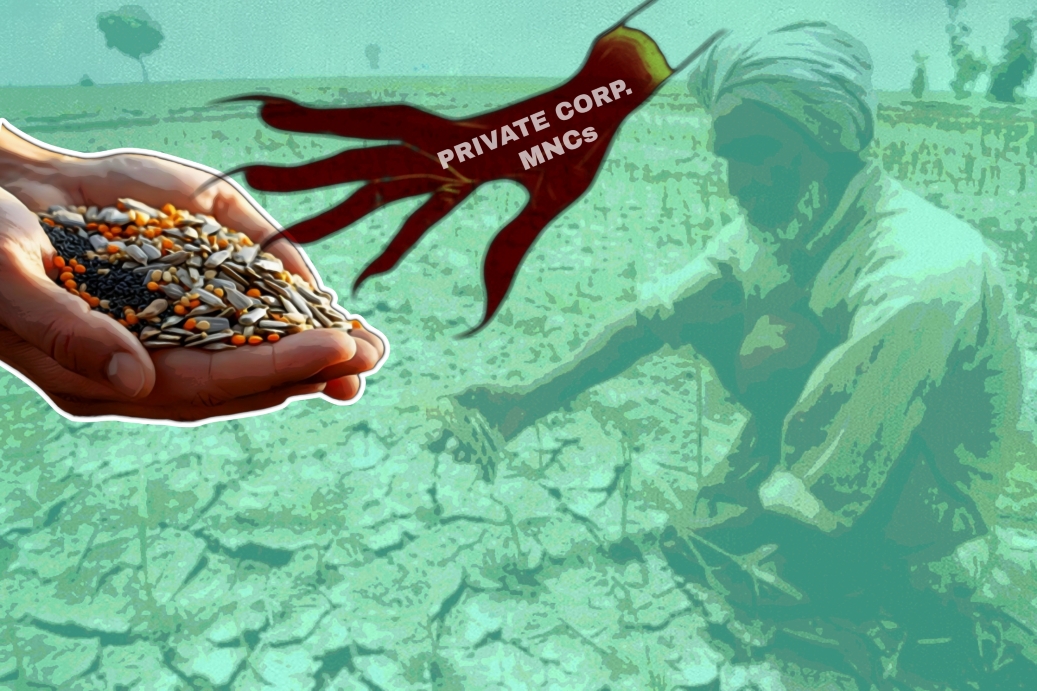
Everyone is aware of the growing misery and penury of the peasants in capitalist India. The governments, both at the centre, as well as in the states have continued serving their ruling monopolist masters by all possible means. They have been taking pro-corporate policies in every field of Indian agriculture—land, fertilizer, pesticides, seeds, marketing, procurement. As a result, millions and millions of peasants have become landless and turned into agricultural labourers. The new Seed Bill 2025 introduced by the central BJP government is in continuation of the same policy.
The Draft Seed Bill, 2025 was tabled on 12 November 2025. The salient features of this Bill are as below:
- Establishing a comprehensive regulatory mechanism replacing the existing Seeds Act, 1966 to oversee the sale, import, export, production, storage and supply of quality seeds in the country,
- Defining farmers, dealers, distributors and producers as separate regulated entities, each with specific roles and responsibilities,
- Creating a 27-member Central Seed Committee and a 15-member State Seed Committee to guide seed regulation,
- Defining “seed” as any type of living embryo or propagule, including seedlings, tubers, bulbs, rhizomes, roots, cuttings, all types of grafts, tissue culture plantlets, synthetic seeds and other vegetatively propagated material, capable of re-generation and giving rise to a plant which is true to such type on which it was produced except in case of seed of hybrids where performance is assured for first filial generation only and includes seeds of cereals, coarse cereals, pulses, oilseeds, fiber crops, forage and fodder crops, green manures, sugar crops, fruits, vegetables, spices, flower crops, ornamental crops and plantation crops,
- Vesting power with The Central Seed Committee to recommend minimum standards for germination, purity, traits, seed health and genetic purity for seeds,
- Authorizing the State Seed Committees to advise their respective governments on the registration of seed producers, seed dealers, processing units and nurseries,
- Making registration of Seed Producers, Seed Processing Units, Seed Dealers, Distributors, and Plant Nurseries mandatory. Compulsory registration of all varieties of seeds and meeting certain prescribed minimum standards. For instance, for transgenic varieties of seeds, registration is to be obtained under the Environment (Protection) Act, 1986,
- Allowing a Central Accreditation System to oversee operation of nationally recognized seed companies across multiple states without separate licenses, to facilitate ease of doing business.
Origin and Evolution of Seed Sector
Before dwelling on further into the details of the Bill, let us see in brief the origin and evolution of the Seed Sector in the pre independence period. Seed is basic input for agricultural production. The response of all other inputs to a large extent depends on the quality of seeds. As India was primarily an agricultural country, the majority of the seed requirements were traditionally met by way of farmer-to-farmer exchange. Seed was thus deemed to be property of the peasants. The farmers themselves handled production, processing, storage and distribution. After attainment of independence, the central government had started to regulate the quality of seed meant for sale in order to increase agricultural production and attain self -sufficiency in Food Production.
Seed Act of 1966
After independence, the first enactment in the seed Sector was The Seeds Act, 1966. It consisted of three important provisions namely a) seed certification, b) seed inspection, and c) seed testing. Each of these is important by itself and at the same time, they mutually reinforce each other. This Act regulated only notified varieties of seeds. It came into force with the enactment of the Seeds Rules in 1968. Again, the government had made amendments to the Seeds Act and Rules in 1972, 1973, 1974 and 1978. Seeds were declared as an Essential Commodities under the Essential Commodities Act, 1955. A Seeds (Control) Order had also been issued by the government in this regard in 1983 with provisions such as compulsory licensing of the seed dealers, price control, control of seed movement and submission of the information about the procurement and sale of seed, etc.
The order became enforceable only from July 1994 due to litigation in Court. The Seeds Act of 1966, to a large extent, served the establishment of Research and Development in the public Sector, of new varieties suited to different geo climatic- agro zones in the country.
Policy on Seed Development, Globalization and TRIPS Under WTO
The introduction of a New Policy on Seed Development (NPSD) in 1988 liberalized the Indian seed industry. Until the late 1980s, participation of private sector in the seed industry in India was limited by two factors: the then economic policies of restricting foreign investment and licensing, and the seed-specific policies that limited the sector to ‘small scale’ participants and severely restricted imports of research or breeder seeds. With the implementation of the New Seed Policy of 1988, the ‘small scale’ limitation was removed, and entry of large domestic and foreign firms were permitted by lifting import restrictions.
After adoption of policies of capitalist globalization in the interest of monopoly capital, by the then Congress Government in 1991 which abolished industrial licensing system and the restrictions on Foreign Direct Investment (FDI) and agreed to the conditionalities of the Trade Related Intellectual Property Rights (TRIPS) stipulated by the World Trade Organization (WTO) in 1994. According to Article 27.3(b) of the TRIPS agreement, if plant diversity is to be protected, patents must be obtained or a specific system must be created for protection (sui generis), or a combination of both.
Role of Public and Private Seed Sector
From then on private sector has started to play a significant role in the seed industry. At present, the number of companies engaged in seed production or seed trade is of the order of 400 to 500. However, the main focus of private seed companies has been on the high value low volume seeds. On the other hand, low value high volume seeds market is still dominated by the public sector corporations. Private sector dominates in vegetable seeds and planting materials of horticultural crops mainly in maize, sunflower and cotton. On the other hand, public sector majorly controls production of high-volume low margin c-seeds for crops of wheat, paddy, other cereals, oilseeds and pulses, the public sector seed corporations might remain dominant in cereals, pulses and oilseeds for more years.
Private Seed Companies Control Over Seed Sector
Consequent to the Economic reforms and signing of TRIPS conditionalities, new companies of foreign and domestic origin entered into the Indian seed sector and vied with each other for the market. Domestic firms invested more on technology to compete with the entry of new research-intensive foreign firms. This resulted in huge increase in the cost of seed production which invariably affected the sale price of Seed. Moreover, the transition from open-pollinated varieties (OPVs), which farmers can save and reuse in subsequent years, to hybrids, which cannot be reused without a significant reduction in yield and quality, forced the peasants to purchase seeds every year. As per a Survey Report Published in the Journal of Intellectual Property Rights, March 2016, (Vol 21, pp 73-88) the value of Indian domestic Seed industry increased from Rs. 600 crores in 1988 to Rs.10,000 crores in 2011 indicating highly sophisticated production by both public and private sectors. The share of value of proprietary hybrids in the Indian seed market increased from 16.66% in 1988 to 60% in 2011. The new seed policy of 1988 initiated and incentivized the process of privatization of the Indian seed industry. As a result, share of private sector in the seed business increased from 50-60% during 1984 95 to 80% in 2010.
PPVFRA Act and Emergence of PSC
India’s signing of WTO in 1995 necessitated to pave the way for Private Research and Development of new varieties of seeds. The Protection of Plant Varieties and Farmers’ Right Act (PPVFRA) 2001 was formulated for protection of plant varieties in India by integrating the rights of breeders, armers and village communities. However, as the Private Seed Companies have more resources to invest, they soon established control of hybrid seed production that accounted for 90 percent of new varieties, which received Plant Variety Protection certificates. So, acquisition of improved technology through increased investment by the private sector compelled the peasants to procure better seeds at high cost. The peasants would thus stand debarred from domestically producing, saving, selecting, and exchanging their own seeds. This illustrates that the technological barrier for the realization of farmers’ rights is more profound in India than the legal barrier.
Disastrous Condition of Indian Peasants
Now, let’s take a look at the disastrous condition of the Indian peasants at present. Due to abysmal increase in the cost of agricultural inputs like seed, spike in irrigation costs due to spurt in diesel price, the cost of agricultural production has increased tremendously during the last three decades. Remunerative price of crops so produced by expending highly in inputs is still elusive to peasants. they All impoverished the bourgeois governments, both at the Centre and in the states, are unyielding to the farmers’ demand of MSP @C2+ 50 % and guaranteed procurement of all agricultural produce at MSP. So, farming is not generating even subsistence level income for the toiling peasants. Trapped in high debt and often forced to distress sale at throwaway price, many peasants are committing suicides or leaving agriculture to work as migrant labourers. According to The National Crime Records Bureau and Statistics, 10783 farmers have committed Suicide in 2023 alone. Unofficial sources put the number of peasants’ suicide in last 30 years to over 3 lakhs.
Since the peasants are the principal stakeholders of agriculture, it is imperative that before making any revision in the laws governing farming, peasants’ interest is to be given highest priority. Same is applicable to the case of seed related regulations.
Among others, timely availability of quality seeds at fair prices, compensation guarantee for crop failures due to spurious or faulty seeds etc. are issues that the peasantry is being deprived of for decades. Still the government machinery is made more and more dysfunctional both in procurement of agricultural inputs as well as selling the produce at fair price. A few years back potato and cotton farmers in states like Maharashtra, Andhra Pradesh, and Bihar massively had incurred heavy losses due to sale of poor-quality seeds by the Private Seed Corporations. Everyone knows that ordinary peasants cannot legally fight these monopolist giants and MNCs who supply spurious or faulty seeds. Even the governments have not endeavored to secure compensation from such companies or to punish them in an exemplary manner.
Other Anti-Peasant Aspects of Seed Bill 2025
Once again, we come back to some other critical aspects of the proposed Seed Bill 2025. In this Bill the definition of ‘Seed’ (Section 2-z) encompasses all seeds and plants and its variations. Whereas the Seeds Act, 1966 covered only some selective seeds. That means, vista is widened for the agri-giants and corporate sharks. Further, the Bill does not have any strong provisions for compensation to the peasants in case of crop failures due to faulty seeds save and except prescribing legal route which, as is known to all, is not that accessible to the poor farmers. Further, while a few individual farmers might save and share seeds, community groups— such as Farmer Producer Organizations (FPOs), Women’s Seed collectives and traditional seed-saving networks— would be classified as commercial entities. They would be subject to the same bureaucratic and digital compliance requirements as large companies. Similarly, there are no provisions for the determination of the prices of the seeds/plant variety. Only in an emergent situation like scarcity governmental intervention is prescribed. It also shows price determination of seeds will be exclusive preserve of the entity which registers Seed / Plant variety under the act. New registration requirements of the Bill will force closure of thousands of seed outlets and nurseries, which are operating currently like cottage industries across the country. Again, the Bill also demands extensive digital reporting. QR codes, online submissions and continuous tracking pose challenges for small rural seed keepers with limited internet access or digital literacy. So, the livelihood of considerable population linked with agriculture will face calamities.
The Bill allows foreign organizations to be recognized for VCU (Value for Cultivation and Use) testing. This will allow genetically modified or patented seeds to enter India solely based on overseas assessments. If genetically engineered or gene-edited seeds are allowed without proper scrutiny, “the hazards posed to human and ecosystem health would greatly multiply; and small farmers would be rendered even more unviable”, observed experts.
The fate of R&D facilities established in the National and State level under ICAR and Department of Agriculture and Cooperation is going to be relegated to the back and priority will be on complete takeover of the facilities by the private operators in seed business. Through this Bill, the BJP government will tweak the federal structure in relation to seed sector, which is an essential component of agriculture now under the state list.
Exclusion of the individual peasants from the coverage of the Seed Bill 2025 will have serious ramifications in so far as peasants are concerned. Following handing over 80% of the seed sector to the private operators, individual peasants would stick to low yielding varieties due to ignorance or distress whereas high yielding varieties would be produced and sold by corporates. This discrimination would be detrimental to the interest of majority of small and medium peasants.
Peasants are Gearing Up to Launch Fresh Struggle
From the foregoing discussion, it can be seen that the present BJP government at the Centre has introduced the Seed Bill 2025 in the interests of the profit-monger monopoly houses and multinationals at the cost of the toiling peasantry. This anti-people pro-monopolist character of the central BJP government is becoming exposed with every passing day. The historic Delhi peasant movement which compelled the government to stall three black farm laws has kindled a new fighting spirit among the deprived peasants.
Now the suffering peasantry is taking preparation to fight against all sorts of anti— peasant anti – people policies of the ruling capitalist class and its servitor governments. We are sure that they will again create history of united organized sustained struggle to force the government to bow down.