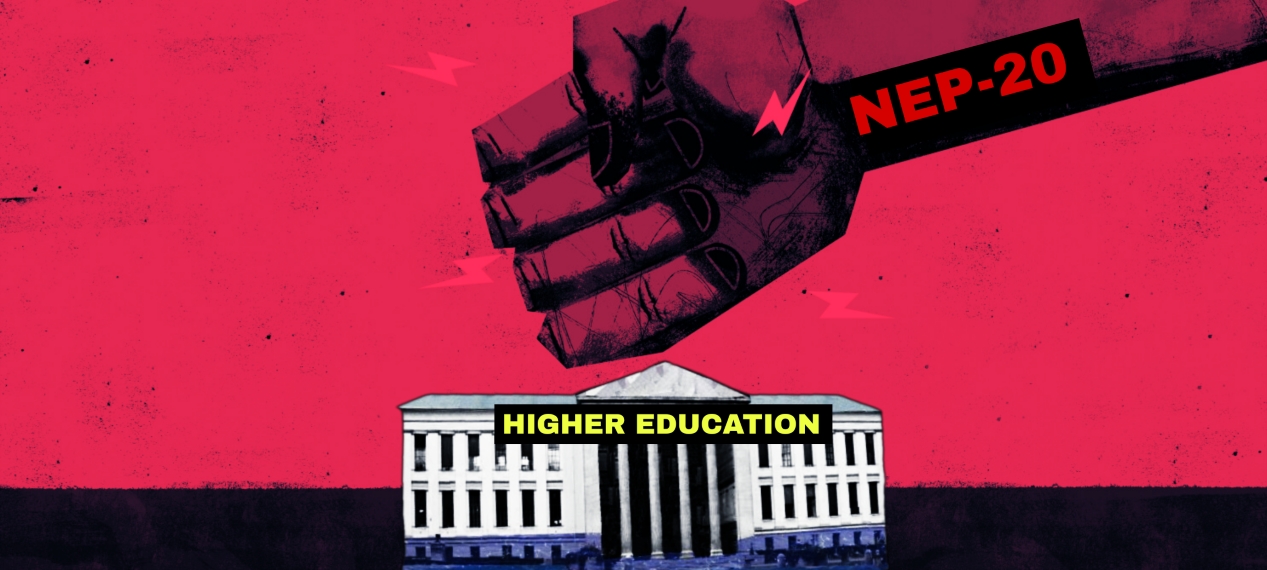
The Octopus, a marine creature, tightly holds its prey with eight arms. The National Education Policy–2020 (NEP 20) can be compared to this mollusk metaphorically, as this policy is unleashing attacks across all spheres of education to convert education into a marketable commodity. In the previous issues of the Proletarian Era, we have dealt with its dire consequences at the school level and also with the ominous effect of vocationalization of education. After striking the hardest blow at the elementary level, the architects of the NEP-2020 didn’t spare higher education either. Rather, they invented newer methods to annihilate it. Let’s begin with the National Credit Framework (NCrF).
What is NCrF?
The National Credit Framework (NCrF) is proposed by the NEP 2020, which will encompass all elementary, secondary, higher, and vocational education & training institutions. All central and state school boards, central and state open school boards, universities, and autonomous colleges have to follow this NCrF. It will completely change the time-tested scientific method of education. Previously, there were academic learning and vocational learning (in a limited sphere). Again, there was no way to combine these two types of education, nor is it scientific to exist. But according to the NCrF, the students can earn credit points from academic, vocational, and experiential courses. The Vocational Education System will provide long-term and short-term professional or vocational courses. The students can earn extra credit points from these vocational courses. A student can easily transfer her credits to academic courses without any previous knowledge in those subjects. Even if a student completes a two-year ITI course and earns 80 credit points (40+40), she can get direct admission to the UG-2, bypassing the UG-1. This is nothing but admixing of academic and vocational education, and a boost for vocationalization of education. The NCrF has also introduced an Experiential Education System. The Framework has said that a student can earn credit points from her experience and ability at four levels (Trained, Proficient, Expert, and Master) working in a commercial company. The educational institutions collaborating with such companies will provide the credit points. For example, a motor mechanic can earn credit points after completing the four levels working in a workshop. A student can achieve credit points from experiential learning through informal learning, non-formal learning, and even NGO activities. Those credit points can be transferred to academic or vocational streams also. Hence, it is easily understandable that the aim of education will be totally replaced by the target to train up a generation who will serve the corporates.
Academic Bank of Credit
According to the NEP-2020, the credits achieved by a student from the school level to the PhD level will be preserved in the ‘Academic Bank of Credit’ (ABC) and will be valid throughout her career. Every student in this country will have to open this account. It will be like a bank account. The difference is that no credit will be deleted or withdrawn from the ABC. A student can change her stream or discipline as well as her institution at any time in her educational career. The credits achieved there will be deposited in the ABC. The advanced capitalist countries like the USA or the European countries have already introduced this credit-bank system. It’s complementary to the market economy, which treats education as a profitable commodity. The credits earned by a student can be used at any ‘education market’ just like a customer uses her credit card at a departmental store anywhere in the world. So, this ABC is to help with the sale and purchase of education. A student can transfer her credit points to any foreign institution, paying millions of rupees.
When this method has not been completely introduced yet in a country like the USA, how is it possible to apply it in a big country like India, where there are numerous boards, inconsistent schedules, delays in the publication of results, overlapping semesters, and in many cases, corrupted administrations? How can we expect that the credits of crores of students will be properly recorded in the ABC decades after decades?
Secondly, according to the NEP-2020, the sole objective of a student will be to earn credits. Our ancestors taught us that education is the means to acquire knowledge. The Renaissance upheld that man-making, character-building should be the aim of education. But capitalism, like all other human creativities, degraded it to a method of achieving some credits.
Thirdly, we have all forgotten our school results. In some examinations, we performed well. In some others, we couldn’t score satisfactorily. But the ABC will record every detail of our performance from the elementary to the highest tier of education. How many of us desired such an engraving of our entire educational career?
Credit Based on Teaching Hours
The new policy is entirely based on a credit system. But what is the definition of ‘credit’? How will it be evaluated? The credit points will not be determined by the theoretical and practical knowledge of a student acquired in a certain time period. Rather, it will be calculated depending on the educational hours a student spent at different levels of education. For example, a student from pre primary level to Class II (a total of 5 years) has to complete 800 learning hours/year and get 27 credits in each. Similarly, from Class III to Class V, 1000 learning hours/year and will get 33 credits, and from Class VI to PhD level, 40 credits/year for completing 1200 learning hours every year.
So, it’s a tale of learning hours. Go to the institutions, join classes, do some laboratory work, participate in field surveys, attend seminars, and sit in the examinations, you will get credit points. Your performance has no value. The credit points are equivalent to learning hours, and not an evaluation of the student’s knowledge.
Multiple Entry and Exit Gate
The NEP-2020 has suggested as well as introduced a ‘multiple entry and exit system’ in all levels of education. It means that a student can change her institution at any level of education. In the existing system, there is a provision for migration if required. Then what is the purpose of such multiple entry and exit gates? Its purpose is to make the student a customer of multiple education sellers. The system encourages the students to change their institutions. This approach may flourish the education business, but destroy the age-old teacher-student relationship, replacing it with a customer-provider relation. Is it at all desirable?
Multi-Disciplinary CBCS
Long before the introduction of the NEP-2020, the education ministry had been advocating the Choice Based Credit System (CBCS). It is a multi-disciplinary system. When the modern education system developed after the Renaissance, both in Europe and in India, certain disciplines or streams were followed. These are: Science, Commerce, Humanities, Visual Arts, Engineering & technical education, Law, and medical sciences. A particular discipline is made up of a combination of a few correlating subjects. They are not only interdependent, but also provide a comprehensive knowledge. For example, the discipline of science is formed with physics, chemistry, mathematics, etc. Humanities are made up of history, political science, philosophy, etc. If the multi disciplinary system is introduced, a student can earn credit points by taking subjects from any discipline. But what is its necessity? Will the knowledge in political science help a student of physics? Or, will the study of chemistry help a student of history? Certainly not. An educational institution is not a grocer’s shop.
Online or Blending Mode Encouraged
The NEP-2020 has given the option to change the mode of education. A student who is presently studying in Offline Mode (classroom education) can continue her studies in Online Mode or ODL (Open & Distance Learning), or Blending Mode (both Offline and Online Mode) next year. It’s detrimental for proper understanding of a subject.
Four-year Undergraduate Programme (FYUGP)
The NEP-2020 has introduced the Four-Year Undergraduate Programme (FYUGP), replacing the traditional three-year degree course. But neither the NEP-2020 nor the education ministry has clarified the necessity of the four-year degree course. This policy is implemented hurriedly throughout the country without any infrastructural development. The colleges and universities are already suffering from a shortage of regular teachers, insufficient classrooms, inadequate libraries and laboratory facilities. Therefore, an additional year at the undergraduate level has become an overburden in most institutions.
From UG-1 to UG-4, a student has to complete 40 credits (plus 4 credits from vocational courses) each year. If a student leaves after UG-1, she will get an Undergraduate Certificate. After UG-2, an Undergraduate Diploma will be given. If the student leaves education after this level, she can take readmission within 3 years at any college/institution, and she has to complete the four-year degree course within a maximum span of 7 years. Similarly, after UG-3 a student will get the ‘Bachelor’s Degree’. And finally, after UG-4, the ‘Bachelor’s Degree with Hons./Research’ will be awarded if a student achieves 160-176 credits in total. If a student performs research work at UG-4, she will get 12 credit points. But Honours students not undertaking research will do 3 courses for 12 credits in lieu of a research project / dissertation. Therefore, a student taking a research project will skip those theory papers. So, it’s evident that a student receiving a Bachelor’s Degree with Honours/ Research will be provided less theoretical knowledge! What a system!
Moreover, if a student gets the Bachelor’s degree with Honours/ Research and scores 75% marks, she will be directly eligible for her PhD. The one-year master’s course will not be needed for him/her. Unless he/ she has to complete the one-year master’s course to be eligible for PhD.
What a peculiar policy! So, a student is eligible for the PhD course without doing a master’s! The advocates of NEP-2020 will say: They are qualified. They have done research projects during UG-4. But, how many colleges have proper infrastructure, research guides, and other necessary arrangements to conduct research work in all subjects? Certainly, very few. And the private institutions are waiting for this grand opportunity. They will welcome the students with a grand fee structure.
Truth of Semester System
Following the guidelines of NEP-2020, the education department has introduced a 90-day semester system. An educational year is divided into two semesters. Hence, there will be a total of 8 semesters in the four year degree course. But, instead of 180 days, each semester will get only 90 days! It is very tough to complete the syllabus in such a short time. Besides this, there will be a compulsory eight-week (around two months) internship or vocational education or training during summer vacation.
So, the total education period is shortened from 12 months to only 8 months (among which there is a two month compulsory vocational education)! Naturally, it raises the question: what is the plan for the rest four months? The semester system was projected as a new method of pedagogy.
Dividing the syllabus into short modules may initially be helpful for a student, but it is often noticed that the student in the fifth semester has forgotten the topics of the first semester. The semester system has practically become a ‘study and forget’ method. The semester system has increased fees, reduced educational hours, complicated the examination process, and hindered the process of acquiring comprehensive knowledge.
NEP-2020 —a Blueprint for Privatization and Commercialization of Education
The NEP-2020 is a blueprint for the privatization and commercialization of education. What the NEP-1986 started four decades ago, NEP-2020 is completing the task on a wide scale. The BJP-led central government, an obedient servant of the Indian capitalist class, is making all changes to ease its implementation. The heads of the UGC, AICTE, NEET, NCrF, CBSE, NCERT, and other governing bodies are their stooges. All chancellors, vice chancellors must either follow the policies; otherwise, their institutions will not get the grant or government funding. The government-aided colleges are now vacant. The government will soon argue why people’s money will be wasted by paying salaries to teachers and professors in colleges and universities that are without students. As a result, they will be closed. Teachers will be removed. Those posts will be obliterated forever. And the private education business will boom.
What is to be done?
The question is, will we accept it? Or will we resist this onslaught? There are protests all over the country. Students, teachers, intellectuals, educationists, and social activists are on the streets. The parliamentary political parties are silent. However, the Save Education Movement is developing in the country.
The All India Save Education Committee has prepared a draft of ‘People’s Alternative Education Policy-2025′. Opinions are being collected across the country. With these views, the People’s Parliament will be held in Bangalore on January 24, 2026. This movement is a ray of hope. This is a silver-line in darkness.