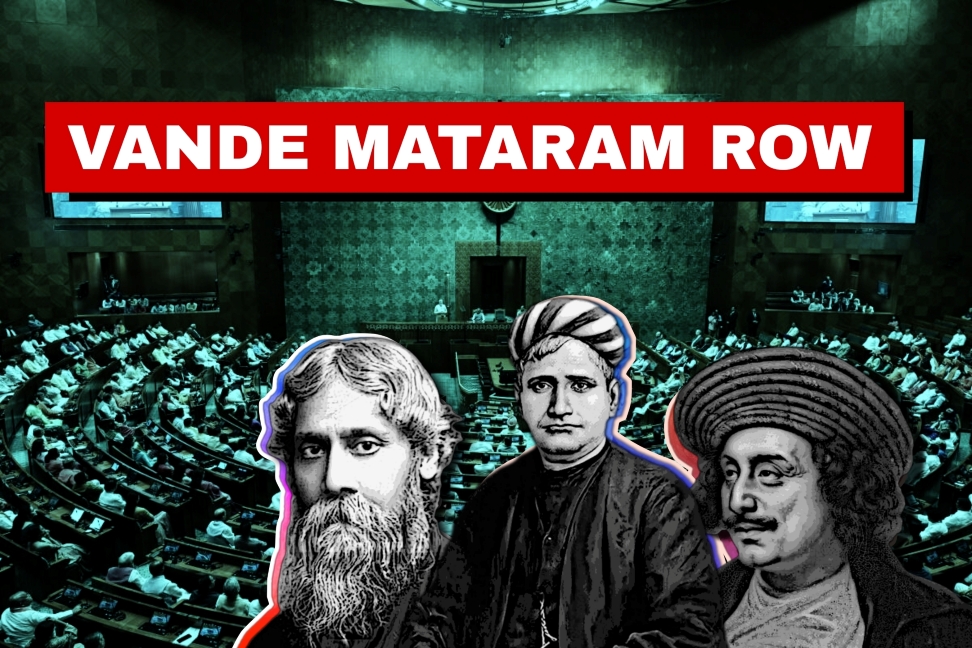
The BJP organized special programmes at 150 locations across the country on 7 November last to commemorate the 150th anniversary of the patriotic song ‘Vande Mataram’. On that occasion, PM Modi said: “The spirit of Vande Mataram illuminated the entire nation during the freedom struggle. But unfortunately, in 1937, crucial verses of Vande Mataram, a part of its soul, were severed. Vande Mataram was broken; it was torn into pieces. This division of ‘Vande Mataram’ also sowed the seeds of division of the country.” This observation is indeed fascinating(!) as he, we are sorry to say, seems to be oblivious of actual history and therefore projected the RSS-Hindu Mahasabha, the forefathers and mentors of the BJP, as having been in the vortex of our glorious freedom struggle and views ‘Vande Mataram’ as the mantra of that anti imperialist freedom movement. Why? We shall peel the beans in sequence.
History of Vande Mataram
Composed by eminent litterateur Bankim Chandra Chatterjee, ‘Vande Mataram’ was first published in the literary journal ‘Bangadarshan’ on 7 November 1875. Later, Bankim Chandra incorporated the hymn in his novel ‘Anandamath’, which was published in 1882. On 24 January 1950, India’s Constituent Assembly adopted it as a national song while Janaganamana, composed by Rabindranath Tagore, was chosen as the national anthem. Our freedom fighters courageously sang it against British rule when the RSS-Hindu Mahasabha had no presence in the freedom movement. On the contrary, RSS ideologues categorically held that the anti British freedom movement was reactionary in nature as it was talking of a ‘territorial nationalism’ and not ‘Hind nationalism’. In an article, BJP and RSS leader Ram Madhav held that the Muslim hand was behind the decision of retaining only two stanzas of Vande Mataram, and squarely blamed the then Congress leaders for having opportunistically changed their stance to seek Muslim votes in the 1937 elections.
Yes, it is true that only two stanzas of Vande Mataram were adopted in 1937 by the Congress— then a platform of all forces seeking freedom. But there was a definite reason. When the Indian Renaissance movement had blossomed in the 19th century, the philosophy of bourgeois humanism or bourgeois democratic revolution did not have that uncompromising youthful fervour of The Western Renaissance anymore, because capitalism as a world system had already degenerated into a reactionary force. Rather, it started forsaking its uncompromising fight against age-old, obsolete creeds of feudal values, customs, religious blindness and absolutism. So right from its emergence, the Indian Renaissance was somewhat crippled from within. It was Ishwarchandra Vidyasagar who was an exception and firmly upheld secular humanist thoughts, which are based on non recognition of any supernatural entity and hence religious tutelage.
The impact of this compromise with spiritualism was also evident in the field of literary creations. Bakimchandra had been in the ambit of this compromising trend of freedom struggle and hence pivoted reincarnation of religious revivalist thoughts, notwithstanding the fact that he wanted the country to be free from alien rule. But under British imperialist rule, the urge for individual development, individual liberty and national independence remained unfulfilled, rather was trampled underfoot. So, particularly among the educated section, there was mounting discontent centring round the rebuff of individual dignity the Indians received from the ruling Britishers. The concept of Indian nation throbbed as a reaction to this affront to the legitimate aspiration of the Indian masses. However, the manifestation of this humiliation was in the form of spiritual resurgence and traditionalism. To articulate this aspiration of the countrymen to emerge as a dignified honoured nation shattering the tentacles of foreign occupation, Bankimchandra looked back to Hindu traditionalism. ‘Anandamath’ was authored in this backdrop. From this point of view, it can be said that this novel was the first ebullience of nationalism on this soil. Its plot was based on Sanyasi rebellion in North Bengal around 1772-73 during the time of Warren Hastings. In fact, the plot was a camouflage to kindle the souls of the countrymen by the millions to be passionate about freedom.
Why Were Only Two Stanzas Retained?
But there is no denying a fact that Anandamath which set many patriotic hearts aflame was based on a Hindu revivalist allegory in which India appears not as a shared civic homeland, but as a divine Mother Goddess to be worshipped. The imagery of Durga, the ascetic warrior monks, and the call for Hindu ascendance are not faint background motifs; they are the ideological spine. The song Vande Mataram begins gently and tenderly, invoking the bounteous, serene land in the first two stanzas, using lush, soft Sanskrit words. Soon, however, it transmutes into the clanging of swords, into thunderous voices raised to spell doom to the enemy. The land changes into the demon-slaying goddess, lethal weapons in all ten hands.
So, Rabindranath Tagore who himself sang this song in his teens in 1896, later realized that the very words “Tang Durgadashapraharanadharini” hi (a Sanskrit sloka which means ‘Ye Durga possessing ten different weapons in ten hands’) in ‘Vande Mataram’ though intended to present Devi Durga of Hindu religion as Goddess of the Motherland, a deity Bankim had freshly minted himself, instantly leapt to a central position in the Hindu pantheon and hence might pose a hindrance before rousing the Muslim community. So he wrote to the Congress leaders: “I freely concede that the whole Bankim’s ‘Vande Mataram’ read together with its context is liable to be interpreted in ways that may wound Muslim susceptibilities, but a national song though derived from it which has spontaneously come to consist only of the first two stanzas of the original poem, need not remind us every time of the whole of it, much less of the story with which it was accidentally associated.” (Amrita Bazar Patrika 02-11-1937) Rabindranath categorically distinguished between patriotic emotion and devotional command. So, he held that “Vande Mataram cannot be the national anthem… its words are full of Hindu imagery which may offend Muslim feelings. A nation is not of any particular religious community.” The text of the 1937 Working Committee statement explicitly mirrors Tagore’s logic. Rabindranath also underlined the communal potential of Anandamath in his novel Ghare Baire (1915). He also tried to uphold the essence of ‘Vande Mataram’ as a binding thread of all Indians in his song “Ek sutre baandhiachhi sahasrati mon, ek kaarje sonpiyachhi sahasra jiban, Vande Mataram…”
(We have tied a thousand minds together in one thread; we have dedicated a thousand lives to one task —Vande Mataram. We shall face athousand obstacles and raging deluge, we, thousands of souls, shall remain fearless — Vande Mataram. …”)
Further, Bankimchandra himself had in his last novel Sitaram, imagined a Hindu realm, founded by a heroic and idealistic king who defeats his Muslim adversaries. He however, came to embody, and even exceed, all the evil commonly attributed to Muslims. His Hindu associates abandoned him and the last to leave is a pure hearted fakir who sadly concluded that it was no longer possible to live in a Hindu Rajya. So, the RSS leader’s assertion of “Muslim hand was behind of retaining only two stanzas” is a travesty of history.
Who Sowed the Seed of Division in India
According to PM Modi, “division of ‘Vande Mataram’ sowed the seeds of division of the country.” It is a fact, no doubt, that only two stanzas of ‘Vande Mataram’ were adopted as the national song in 1937. But it was V D Savarkar, the Hindu Mahasabha leader, who had sent five mercy petitions to the British rulers, begging most humbly for commuting his life term, and offered himself as a volunteer for any service to the British government, had not only coined the word ‘Hindutva’ —the concept that forms the ideological core of the RSS-BJP, but he was also the proponent of the two nation theory way back in 1923 (in his book ‘Essentials of Hindutva’) which Hindu Mahasabha accepted in its conference in 1937 and was then endorsed by the Muslim League in 1939. Syama Prasad Mukherjee, another Hindu Mahasabha leader who ran a coalition government with Muslim League in undivided Bengal and is held in high esteem by PM Modi and his associates, wrote to Lord Mountbatten, the then Viceroy of India, in 1947, arguing that Bengal must be partitioned even if India was not. Incidentally, he also wrote to the Governor of Bengal, on 26 July 1942, advising him how to crush the ‘Quit India’ movement. Then how was it that retaining two opening paras of ‘Vande Mataram’ had sown the seed of partition of the country?
Why this Adoration of ‘Vande Mataram’ by RSS-BJP?
The fact is that the RSS and the BJP—have never sung ‘Vande Mataram’ or ‘Jana Gana Mana’ in their shakhas or offices. Instead, they used to sing ‘Namaste Sada Vatsale’, a song glorifying their arch communal Hindutva doctrine. So, this sudden overflowing devotion towards Vande Mataram by the RSS BJP—Sangh Parivar is not without a purpose. To them, ‘Vande Mataram’ is not simply remembered as a thread in the fabric of the anti-imperialist freedom movement. It has been recoded as a marker of loyalty towards communal Hindutva. That is why they are advocating rendition of all stanzas of the song. The recent BJP decision to celebrate the song with gala events is aimed at intensifying the fusion of religious and communal passions and defining the product as authentic patriotism. In this way, the song quite precisely prefigures the Sangh Parivar’s Hindutva agenda of spewing venom against religious minorities and exacerbating political polarization across religious lines to strengthen the Hindu vote bank. What was once a song of freedom struggle against British imperialism has been transformed into a moral surveillance device of the arch communal Hindutva and engaging in pseudo patriotism or pseudo-nationalism. But one thing is clear. The right-thinking Hindu people would never accept it.
BJP’s Declaration of Banning Rabindrasangeet
Coming in tandem is the open declaration of a ban on highly acclaimed patriotic song by Rabindranath by the BJP leaders like Himanta Biswa Sarma, the Assam Chief Minister, on the pretext that singing the national anthem of Bangladesh was a treason as it is tantamount to endorsement of the claim by a section of leaders in Bangladesh that the entire northeast region was part of the neighbouring nation. Incredible indeed!
There is a glorious history behind the composition of this song. When Lord Curzon, the British viceroy of India, had ordered the partition of the then undivided Bengal in 1905, it sparked major protests and provided a fillip to the crystallizing freedom movement. At that time, Rabindranath had penned a song, Aamar Sonar Bangla, ami tomaye bhalobasi (My golden Bengal, I love you). This song was on the lips of everyone. Though written in the context of the division of Bengal, it had the content of a nationalist fervour and manifestation of wrath against the British imperialist oppressors. Later, when, after partition, the Pakistani government proposed making Urdu the only state language, despite Bengali being spoken by the vast majority of the population in the then East Pakistan, a massive protest movement erupted. On 21 February 1952, students and activists marched in Dhaka in protest. The police opened fire on them, killing several demonstrators. But the movement did not suffer any setback but intensified further. Ultimately, the Pakistani rulers had to bend down, and Bengali was recognized as an official language of East Pakistan in 1956. The Language Movement became a powerful symbol of a typical Bengali identity, if not a kind of nationalist feeling among the Bengalis of the then East Pakistan and a precursor to the broader struggle for cultural and political autonomy, which culminated in the Bangladesh Liberation War in 1971 and creation of Bangladesh as a new sovereign bourgeois state. It was at this point of time that the Rabindrasangeet Aamar sonar Bangla was adopted as the national anthem of Bangladesh. This song is sung with emotion in both India and Bangladesh. Even PM Modi during his election campaign in West Bengal had pronounced with great effort the opening lines of this song in Bengali seemingly to woo the feelings of the Bengali populace.
But now after the dethroning of Sheikh Hasina from the prime ministership of Bangladesh and an interim government headed by Mohammad Yunus taking over the charge, the relationship of the BJP-led Indian government who has given asylum to Hasina, and the Bangladesh government is strained. And with resurgence of Islamic fundamentalism in Bangladesh as a reaction to domination of Hindu fundamentalism in India, the Indian government is accusing the Yunus government of being in complicity with the Islamic fundamentalists and abetting the persecution and killing of the Hindu minorities there. So, invoking a convenient corollary, the RSS-BJP, in keeping with their Hindutva doctrine and anti-Muslim tirade, are upping their ante against Bangladesh. That is the justification the BJP leaders are giving in support of their stand of banning the Rabindrasangeet “Aamar Sonar Bangla”. But will the Indian people accept this?
BJP Leader Decries Rammohan Roy as an Agent of British Rulers
Alongside axing Rabindrasangeet, the BJP has also started turning guns at the stalwarts of the Indian Renaissance. Inder Singh Parmar, the Madhya Pradesh Education Minister and BJP leader, remarked that Raja Ram Mohan Roy was a “British agent” who started a “vicious cycle of religious conversion”. The British had projected several such people as “fake social reformers” and promoted those who encouraged conversions, he claimed. But then in view of the public rage over such an irresponsible and insulting utterance about a great personality revered by one and all for having been a living bridge over which India marches from her unmeasured past to her incalculable future and the arch which spanned the gulf that yawned between feudal orthodoxy and modern humanity, between immobile custom and path of progress, the BJP minister underwent a somersault and tendered apology for, what he said as a face saving, ‘slip of tongue’. Never has one come across such a slip where an entire sentence had come out of a tongue.
In fact, RSS-BJP, who advocate justifiability of a ‘Hindu Rashtra’, have been opposed to the surge of the Indian Renaissance movement that sought to break up the age-old inertia of religious bondage, obscurantism, superstitious customs and practices and heralded advent of modern, democratized society based on democratic values and morality. For, the thoughts of Renaissance militate against the religious prescripts, fundamentalism and communalism which the RSS-BJP stand for. Raja Rammohan Roy opposed the opening of government Sanskrit college in Kolkata and instead took initiative to set up a college (Now Presidency University, Kolkata) for the study of modern disciplines, thereby liberating the shudras from the clutches of Hindu fundamentalists. He was also successful in abolishing most inhuman satidaha system (a Hindu ritual in which a widow self-immolates on her deceased husband’s funeral pyre). Naturally, he does incur disapproval of the Hindutva protagonists. So has been the deliberate ‘slip of tongue’.In fact, the RSS-BJP have been on a mission to pave the way for social regression which warrants maligning doyens of the Indian Renaissance, undermining their contributions, distorting history, shielding the truth, retrograding the mental process of the people while fostering blindness, fanaticism, divisiveness, irrationality and such other ills taking root. That is the bourgeois class design to sustain the reactionary capitalist rule of oppression and suppression. The RSS-BJP, as trusted servitors of the ruling Indian capitalist class are trying to operationalize it in their own way.