
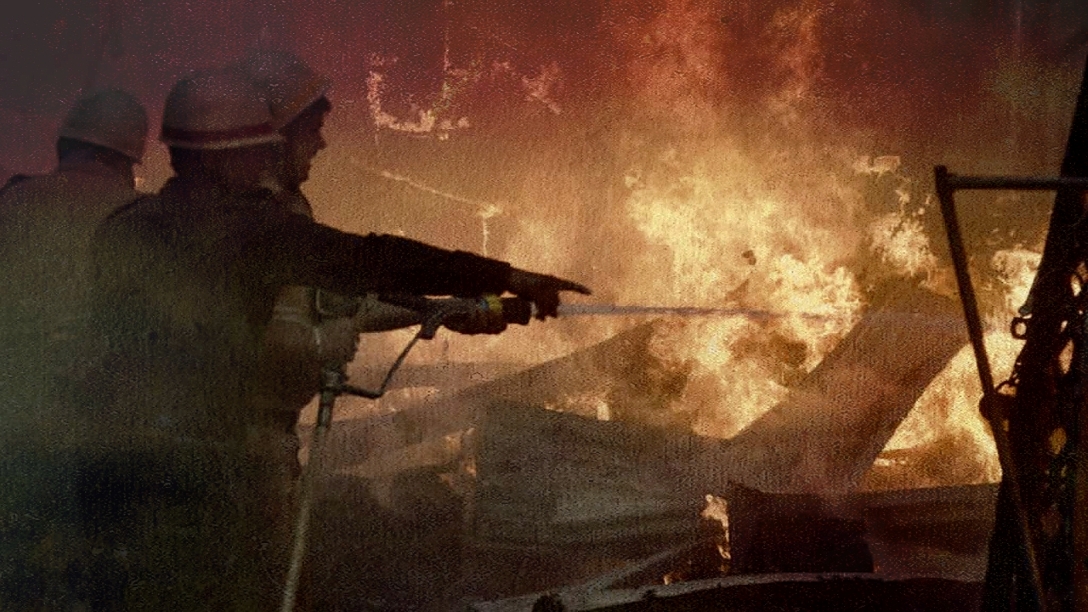
The devastating fire that erupted in the early hours of 26 January last at the two adjacent warehouse structures, one being a decorator’s warehouse and the other, a factory of ‘Wow Momo’ located in the Anandapur–Nazirabad area of Kolkata has been one of the most shocking industrial disasters in the city’s recent history. As rescue and recovery operations progressed, charred human remains were recovered from inside the warehouses with reported 27 deaths and 25 individuals’ missing till 1st of February, raising fears that the final toll could rise further once debris clearance is completed.
Nazirabad Tragedy
The location—tucked inside a densely populated zone—made firefighting operations exceptionally difficult. Narrow access roads, absence of internal fire-fighting systems, and the presence of combustible stock caused the fire to spread rapidly. Fire brigade teams from multiple stations took more than 32 hours and dozens of fire-tenders to bring the blaze under control. Even after the flames were doused, cooling operations continued for days, as pockets of fire repeatedly reignited due to stored materials. What began as a blaze inside a warehouse premises soon escalated into a prolonged inferno, exposing grave lapses in fire safety, urban regulation, and worker protection.
As the fire had finally been brought under control, charred bodies or dismembered body organs in whole or in parts were recovered. The identity of those burnt alive were identified with the help of DNA analysis of the relatives and some compensation for namesake was promised by the government. The manager of the Momo company and some others were taken into custody to cool down the seething inhabitants of the area. Curiously, the state fire minister, a high profile ruling TMC leader could find time to visit the place of occurrence only after 32 long hours as he was reportedly locked in a party meeting and overseeing the preparatory arrangements of Saraswati Puja in his constituency. Though usual blame game by the power-hungry parliamentary opposition parties had settled down after a couple of days, the deep scars will keep tormenting the families of dead and injured. The pertinent question that remains is will such recurrent incidents of fire taking tolls of precious lives and destruction of properties stop here?
Industrial Disasters are Galore
A deeper insight into the whole matter reveals that although the narrated incident looks an isolated one; it is in fact part of the many devastating industrial accidents in India which have been alarmingly rising over the last decade. Fires, explosions, toxic leaks, and building collapses are reported regularly across the states. Official and independent estimates report over 30,000 industrial accidents happening annually in India, causing thousands of deaths and several thousand more serious injuries. Fire-related incidents, particularly in warehouses, chemical units, garment factories, and small manufacturing clusters constitute a significant share. Major disasters in recent years, like explosions, fires, and warehouse infernos reveal a pattern rather than isolated failures. Experts point out that official figures often underreport the real scale, as accidents in informal units, contract labour spaces, and unregistered warehouses frequently go unrecorded never entering official records, masking the true scale of the crisis. Industrial accidents in India have become a systemic problem rather than rare mishaps, pointing to structural failures in governance and regulation. Most importantly, there is hardly any fire audit allowing the factory, godown, market or building owners to merrily skirt installation as well as inspection of firefighting devices.
Between 2012 and 2022, more than 1,000 factory workers on average died each year in registered factories alone due to fire. This excludes deaths in the informal sector. Data from the Ministry of Labour’s Directorate General Factory Advice Service & Labour Institutes (DGFASLI) showed over 3,300 deaths in registered factories between 2018 and 2020 while the figure is estimated to be over 6500 by independent analysts. In 2024 alone, labour unions reported over 400 workplace fatalities and more than 850 serious injuries from industrial accidents such as fires, explosions, and toxic chemical-related incidents. The worst industrial disaster at Bhopal Union Carbide factory, the persistent inaction of the Sterlite group to contain severe air and water pollution, and environmental violations at tits Tuticorin copper smelting plant, the Vizag Styrene Gas Leak and Anakapalli Pharma Unit Accident of Vishakhapatnam, Jaipur Oil Depot Fire, Korba Chimney Collapse in Chhattisgrah, Sigachi Industries Explosion in Telangana—the list is big. So, the reported numbers represent the tip of an iceberg; because millions of workers in India’s vast informal and unregistered sectors remain outside official safety frameworks.
Inhuman Treatment to the Workers
Inhuman treatment of workers came to light when the details of the Kolkata incident were known. Not only inflammable materials were stocked without any safety measures, one of the two premises was allegedly locked from outside to avoid any ‘theft’ with workers sleeping inside the premises. So ultimately, with no exit to escape, the warehouse literally became a burning ‘Lacquer palace’ for the workers trapped inside. This bore testimony of criminal apathy on the part of the owners towards the security of the workers with the government remaining a mute spectator. In the past, in Delhi and the ‘National Capital Region’ (NCR) Industrial areas, a massive, multi-state manufacturing and logistics hub surrounding Delhi, comprising over 60 distinct industrial clusters across Haryana, Uttar Pradesh, Rajasthan, and Delhi, numerous illegal factories and godowns have repeatedly caught fire, often at night when workers were either sleeping or on the job. Gujarat too has repeatedly witnessed such warehouse and logistics hub fires where storage of hazardous materials was poorly regulated, often without proper safety clearances.
Structural Causes Behind Industrial Accidents
Unregulated rapid industrial and logistics expansion, driven by sole objective of profit maximization, has led to warehouses operating without proper regulatory clearance resulting in mushrooming growth of industrial units in residential zones and storage of hazardous materials without safety compliance. Labour and factory inspections have increasingly turned into infrequent exercises, paper-based formalities, processes weakened by staff shortages and political pressure. Corruption sanitizes all illegal deeds. As a result, violations go unchecked until disaster strikes.
Apathy Towards Workers’ Safety
Utter negligence towards ensuring workers’ safety is the core issue at the heart of these accidents with a a slew of underlying disturbing truths. The workers’ lives are treated as expandable; safety measures viewed as avoidable costs; advantage is taken of lack in bargaining power and fear of job loss of the contract and migrant workers. So, workers are compelled to refrain from reporting hazards. So, the details of safety measures remain only on paper.
Growing Informalization of Labour
A majority of industrial workers are now employed either on contractual or temporary basis (even as daily wagers) employed through labour contractors who care a fig for security and insurance of the labourers. This system allows employers to evade responsibility, while workers remain unprotected and voiceless. Warehouses turning into living quarters are also one of the most disturbing aspects. This practice violates whatever little of labour laws and fire safety norms are still in vogue. Yet, due to weak enforcement, it has become widespread and eventually normalized. The profit hungry owner class and their lackeys feel no obligation to honour dignity of the workers.
The New Labour Codes —An Insult to the Injury
Industrial accidents are no more random tragedies. Rather they have been occurring into a predictable consequence of weakened labour protections and regulatory apathy. The country has seen repeated workplace disasters that expose a simple but devastating truth, where workers are being left to risk their lives while legal safeguards are dismantled. The government, turning a blind eye to all these incidents has further diluted the safety protections with labour laws being eviscerated to codes. Until recently, India’s workplace safety architecture was governed by 29 distinct labour laws, each with detailed, enforceable provisions for worker protection. Laws such as the Factories Act, 1948, included explicit requirements for fire prevention, welfare facilities, machine safety, and accident reporting. Others, such as the Contract Labour Act, 1970 and the Inter-State Migrant Workmen Act, 1979, provided at least certain specific protections for vulnerable worker categories. However, in 2025 the new ‘labour reform’ initiative of the BJP government, obviously at the instance of its masters, the ruling capitalist class, watered down all 29 laws to four draconian labour codes. Among them, the Occupational Safety, Health and Working Conditions (OSHWC) Code was meant to subsume safety and hygiene regulations. But the consolidation has resulted in key protections being generic rather than specific with detailed clauses on hygiene, fire safety, and accident reporting being replaced by broad duties that depend on future rules to be framed. And the Occupational Safety, Health and Working Conditions (OSHWC) Code has become discretionary rather than enforceable where the state governments can even exempt activities or facilities from certain provisions on economic grounds. Also, it has become less punitive with penalties for safety breaches often being “compounded” rather than resulting in criminal liability, thereby weakening deterrence. The Factories Act, for example, mandated prevention strict fire measures, ventilation standards, sanitation, and welfare facilities for workers, all with legal force. Under the OSHWC Code, many such safeguards are now subject to rule-making and interpretation, reducing uniform protection across industries. Enforcement has been weakened by turning Inspections into mere facade with critical change in the labour inspection regime. The older legal framework allowed frequent, unannounced inspections by factory and labour inspectors. To some extent these served as a real deterrent. Under the new codes, inspections are increasingly routine and facilitative, reducing the likelihood of exposing violations before they result in disasters. Inspector has been recast as an “inspector-cum-facilitator.” Inspections are increasingly digital, randomized, or paperwork-driven and enforcement becomes largely virtualized in a country where most worksites are informal and unsafe.
The Cost of Neglect
Weak accountability on the part of the employers and labour safety rules being tweaked with alacrity, the result is a steady stream of workplace tragedies such as fires, explosions, electrocutions, falls, and structural collapses that could be prevented with enforceable safety standards and rigorous inspection. Despite alarming data of 3,331 deaths between 2018 and 2020 in registered factories, there have been just 14 imprisonments under safety laws in that same period, underscoring enforcement failures even under the old system.
Absence of Accountability After Disasters
Even after some major industrial accidents, enquiry committees are formed, compensation announced, and lower-level officials suspended. However, owners and principal employers rarely face consequences. Crucially, official data underestimates the real toll because nearly 90% of India’s workforce operates in the informal sector, where accidents and fatalities often go unreported and unrecorded. Unions and watchdog groups argue that combining registered and informal sectors would reveal far higher daily workplace deaths, of which many could be avoided with robust safety regulation.
Workplace Safety should be a Fundamental Right
Article 21 of the Indian Constitution guarantees the ‘right to life and personal liberty’. But what does that right mean if a worker must risk death every day to earn a living? A right to life that ends at the factory gate is a hollow promise. Unsafe workplaces—where exits are locked, machines unguarded, unlabeled, hours chemicals unregulated— systematically violate Article 21. Courts have repeatedly expanded this article to include dignity, health, and livelihood. Safety is the missing link that binds them together. Without safety, employment becomes coerced survival, not free choice. Recognizing workplace safety as a Fundamental Right is not a legal luxury, rather it is a moral, constitutional, and economic necessity. This cannot be achieved with labour inspections weakened, penalties reduced to fines, and “self-certification” normalised. When safety is only a regulation, it becomes negotiable. But if it is a fundamental right, the burden shifts from workers proving harm to employers and the state proving protection. Rights create enforceability. They empower courts, unions, and individuals to act before death occurs, not after.
Endowment of Ruthlessly Exploitative Capitalism
Threse series of fatal accidents lay bare the most inhuman, cruel and insensitive face of the existing capitalist system where maximum profit of the owners override everything—safety and security of the workers, release of adequate subsistence-level wage, unhygienic and accident-prone working conditions, treating the labourers like animals—everything. And the servitor governments work as hand-maiden to such criminality. More crisis-ridden is capitalism, more is the brunt of that squarely passed on the workers. And domination of bourgeois and social democratic forces in labour unions has virtually institutionalized predicament, indigence and inhuman life conditions of the workers.
So, it is incumbent on the suffering workers to imbibe this truth, organize themselves under the banner of correct revolutionary trade union, steel their fighting unity rising above all divides, fear and lures, and spearhead a real uncompromising sustained movement to wrest their just demands. It also devolves on the class-conscious intelligentsia and thinking people to go the workers and educate them. History adjures the task to us.
The Poorest Workers Face the Greatest Danger
India’s most dangerous jobs— construction, warehouses, mines, chemical units, transport, sanitation— are staffed by contract workers, migrants, women and tribals. These workers lack bargaining power, job security, and often legal identity. When safety is discretionary, inequality decides who lives and who dies. A democracy cannot allow prosperity to be built on disposable bodies. Countries with the strongest workplace safety regimes are not less competitive rather are more productive, more skilled, and more stable. Unsafe workplaces lead to higher healthcare costs loss of skilled labour and intergenerational poverty.
Compensation is not Justice
Post-accident compensation is often cited as proof of concern. It is not. Compensation monetizes death but does not prevent it. No amount of money restores a burned body, a crushed spine, or a child who lost a parent. A caring system should prioritize prevention over payout, accountability over charity.
Selective Compassion with Relief Depending on Visibility
The Prime Minister Modi’s announcement of ex-gratia aid for the victims of the Kolkata Anandapur warehouse fire was swift and prominently publicised. Condolences were expressed, compensation declared, and official handles amplified the gesture as proof of a sensitive and responsive state. Yet, this sudden display of empathy throws into sharp relief a troubling absence: the same Prime Minister has remained conspicuously silent on the Indore water contamination tragedy, where poisoned drinking water has claimed more than 31 lives and pushed nearly 2500 into hospitals. Yet, there has been no Prime Ministerial ex-gratia announcement, no national acknowledgement of state accountability, no comparable public expression of condolence. Question arises whether the contrast is merely administrative or deeply political? Are deaths caused by fire more deserving of compassion than deaths caused by poisoned water? There is no dispute regarding the need to compensate Kolkata’s fire victims. But justice cannot be selective. Either the Indian state grieves for all its dead, or its condolences mean nothing at all. Modi government advertising itself as decisive, compassionate, and accountable must explain why fire victims in an opposition ruled state going to face elections receive relief while water victims ruled by the BJP itself and not having assembly elections in near vicinity receive silence. Every expression of sympathy rings hollow with all the signals indicating towards the ensuing assembly elections.
The False Choice Between Development and Life
The Anandapur warehouse fire is not an aberration, rather part of a national pattern of industrial neglect. When labour protections are diluted, inspections weakened, and profit placed above human life, fires no longer remain confined to buildings— they spread into the moral and democratic foundations of the society. Economic development cannot be built on the systematic endangerment of workers. Unless workers’ safety is restored as a legal, moral, and political priority, the industrial growth will continue to be marked by avoidable tragedies and silent suffering.


