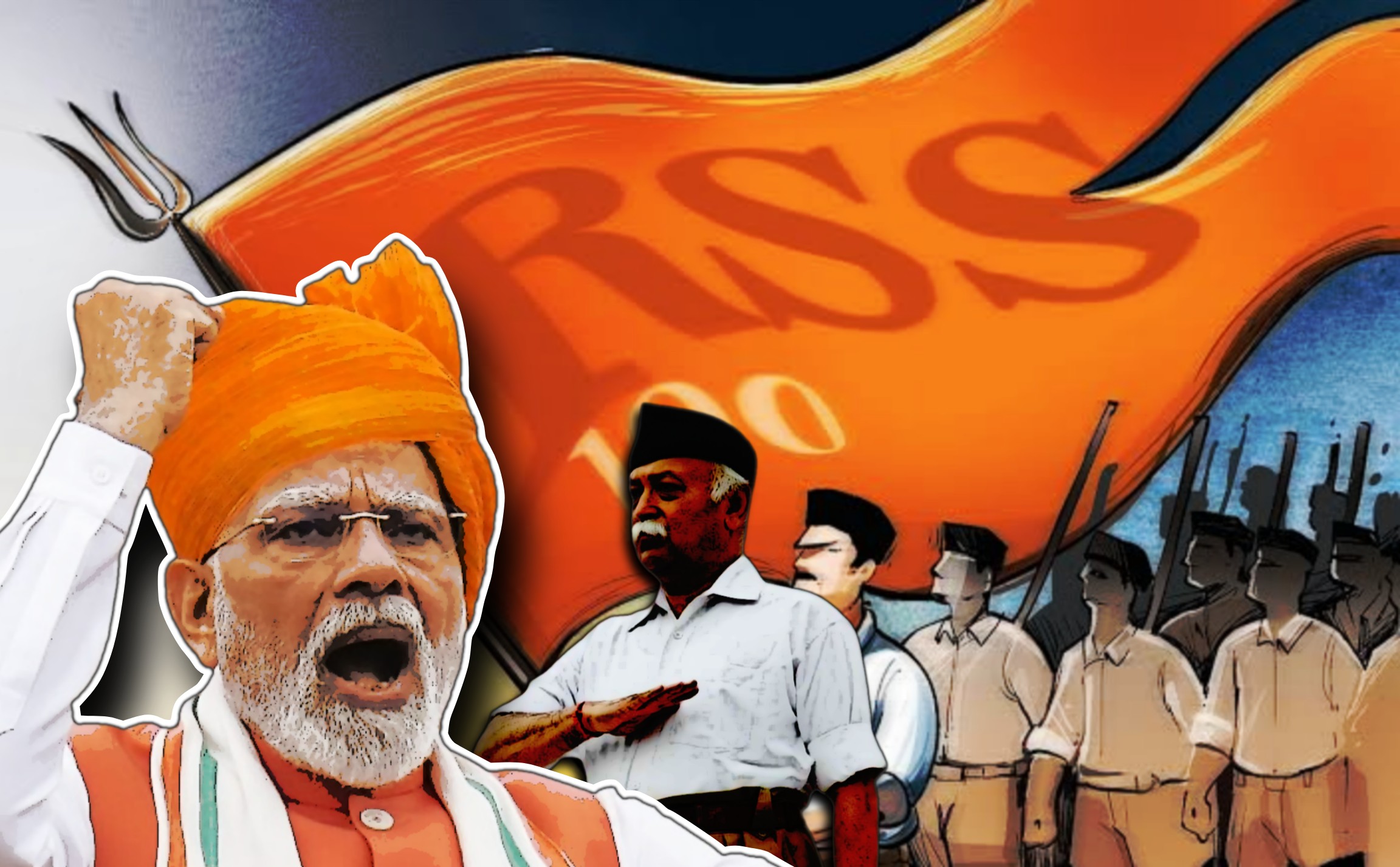
On the first two days of October 2025, India witnessed not one centenary celebration of the Rashtriya Swayamsevak Sangh (RSS) but two. One in Delhi, choreographed under the Ministry of Culture’s seal, with Prime Minister Narendra Modi on stage and the trappings of the State itself. The other one was in Nagpur, the RSS’ spiritual home, where Mohan Bhagwat, the RSS chief addressed the RSS cadres known as swayamsevaks. Everyone is aware that the RSS is the mentor of the BJP. The centenary celebration of the RSS in the form of a two-city theatre with outwardly two kinds of ambience and two forms of countenance: one conferred by the BJP-led Government and the other cultivated by the RSS for itself with its own contours—might look to be wrapped with two different outlooks. But was that really so or were the two events supplementary and complementary to each other?
PM Modi expectedly effusive in praise for RSS
Let us start with the Delhi programme. PM Modi, himself an RSS man, was effusive in praise of the Sangh. He projected the RSS as a key cog in the country’s fight for independence, taking it upon himself to dispel the widely held belief that the outfit had sided with the British.”If we look at the freedom struggle, many workers, including the most revered (RSS founder) Dr Hedgewarji, participated in the freedom movement. Doctor Sahib went to jail several times. The Sangh protected many freedom fighters and worked shoulder-toshoulder with them. In 1942, when the movement against the British was launched in Chimur, many volunteers faced severe atrocities,” said PM Modi. Fact is that K B Hedgewar decided to join the Civil Disobedience in 1930 as an individual, resigned his position as the head of the RSS and went to jail to feign his nationalist credentials and also, according to his official biographer, to attract Congress cadre in the jail to the RSS. But the RSS as an organization stayed away from the movement. And Hedgewakar himself ridiculed the freedom fighters who were jailed by the British rulers in the following language: “Patriotism is not only going to prison. It is not correct to be carried away by such superficial patriotism.” (CP Bhishikar, Sanghavariksh Ke Beej: Dr. Keshavrao Hedgewar, Suruchi, 1994, p. 21) He even described the British rule as an “act of providence”. So, his going to the jail was not spurred by any genuine patriotic feeling but was a ploy to whisk away volunteers of freedom movement to the RSS. Moreover, as we have stated many a time, M S Golwalkar, the RSS ideologue made it amply clear that “The theories of territorial nationalism and of common danger, which formed the basis for our common concept of nation, had deprived us of the positive and inspiring content of our real Hindu Nationhood and made many of the “freedom movements” virtually anti-British movements. Anti-Britishism was equated with patriotism and nationalism. This reactionary view has had disastrous effects upon the entire course of the freedom movement, its leaders and the common people.Those only are nationalist patriots, who with the aspiration to glorify the Hindu race and Nation next to their heart, are prompted into activity and strive to achieve that goal. All others are either traitors and enemies to the National cause.” (We or Our Nationhood Defined) He was not far from the Nazi supremo Hitler when he said “To keep up with the purity of the race and its culture, Germany shocked the world by her purging the country …. Race pride at its highest … a good lesson for use in Hindustan to learn and profit by”.(ibid) In other words, the RSS held the Indian freedom struggle and its leaders reactionary and treacherous and found in Hitler an equable figure.
PM Modi claimed that “The Sangh has fought against the atrocities of the British. Their only interest has always been love towards the nation.” He also added that Sangh volunteers gave shelter to freedom fighters and its leaders were also jailed during the freedom struggle. But do facts bear out these lofty claims by the hon’ble Prime Minister ? In the entire period from 1925 to 1947, the RSS did not participate in any campaign or movement for national independence by driving away the British imperialist rulers. Two years after the foundation of the RSS, the antiSimon Commission protests swept the country. But the RSS was nowhere to be seen. According to historical records, the RSS stayed away from the ‘Quit India’ movement. Nor did it initiate any movement against the Britishers by itself. It instead collaborated with the British rulers to break the freedom movement. The RSS opposed Netaji Subhas Chandra Bose and his ideals, and actively undermined his efforts towards a united freedom struggle. Historical accounts show a deep ideological conflict between Netaji’s s secular, socialist, and anti-imperialist vision and the communalist, pro-British stance of the RSS and its ally Hindu Mahasabha of Savarkar. The RSS also did not support the Indian National Army (INA), led by Netaji Subhas, during World War II. In one instance, RSS founder K.B. Hedgewar is reported to have avoided meeting with an associate of Netaji to prevent antagonizing the British. Savarkar and his Hindu Mahasabha, actively campaigned for Hindu youths to join the British Indian armed forces. The party’s decision was based on the strategy of “Hinduize all Politics and Militarize Hindudom”. RSS was an indulgent onlooker to Hindu Mahasabha’s moves.
RSS also considered Bhagat Singh an “anarchist” and even spied for the British government. H.V.R. Iyengar, Home Secretary, Bombay, pointed out on 16 February 1944 that “the Sangh has scrupulously kept itself within the law and, in particular, has refrained from taking any part in the disturbances that broke out in August 1942”. ( Home Department (Political) Proceedings, File 28/8/42- Poll(I) and File 28/3/43-Poll(I).
In order to establish that the RSS supported numerous freedom fighters, working shoulder to shoulder with them, PM Modi cited the 1942 movement in Chimur, where many swayamsevaks endured severe British atrocities. But this is again not corroborated by facts/history. During the agitation in Chimur (currently in Maharashtra) which was a part of the ‘Quit India’, RSS leaders encouraged their members to join the Civic Guard, a colonial equivalent of the Home Guards.
Why this attempt to give the impression of being ‘nationalist’ but keeping away from the actual national freedom movement? The answer is not very far to seek if we realize that its creed is a sectarian ahistoric concept of Hindu religionoriented nationalism, a proposition which emanated from the two-nation theory mooted by Savarkar and later endorsed by Mohammad Ali Jinnah of Muslim League. So, the RSS kept itself alienated from the genuine concept of Indian nationalism that historically germinated in course of the glorious freedom struggle against the British colonial rulers.
We are skipping, for brevity’s sake, the details of the barefaced role of the Hindu Mahasabha founded by V D Savarkar, in joining the RSS in this utter betrayal to the cause of the freedom movement. The details were given in more than one article published in the Proletarian Era earlier. Only we want to refer to two letters in this connection. Only we want to state again that Savarkar who is profusely praised by PM Modi for “his valiant spirit and unwavering dedication to our nation’s freedom and integrity” got released from the British jail by filing one after another mercy petitions assuring the British government that he would “serve the Government in any capacity they like,” and honoured his commitment by, among other things, asking “every branch of the Hindu Mahasabha in every town and village to actively engage itself in rousing the Hindu people to join the British army, navy, the aerial forces”. In reciprocation, the British commander-in-chief, “expressed his grateful appreciation of the lead given by Barrister Savarkar in exhorting the Hindus to join the forces of the land with a view to defending India from enemy attacks,”
Then comes Syama Prasad Mookerjee, another Hindu Mahasabha leader who ran a coalition government with Muslim League in undivided Bengal, opposed the ‘Quit India movement’ tooth and nail and later resigned from Hindu Mahasabha to join the Nehru cabinet as a minister, later, fell out with Nehru, resigned from Nehru’s cabinet and with the help of the RSS founded the Bharatiya Jana Sangh, the predecessor of the BJP, in 1951. Anticipating that the Quit India movement of 1942 would stir the British rulers Syama Prasad had written to the Governor of Bengal that “any widespread movement launched by the Congress….must be resisted by any government” and it should ensure “that in spite of the best efforts of the Congress, this movement will fail to take root in the province.” He had been described by Giuseppe Tucci, the Italian Professor who taught at Shantiniketan and Dacca university and was the major conduit for spreading fascist ideas among Bengali students and teachers as “our most important collaborator” in Calcutta. (Casolari, In The Shadow of the Swastika, p16.)
The other letter was from former home minister Sardar Ballabh Patel in 1948 to Syama Prasad which stated, inter alia,: “As regards the RSS and the Hindu Mahasabha, the case relating to Gandhiji’s murder is sub judice and I should not like to say anything about the participation of the two organizations, but our reports do confirm that, as a result of the activities of these two bodies, particularly the former, an atmosphere was created in the country in which such a ghastly tragedy became possible.” PM Modi hails Syama Prasad as an “immortal son of the nation”, may be because of his outright pro-British role, quitting his mother organization for ministership and then forming another organization in collaboration with the RSS.
PM Modi also released a special postage stamp and a commemorative Rs 100 coin to mark the centenary of the RSS in his utmost effort to assiduously woo the Sangh leadership. He went to the extent of copiously praising RSS chief Mohan Bhagwat stating that his tenure has been “the most transformative period in the 100- year journey of the RSS”. It means he sought to place Bhagwat above Hedgewar, Golwalkar and others. Flattery par excellence!
Gospels of Shri Mohan Bhagwat
But the hustle bustle of Nagpur conclave was different. RSS chief Mohn Bhagwat cunningly sought to play the tone and tune of a critique of what is happening in the country obviously with a view to carrying the aggrieved countrymen with him. If providence wanted to play a prank, it could not have scripted it better. He outlined six key observations, including fostering grassroots leadership, re-establishing valuebuilding systems in homes and schools, prioritizing social unity, preserving Hindutva as a foundation of national cohesion, and organizing society to safeguard ‘Sanatan Dharma’. Alongside, he highlighted the widening gap between rich and poor and the growing concentration of economic power. While the entire country is aware of these hard facts, Bhagwat, it seems, woke from a long slumber to discover such sordid state of affairs. But fact is that all anti-people pro-monopolist policies have been adopted jointly by the RSS and the BJP. Bhagwat also hinted that India had failed to win enough global support for ‘Operation Sindoor’ which was a mild flagging of India’s global vulnerability because of a lack of enough international support. He said the episode had also shown “who our friends are in the global arena and to what extent they are willing to stand by us”. The comment, made in the backdrop of a visibly fractured global consensus on terrorism, is being read as the RSS chief’s attempt to indicate that India’s diplomacy must be tempered by vigilance and realpolitik.
Pointing finger at the “flaws” in the economic model being pursued across the globe, he suggested a course correction to tackle domestic inequality. But he did not spell out what should be done concretely to achieve that objective. See how cunningly he balanced both praise and criticism by carefully patterning his speech. “In the economic sphere, one can say that our situation has been improving according to the prevailing indicators…. However, the flaws of the prevailing economic system, such as the widening gap between rich and poor, the concentration of economic power, the strengthening of new mechanisms that enable easier exploitation by the exploiters… are globally exposed.” He even expressed worries about capitalism’s failures, about inequality eating away at social stability, about progress that leaves human beings behind. However, he only hinted at the problems but expectedly remained tightlipped over the pathway to its remedy, even amelioration.
He also referred to the latest anxieties like climate change, environmental disasters, the schism between technological progress and the human ability to adapt. Notably, these were not filler lines. They were repeated, weighted. Bhagwat also frowned on India following the path of the “consumerist development model adopted worldwide”, which he said was leading to an ecological disaster in the Himalayas.
Bhagwat also talked of morality in public life, social responsibility, and the dangers of manufactured discord. “Our country has immense diversity. Many languages, multiple religions, diverse lifestyles and a variety of cuisines due to geographic diversity, caste and sub-caste – all these diversities have existed since inception. We must remember that this larger identity is above everything else for us. Because of this, our attitudes towards each other in society are required to be harmonious and respectful. Everyone has their own beliefs, icons and places of worship. We should be careful not to disrespect these in thought, word, or action…While foreigners have left, our own brothers who accepted these religions and continue to follow them are still present in Bharat. According to Bharatiya traditions, all are welcome and accepted. We look at them as ours rather than as the ‘other’. We regard, and must regard, these diversities as specialties and understand the tendency to take pride in them,’’ he said.
Bhagwat once again reiterated Sanatana Dharma’s (meaning eternal religion i.e. Hindutva) universal approach and its relevance in modern times. But point is what is Sanatana Dharma? Adi Shankaracharya, who established Advaita Vedanta school of Hindu philosophy and wrote commentaries on key Hindu scriptures, proclaimed that “Ekameva Adviteeyam Brahma” (The Absolute is one alone, not two). Swami Vivekananda also endorsed that view. But we know that various sects ( subgroups within a larger religion) of Hinduism believe in different gods. The followers of Vaishnavism revere Lord Vishnu while Saivism worships lord Shiva as the ultimate reality. Kali Kula sect (Shakto tradition) considers Mother Kali as the supreme goddess. There are many such divisions within Hinduism. Then what is the universal approach or eternity of Hinduism that RSS espouses for?
In any case, outwardly, it would occur that Bhagwat is at odds with the performance of the BJP government, the policy of spewing communal hatred and precipitating divides and discords or giving vent to the exasperation with the BJP government’s development paradigm.
This is the camouflage and manipulative overtures with which the RSS seeks to outsmarts its opponents, ensures total submission of its lackeys to its dictates. It says something but means something else. Did Bhagwat utter a single word against lynching of the minorities, their harassment over the issue of citizenship, their continued persecution by the power that be? No, not at all. Bhagwat also said, “India should give the world a new model.” But did he indicate what was the “new model of development”? Again, a big NO. His critical protestations against capitalism were not accompanied by any suggestion of an alternative order.
Bhagwat’s remarks, therefore, served a dual purpose: on one hand, he positioned the RSS as a voice of social conscience and reform, and on the other, he subtly avoided direct confrontation with the ruling establishment. This nuanced approach allowed him to address widespread discontent without jeopardizing the organization’s alliance with the BJP. By highlighting systemic issues yet refraining from proposing tangible solutions, Bhagwat maintained the RSS’s image as both a critic and a supporter, threading a careful line in India’s contemporary political discourse.
Was Bhagwat explicit about stopping persecution and harassment of the religious minorities? No, not at all. He spoke of unity, social cohesion, of the dangers of sowing discord—sometimes a veiled rebuke to cow vigilantes or lawbreakers acting in the RSS name. He only preached sermons like “all of us should follow rules, maintain order, and demonstrate harmonious behaviour”. These are all pep talks which bear testimony to his playing to the gallery. The RSS leadership is aware that there are accumulated grievances among the people against the misrule of the BJP and growing inhuman capitalist exploitation. And people also know that the BJP is the political outfit of the RSS. Hence is the endeavour to pretend disagreement with the BJP and curry favour with people at large.
Secondly, Bhagwat expressed concern at the regime change in Sri Lanka, Bangladesh and, more recently, Nepal because of a violent outburst of public anger against respective oppressive regimes. He warned of what he called the “grammar of anarchy” and held that taking the law into one’s hands and coming out on the streets or engaging in hooliganism and violence is not correct. Thus, Bhagwat on the one hand cautioned the BJP of possible surge of people’s protest against growing predicament in every sphere of life and on the other hand, tried to pacify the aggrieved masses from rising into protest shrewdness par excellence!
Both RSS and BJP are serving ruling capitalism
Whom are both the RSS and BJP serving? Obviously the ruling capitalism, the root of all evils. The theory of Hindutva is a stratagem to overwhelming majority of Indian people with religious blindness, regressive mindset, exclusiveness and the nurturing of disaffection with other religions. This backwardness and Hindu religious obduracy are conducive to fomenting communalist thoughts and developing hatred for other religious communities. This is exactly what the capitalist rulers want—deep rooted irrationality, extreme bigotry and divides centring religion because that creates hindrance before uniting all oppressed people on the platform of mass movement against ruthless capitalist onslaughts wreaking havoc in people’s life, irrespective of religious affiliation, caste, creed, ethnicity, language and region. So, PM Modi’s eulogy of the RSS and the RSS chief’s covert campaign for Hindu nationalism interspersed with some observations about the economic-political-ecological miseries people at large are confronted with, have a sort of subterranean link—deception of the highest order.