
In August last year, the US imposed a 25 per cent reciprocal tariff on Indian goods, followed by an additional 25 per cent levy linked to India’s continued purchase of Russian crude oil. The Trump administration argued that its tariffs would promote domestic manufacturing, protect national security, and substitute for federal income taxes. US hitherto was having a trade deficit with India to the tune of $45.6 billion in 2024. It means that while US imports from India was $129 billion, its exports to India were $83.4 billion. This was as on 2024. In other words, the US imported goods worth $45.6 billion more from India than what India imported from it. As we know, US imperialist administration, besides flexing military muscle, also uses draconian economic sanctions to bully other states into submission. It had, of late, found that such trade deficit with India was inherently harmful for its economy. Moreover, consequent to US war machinations in the Middle-East, a big reservoir of oil, India switched to Russia for importing crude at a much cheaper price. And this transaction is either in rupees or rubles, not dollars. So, dollar is affected. That is what irked US administration. So, President Trump, whom the Indian BJP Prime Minister has hitherto viewed as a close friend, unilaterally raised tariff on Indian imports to 25%. And then, in early August US announced that if India did not desist from procuring oil from Russia, an additional tariff of 25% tariff would be imposed on it. In effect the total levies would be as high as to 50%.
Subsequent Developments
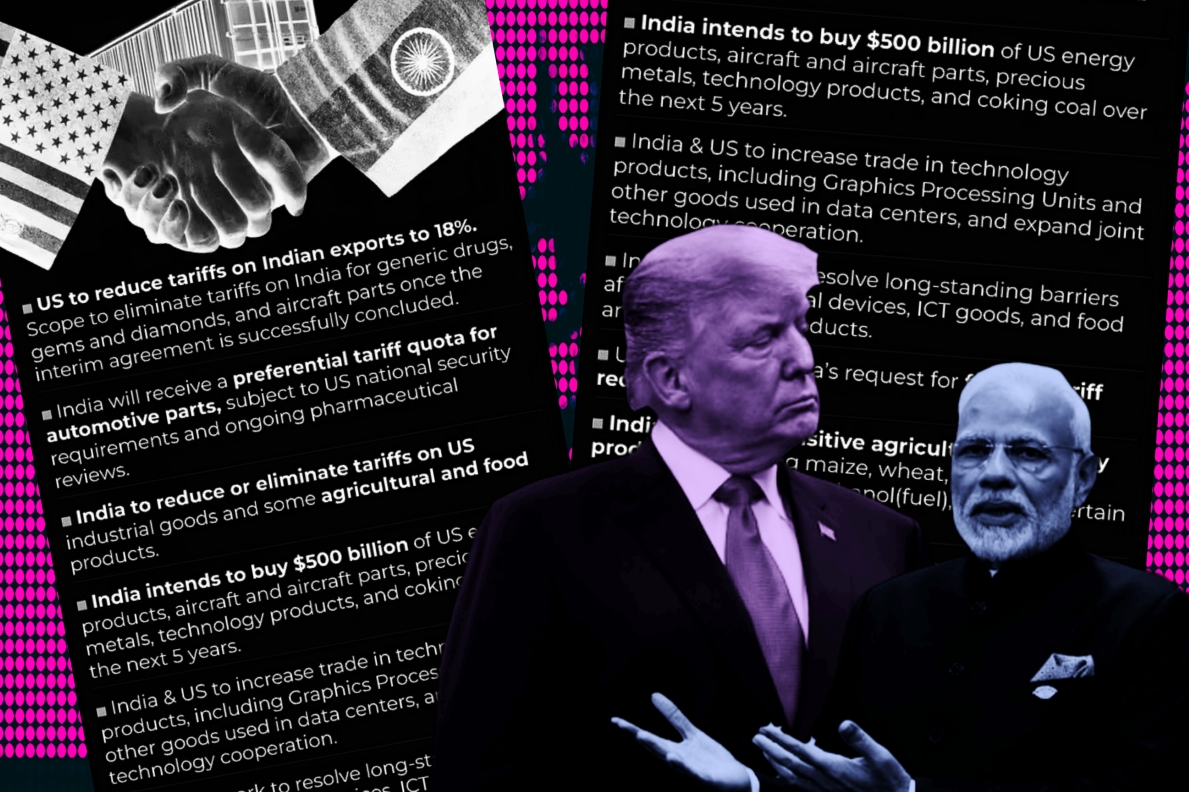
Visibly rattled, the BJP-led central government, under instructions from its masters, the ruling Indian monopolists, began hectic parleys with US authorities with a view to lowering such hefty tariff that was destined to virtually inhibit export of Indian goods to US. Though PM Modi stayed away from any bipartite negotiation, two of his key cabinet ministers were deputed to settle the issue with US. After several rounds of discussions, both US and India released a joint statement that they have reached a framework for an Interim Agreement regarding reciprocal and mutually beneficial trade. The framework, as stated, reaffirms the countries’ commitment to the broader US-India Bilateral Trade Agreement (BTA) negotiations, launched by President Trump and PM Modi on 13 February 2025. BTA will include additional market access commitments and support more resilient supply chains.
Nicely worded no doubt! But what is the reality? India has reportedly agreed to either eliminate or reduce tariffs on all US industrial goods and a wide range of US agricultural and food products. In reciprocation, US would bring down the import tariff to 18%. The statement does not quantify India’s commitment except saying, “India will eliminate or reduce tariffs on all US goods”. That leaves scope for assuming that there could be an assurance of zero tariff on some (as yet publicly unspecified) US products from day one.
Effect on Tariff Structure
The average tariff rate imposed by India on US imports was 17 per cent, and for agricultural products it was 39 per cent. This high tariff on US goods would come down substantially, if not to zero in some cases if the current negotiation! framework is implemented. This will virtually open the floodgates for US products in India’s market. On the other hand, average tariff imposed on Indian products exported to the US market was as low as 3.3% and trade weighted average tariff turned out to be 2.2%. In other words, hitherto applicable rate of tariff around 2-3 % is now increased to 18%.
Further, India has expressed its intention (read committed) to purchase around USD 500 billion worth of US goods over the next five years. One wonders how can a country give an omnibus commitment to buy goods at the rate of USD 100 billion each year, unless there is some compulsion, economic or political? The BJP government is celebrating an 18% US tariff rate on the Indian export. But it is comparing the latest tariff with the pre-deal 50% tariff rate as a reference point instead of the near zero tariff regime which prevailed before Trump became president for the second time. What is noteworthy is that the US is India’s biggest trading partner accounting 17% of India’s merchandise trade while India’s share in US merchandise imports is 2.8 to 3%. Hence the dependence of India’s exports on the US market is relatively greater than dependence of US exports on Indian market. Now, with the new deal, India’s import bill from US will end up increasing substantially in a bid to appease the US. Also, benefit of saving in export bill because of lowered tariff, if any, does not accrue to the common people but swells the coffer of the monopoly houses.
Russian Oil Issue
An important and direct conditionality has been tying India down to being “monitored” over its purchase of Russian oil. One does not know how Russia will view this move by India. Fact is that in 2019 itself, India had agreed not to buy Iranian and Venezuelan oil, due to US sanctions. At its peak, India was importing around 2.2 million barrels per day (bpd) of Russian crude. Since December, that has been slashed to around 1 million bpd in December and January last. That is still around 30 % of India’s total purchases. It is to be seen if India will be forced to stop its huge purchases of Russian crude oil, or will it find a way to keep the tap partially open? This aspect is not featuring in the joint statement. Nor has India said that it would not buy oil from Russia. Even Russia has not given any indication that its oil export to India would dip. It is only presumed that India has given some commitment to stop direct or indirect imports of Russian oil and procure Venezuelan oil through US at a higher price.
Pertinent to mention that while commenting on the deal, US President Trump has said: “If the Secretary of Commerce finds that India has started directly or indirectly importing Federation oil… Russian (it) shall recommend whether and to what extent I should take additional action as to India, including whether I should reimpose the additional ad valorem rate of duty of 25 per cent on import of articles of India.” There is indeed a suppressed threat, but nothing is on paper. However, in view of its war on Iran which entailed closure of the Strait of Hormuz, a key conduit for India and purportedly responsible for 40% of its crude supply, US has authorized the sale of Russian oil to India for a period of 30 days from 6 March 2026. However, US Treasury Secretary hastened to add that the US expects India to hike US oil purchase. In fine, the framework deal is no doubt heavily tilted in favour of the US and the asymmetry is obvious.
Changes in Bilateral Trade
The pact also has other ramifications. As already stated, India enjoys a trade surplus of about USD 45 billion. With operationalization of the new agreement, India’s trade surplus with US would effectively be wiped out and replace it with a growing trade deficit. This deal does not even have reciprocity because US will charge an 18% import tariff on India’s exports, and India will give low single-digit tariffs to the US. The truth is India may have got 1 or 2 % lower import tariff in the US and nothing more. The fact is, no East Asian country has offered to dilute its trade surplus with the US like what India has done.
Opening Agricultural Market to US is Disastrous for Indian Peasants
US agriculture is heavily subsidized and controlled by giant agro-multinationals. For long, US had been trying to make forays into Indian agricultural market in a big way and India was resisting that in the global forums like WTO. India had consistently argued on international platforms that agriculture in developing countries cannot be treated like any other tradable commodity. But now that resistance has gone. Hitherto, India was primarily importing tree nuts (almonds, pistachios, walnuts), cotton, and soybean oil from the US. Now a wide range of agricultural produce from US will flood Indian market.
Union Commerce and Industry Minister Piyush Goyal, who was associated in negotiation with US, in his press brief assured that India’s agriculture sector is fully protected. He assured that the new India–US trade deal will not hurt Indian farmers, dairy producers or rural jobs. But all such words fly in the face of the confident assertion by the US that it will wipe out its agri trade deficit with India. Fact is that India has agreed to “eliminate or reduce tariffs on a wide range of US food and agricultural products, including red sorghum for animal feed, tree nuts, fresh and processed fruit, soybean oil, wine and spirits, and additional products”. That is the reason Brooke Rollins, the US Agriculture Secretary, confidently stated that India’s offer to open up its agri sector will help America wipe out its trade deficit of USD 1.3 billion with India in the agriculture sector. And huge money would flow in US agricultural sector. Yes, money would fly from Indian Public exchequer. Will that go to US farmers? No. It would flow to the giant US agro-multinationals. So, money from India’s public exchequer would enter into the pockets of US agro-giants.
If relatively cheaper agricultural products from US are available in India, Indian produce would face steep competition which would compel the Indian peasants to resort to more and more distress sale of their crops. Who will gain? The Indian monopolists like Adani owned AWL Agri and Ambani owned Reliance Jio Mart.
Reiteration of Anti-Peasant Pro-Corporate Agro-Policy of Indian Government
In fact, the BJP government brought four Black Farm Acts in 2020 which was purported to hand over the agricultural sector to the monopolist giants and multi-nationals on a silver platter. At that time also, the Indian government had tuned up its propaganda machine to hype the so called “benefits and happiness” its new farm laws would ensure for the farmers. But the peasants refused to be deceived by such sweet-coated words. Finally, under pressure of the heroic struggle and self-sacrifice of the peasants, and supported by all sections of the toiling people across the country, for over one long year which saw over 750 lives lost, the BJP Government had been forced to announce repeal of the three anti-peasant pro-corporate Laws.
Now, the same logic is being reiterated in justification of widely opening up Indian market to US agro-giants. Indian authorities claim that reduced tariff would benefit Indians. Which Indians? The common peasants and ordinary suffering people? No, not at all. The powerful agro-syndicates of India would buy that stuff at lower price, add its profit margin to it and then sell the same in the retail market at higher cost.
For example, for a long time, oil prices in international market were hovering around US $65-70 per barrel. The Indian government was also procuring Russian oil at a steeply discounted rates, dropping as low as $35 per barrel when international Brent crude price was $65 per barrel. But has that benefit been passed on to the people? No. Instead, the government usurped the benefit by way of levying very high tax. On the other hand, Reliance Industries owned by Ambani significantly increased purchases of discounted Russian oil, buying approximately $33 billion worth since February 2022. What did it do with that oil? Was it sold in the domestic market? Practically no. Instead, it exported most of the refined oil and had seen significant revenue inflow of over $85 billion from February 2023 to mid-2025. Just the other day, India allowed British apples to be imported in India. Immediately, the apple growers of Jammu and Kashmir as well as Himachal Pradesh complained that they are being ousted from the market. But has the price of apples in retail market come down? No. This is the hard truth.
Indian Agriculture Differs from US Agriculture
In US, agriculture is primarily a source of income and profit for large corporations and business houses that enjoy heavy clout within the governance system. But in India, in contrast, agriculture rests to a large extent on small landholdings, unpaid family labour, seasonal uncertainty and cultural continuity. For farmers, their fields are as precious as the birth of a son. Oxen, cows and buffaloes are not merely sources of sustenance; they form part of an emotionally-connected and fragile ecosystem and social bonds. If agricultural market in India is liberalized, Price signals (change in the price of goods or services that communicates information to consumers and producers, indicating that supply or demand should be adjusted) as held by many experts, are bound to collapse. For a small farmer, even a modest price dip can determine whether a daughter or son goes to school, or whether a loan is rolled over once again. Such realities regrettably never find space in trade negotiations amidst capitalist-imperialist countries who see everything through the lens of profit maximization of the giant corporates and multi-nationals. It goes without saying that following the trade pact, the condition of Indian peasants will deteriorate further, if not brought to precipice of ruination. This is bare and simple economic coercion masquerading as trade policy.
Impact on Other Sectors
Indian authorities are optimistic that the tariff cut is expected to significantly benefit labour-intensive Indian industries such as textiles, apparel, leather, footwear, plastics, rubber goods, organic chemicals, home décor, handicrafts and select machinery. But is that the case? Just take one example. The US hitherto accounted for roughly 30% of India’s textile exports, worth $10–11 billion annually. A new US-Bangladesh trade arrangement reportedly grants zero tariffs on garments made using US cotton. This gives Bangladeshi exporters a decisive advantage over Indian exporters, who still face an 18% tariff. India exports $4–4.5 billion of cotton and yarn to Bangladesh. If Bangladesh shifts to US cotton to qualify for duty-free access, Indian cotton exports could collapse. Major textile hubs such as Ludhiana and Tiruppur, which employ hundreds of thousands of workers, could face severe order losses, layoffs, and factory closures. Cotton farmers, small mills, and textile workers will bear the brunt. This is not a level playing field. It is structural displacement.
Question of Sovereignty
A section of the observers is saying that by agreeing to such asymmetric trade pact, India has compromised with its sovereignty. Such conclusion is not correct. It is a business deal between two imperialist countries, one being more powerful than the other. India, for example, entered into a trade agreement with European Union. India is also member of BRICS alliance which comprises both Russia and China. China, incidentally, remains a top trading partner of India, with 2025 bilateral trade hitting a record $155.6 billion. So, in the context of acute insoluble global market crisis coupled with imperialist-imperialist contradiction over grab of market, this is an independent trade pact of Indian imperialist state marked by a retreat in the context of a given particular economic-political situation to protect its class interest. Hence, the question of surrendering sovereignty does not arise at all.
It bears recall that when a controversy arose as to whether economic dependence of a country on another means the former’s political subjugation to the latter, great Lenin ridiculed that view as a puerile attempt to be clever without having the slightest bearing on the subject. He then added: “Not only small states, but even Russia, for example, is entirely dependent, economically, on the power of the imperialist finance capital of the “rich” bourgeois countries. Not only the miniature Balkan states, but even nineteenth-century America was, economically, a colony of Europe… that has nothing whatever to do with the question of …the national state”. Hope this is enough to rebut such a flawed view.
Why Indian Government Yielded to US Dictates
Pertinent question is why did India yield to such tall orders of US? Surely, uninterrupted trade with US is one compulsion. But more is the political compulsion. As we have said times without number, ruling Indian monopolists want to emerge as a formidable superpower not just in Asia but the world. Its main competitor is China, now a powerful imperialist force after counter revolution. For that, it needs backing of US. Hence PM Modi as apostle of ruling Indian capitalism has been trying utmost to curry favour with US even if those warrants stooping to sickening sycophancy. On the other hand, neither Russia nor European powers are considered to be dependable ally in so far as fulfilment of the aspiration of the Indian monopolists to attain the status of a global superpower is concerned. The oft-repeated objective of becoming a US$ 4 trillion economy is aligned with that aspiration. So, to appease US by agreeing to some of its terms has become imperative. This is the crux of the whole issue.


