Let’s have a forensic examination of the economic incentives and political machinery that make violence profitable. If the purpose of an economy is to efficiently allocate resources to meet human needs, then the global arms trade is its malignant doppelgänger. It is a system exquisitely calibrated to convert geopolitical fear into demand, and human suffering into profit. The output is not prosperity but rubble; its leading indicators are not productivity gains, but casualty counts. As conflicts rage in Ukraine and Gaza, the quarterly reports of the world’s premier arms manufacturers tell a story of booming business. For the merchants of death, the world’s disorder is their order book. The human cost is grotesquely familiar: over 60,000 killed in Gaza, more than 1.1 crore displaced in Sudan, and a generation of Ukrainian children schooled in bunkers. Yet, in the boardrooms of imperialist rulers of US, UK and Russia, these tragedies are filtered into metrics of economic growth and rising market share. According to the Stockholm International Peace Research Institute (SIPRI), the combined revenues of the world’s top 100 arms companies grew by 4.2% in 2023, reaching a staggering $632 billion (Rs 62,45,600 crores approximately). This is not a passive market fluctuation; it is a direct correlation. War is good for business, business of the monopolist tycoons and multinational behemoths desperate for profit maximization when demand of utility goods including food articles is squeezing with every passing day, not because of any divine ordain but propelled by the laws of capitalism itself.
The most striking gains are of the rulers of imperialist countries directly or indirectly engaged in war. Russian arms companies, feeding the war machine in Ukraine, saw revenues surge by an astonishing 40% in 2023. Israeli arms producers, capitalising on the war in Gaza, reported record sales. Turkish companies, adept at leveraging the conflict in Ukraine for export opportunities, enjoyed a 24% revenue increase. This pattern is historical, not hysterical. It echoes the cold calculus of the pre-1914 arms races when profits of Vickers and Krupp, rival and collaborating British and German armament manufacturers, respectively, known for their massive industrial power and the advanced weaponry they produced for both World Wars and beyond surged astronomically. A significant connection was their 1902 patent agreement, where the British Vickers company licensed German Krupp fuses for use in their artillery, a business relationship that became awkward after World War I. Vickers earned substantial profits, including £10,764,000 for fuse no. 80 alone. Krupp too netted enormous profit.
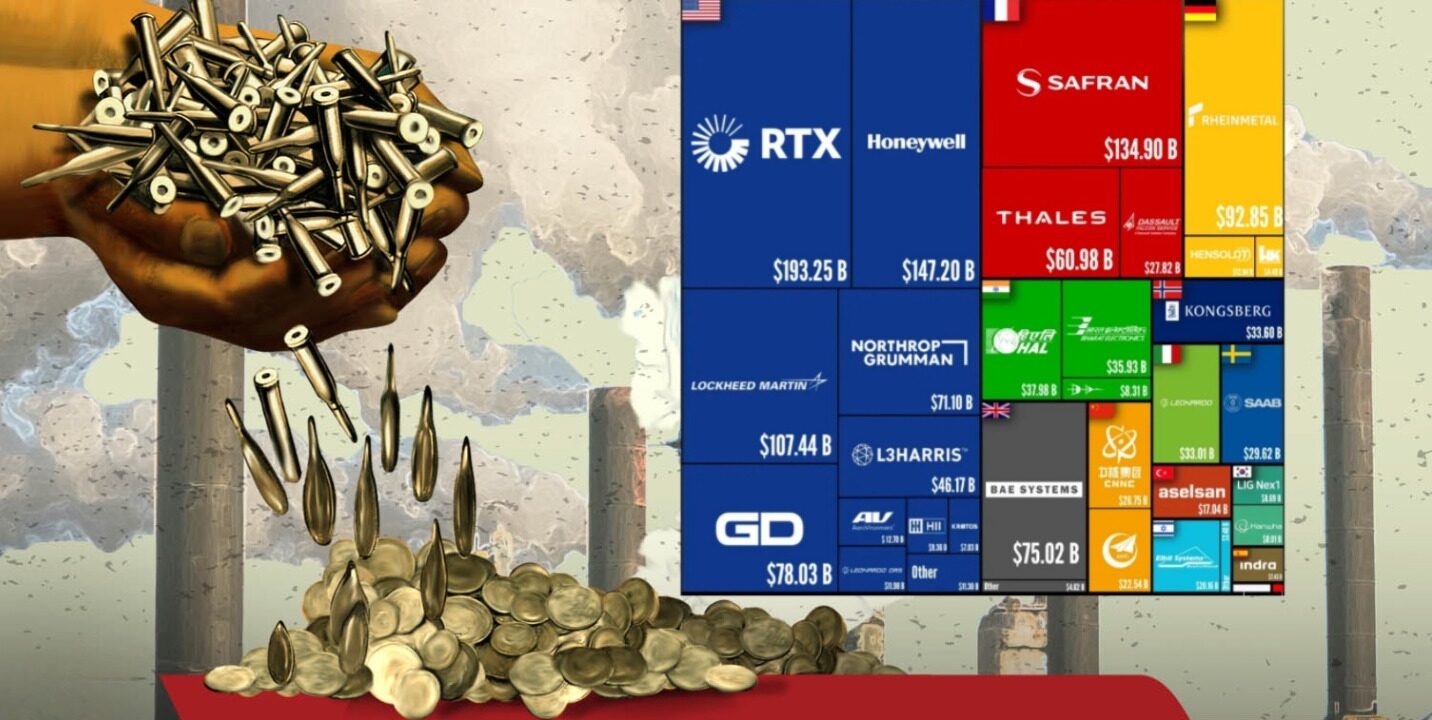
Now the market remains dominated by American behemoths. Lockheed Martin, RTX (formerly Raytheon), Northrop Grumman, Boeing, and General Dynamics occupy the top five global spots, a testament to the sheer scale of the Pentagon’s $997 billion military budget in 2024 which was 37% of total global military spending for that year and was a 5.7% increase from the previous year. As a senior Pentagon official once remarked to a congressional committee, “The defence industrial base is a unique, critical component of our national power.” The unspoken subtext: the increasing growth of arms industry is non-negotiable, irrespective of which wars or proxy wars are required to sustain it. In fact, stoppage of war is an indirect war against US economy.
This state-arms merchant symbiosis is replicated among other imperialist countries as well. In Britain, the government operates as a full-service concierge for its champion, BAE Systems, a British multinational defence, aerospace, and security company headquartered in London. Its arms revenue climbed to $29.8 billion while its pretax profit in the six months ended 30 June 2025 rose 2.2% to £1.19 billion from £1.16 billion a year prior.
An analysis of Whitehall meetings (meetings of UK government departments located on Whitehall Street in London) reveals ministers and senior mandarins regularly meet with arms lobbyists, on average, 1.64 times a day over a recent ten-year period. The revolving door spins with snowballing regularity: 40% of senior Ministry of Defence personnel exit into the arms and security sector.
This creates a policymaking environment where the interests of the ruling monopolists and the corporates become indistinguishable, and often indistinguishable from surging corruption. The quashing of a Serious Fraud Office investigation into BAE Systems Saudi deals remains a stark monument to this impunity. In 2010, BAE Systems pleaded guilty in a United States court to charges of false accounting and making misleading statements in connection with arms sales. An investigation by the British Serious Fraud Office into the deal was discontinued under political pressure from the Saudi and British governments. In other words, arms deals are not free from corruption aided and abated by the imperialist-capitalist rulers and their cohorts. Indian bourgeois governments have been partner to such corrupt arms deals like Bofors, Coffin, Rafael and such others.
New frontiers of this arms economy in Asia
China, a formidable imperialist power after counter-revolution, is now a clear second to the US in terms of total revenue earned from arms industry. It operates a state-controlled model of private-public partnership. Chinese arms industry is dominated by large state-owned enterprises (SOEs) such as Norinco Group, the Aviation Industry Corporation of China (AVIC), and China State Shipbuilding Corporation (CSSC). Some smaller arms companies are involved in the manufacturing of components and materials for defence.
India, another imperialist power also is emerging as a powerhouse, with its defence budget swelling to over $74 billion. Major private Indian arms companies include Tata Advanced Systems Limited (TASL), Larsen & Toubro (L&T), Mahindra Defence Systems, Bharat Forge (part of the Kalyani Group), and Paras Defence and Space Technologies. Some of them also have joint ventures with US defence giants like Lockheed Martin, Shield AI, General Atomics, Boeing, Skydio, and AM General. Companies like Hindustan Aeronautics Limited (HAL) and Bharat Electronics Limited (BEL), the state-owned enterprises are poised for exponential growth, buoyed by rising arms exports and government’s stress on domestic manufacturing of armaments.
An Indian defence ministry official recently boasted that the country’s iDEX scheme, fostering innovation in AI and cyber warfare, would “leapfrog our private defence sector into a new technological era.” The language is of innovation and sovereignty, but the outcome is the same: the further financialization of warfare.
The executives of giant global arms companies notably speak in the bloodless vernacular of corporate strategy. “The elevated threat environment,” a Lockheed Martin representative told analysts, “is driving increased demand for our integrated deterrence portfolio.” An RTX statement pointed to “strong growth across our space and missile product lines due to heightened global tensions”. This euphemistic lexicon—where “threat environments” mean propensity of wars and “demand” denotes increasing holocaust and genocide—is purported to insulate the war-mongers who place orders for lethal weapons.
The opportunity cost (the value of the next-best alternative that you give up when you make a choice like the opportunity cost of going to college includes the wages you could have earned by working full-time instead of studying) of this engineered violence is perhaps the most profound moral indictment. The United Nations calculates that just 3% of global military spending could fund universal primary and secondary education. The cost of a single F-35 stealth fighter jet, at roughly $80 million, is equivalent to the annual education budget for 2,00,000 children. Indian government signed a defence deal worth Rs 63,000 crores with France-based Rafael company for procuring 26 planes whereas it feels constricted to provide Rs 86,000 crores for a year’s Rural Employment Guarantee Scheme to the abjectly poor. Yet, this calculus holds no sway in a system where political power is fortified by campaign contributions from defence contractors and where national prestige is measured in megatonnage and arms export licenses.
The machinery is self-perpetuating. The United Nations Security Council, tasked with curbing conflict, is held hostage by the veto power of its permanent members—the very states that are the largest arms producers. Their diplomatic manoeuvres are often less about peace and more about managing conflict to avoid damaging valuable commercial relationships.
But why is this craze for arms manufacturing? Why the imperialist superpowers cannot live without orchestrating or fuelling wars? Why are they more inclined towards the bloody balance sheet of profit maximization from arms industries while the people at large are more and more consigned to a ruinous life filled with war tensions, fratricidal bloodbath, hunger, starvation, famines, joblessness, lack of minimal education and healthcare? It demonstrates that the world has perfected the economics of death while remaining woefully inadequate at financing peace. Why so? Because, with deepening of capitalist crisis, as pointed out by Comrade Shibdas Ghosh, Founder General Secretary of the SUCI(C) and an outstanding Marxist thinker of the era, all capitalist countries, advanced or backward, are trying to survive through militarization of economy. In his language: “…the imperialists … trying to offset the difficulties by having recourse to frantic rearmament and militarization of industry …” “since a market boom cannot be sustained due to crisis, attempts are being made to stimulate it artificially. This means, that the government itself turns up in the market as the buyer with the money from the government budget funded by the people’s money. But what will the government buy? To what use can those things come? So, they increase the military strength and trigger off war here and there. They go on producing armaments, increasing military strength and building up defence industries. This very act of militarization of economy, fully dovetailing the productive system with military production – this is what we call militarization of industry …militarism is aggravating the capitalist contradictions and crisis further still. And the more acute the crisis, the more militarized is becoming the economy. There is thus a vicious cycle going on, leading to an unbridled arms race.” (SW Vol II p 45-46 and Vol IV p563-64)
So increased militarization of economy and then the necessity of disposing off the stockpile of arms, are prompting the imperialists to generate war. More the wars, more is the demand for arms and concomitant boost of defence industries. This is the root cause.