
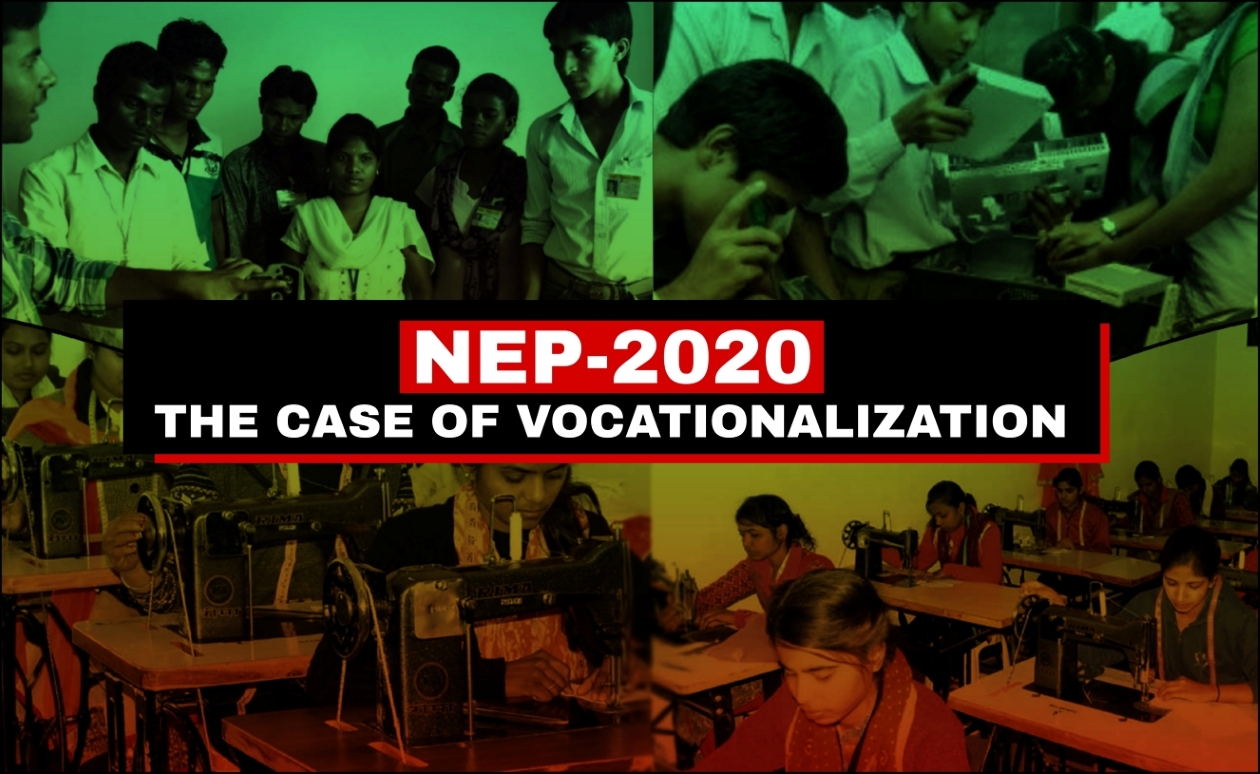
In the last issue of P Era, we dealt with the scenario of virtual ruination of school education in the government and government aided schools through hurried and drastic implementation of National Education Policy 2020 (NEP 2020) by the BJP-led Union government. In this issue we shall deal with the issue of vocational education, also a prescript of NEP 20.
One of the most startling things set for school education is the introduction of vocational education from class six. What is vocational education? According to the National Curriculum Framework for Foundational Stage (NCFFS): “In the Foundational Preparatory Stages, and multiple capacities will be developed through play and other activities, which will be subsequently useful in vocations. These capacities will be called prevocational capacities. In the Middle Stage, exposure to a wide range of work will be given to students. This will equip them to achieve skills in a vocation of their choice in the Secondary Stage and help them progress into gainful employment.” [pp 425]. Also, “ Students will have to go for “relevant internships” in “poultry, dairy farms, pest control units, nursery, local workshops, workplaces, tailoring mechanic carpentry units, hotels, restaurant, hospitals, gyms, old age homes, beauty salons, etc.” [pp 432] In other words, emphasis will be on making the students ‘fit for job’ rather than acquainting them with the treasure of knowledge enshrined in the pages of books of different disciplines.
But the question arises why is this so called ‘job oriented education’ introduced from the early stage? The government argues that so long the students were getting degree but not acquiring job oriented skills. Hence they remained unemployed. Is it at all true?
Striking Reality of the Job Market
Are the youths unemployed because of lack of job-oriented skills? Then why are lakhs of students passing out from ITI, CTI, degree and diploma engineering colleges and other professional courses jobless. Unemployment rate among engineering graduates in India, is as high as 48% to 83%.). A survey by ‘Unstop’ (a well-known NGO) found that even 50% MBA degree holders are unemployed. Examples are many. The ‘vocationalized’’ students will end up being ‘self-dependent’ as per the opinion of the government and if job remains elusive, they will make a career in ‘self-employment’ and the government would be able to shirk off its responsibility of providing jobs, which, as per its version, is attributed to factors like market saturation and over supply of graduates. (NASSCOM report)
Employment scenario in India is indeed grim but not becauseof absence of job skills. In this decadent moribund capitalist system, buying power of the people at large is dipping entailing fall in demand and concomitant squeezing of market. So, labour intensive industries are closing down one after another throwing crores of people out of job. Only capital intensive industries with very limited manpower are in operation. Again, due to the impact of automation and A.I., the unemployment problem is further aggravated. Every Government starting from the Centre to the states has declared virtual moratorium on recruitment and increasingly resorting to contractualization of labour. Are there lakhs of posts lying vacant in every government sector because of absence of skilled employees? Then why is the government clamouring for vocational education? Is there any guarantee that students who are getting vocational education will get a job?
In this context let us quote from NEP 2020: “By 2025, at least 50% of learners through the school and higher education system shall have exposure to vocational education,… Vocational education will be integrated in the educational offerings of all secondary schools in a phased manner over the next decade…”. (NEP-20, Article 16.4). Surely the government is not eager to introduce vocational education from such an early stage out of concern for lowering mounting unemployment. Then what is the object?
Role of Education in Human Life
Government’s objective is to strip education from its essence. Is it that the role of education in human’s life is only of an enabler to get job? No, not at all. What is education? From the dawn of civilization, human experience and knowledge have continuously grown through struggles of man against Nature and through the conflicts and contradictions within society. It is the abstraction of this accumulated human experience that is conveyed through books and other media within the educational structure. The social necessity which acted behind the evolution of idea of education is that the individuals should assimilate the abstraction of this past human experience and by applying this knowledge in practice gain newer experience to be handed down to the next generations and thereby add to the repository of human knowledge. This is how education ought to illumine the path of social progress. Real education equips man to find truth, to study and know material world; it imparts in him the ability to understand the contradictions in his environment, both natural and social, and to comprehend his role in these contradictions.
So, the purpose of education is to impart ethics, human values and social consciousness to the students so that they will become a harmoniously developed responsible citizen with developed thinking as well as developed humane faculty. In fact, education is a tool for man making and character building. And only a comprehensive secular, scientific and democratic education system can fulfil that objective. Long back seeing the educational curriculum of the USA, a celebrity like Einstein opined: “It is not enough to teach a man a speciality. Through it, he may become a kind of useful machine, but not a harmoniously developed personality. It is essential that the student acquire an understanding of and a lively feeling for values. He must acquire a vivid sense of the beautiful and of the morally good. Otherwise, he–with his specialized knowledge–more closely resembles a well-trained dog than a harmoniously developed person”. (Ideas and Opinions 1954) Rabindranath held that purpose of education is to create a ‘whole man’. May be the formulators of NEP 20 consider themselves wiser than legendary personalities.
There is another danger. Vocational education will impart technical aspects of a job, not the epistemological part of learning. So, a student instead of acquiring a rational bent of mind would only emerge with a mechanical mindset devoid of scientific temperament. Since from early school life, the students will be deprived of comprehensive basic education covering every aspect of life and nature, they will end up developing job-specific expertise like a robot. Such robotized mind would never raise question about any injustice and illegitimacy of anything but blindly obey orders to eke out a livelihood.
Resist Vocationalisation of Education
But what will be the fate of carpenters, electricians, metal workers etc., produced by vocational education when cottage and small scale industries which are almost on the verge of closure due to the pressure of monopoly and corporate industries. ‘Vocationalized’ students would at best sell their skill as cheap labour.
It is to be understood that nobody rejects necessity of vocational education outrightly. Diploma courses in polytechnics, ITIs, CTIs, and other vocational and professional courses which could be pursued only after a certain level of school education, (say secondary) after independence, as it was necessary for the industrialization which was taking place in the country. Now as the industrial scenario is so bleak, over-emphasis on vocationalization is to shield the fact that vocational education itself does not ipso facto generates employment. Vocational education must grow hand in hand after school education with proper opening for being absorbed as skilled hands. Otherwise, it is a deception. That is what we have sought to explain in this article. Any sensible person should oppose and raise their voice of protest against this heinous design to ruin school education.


