
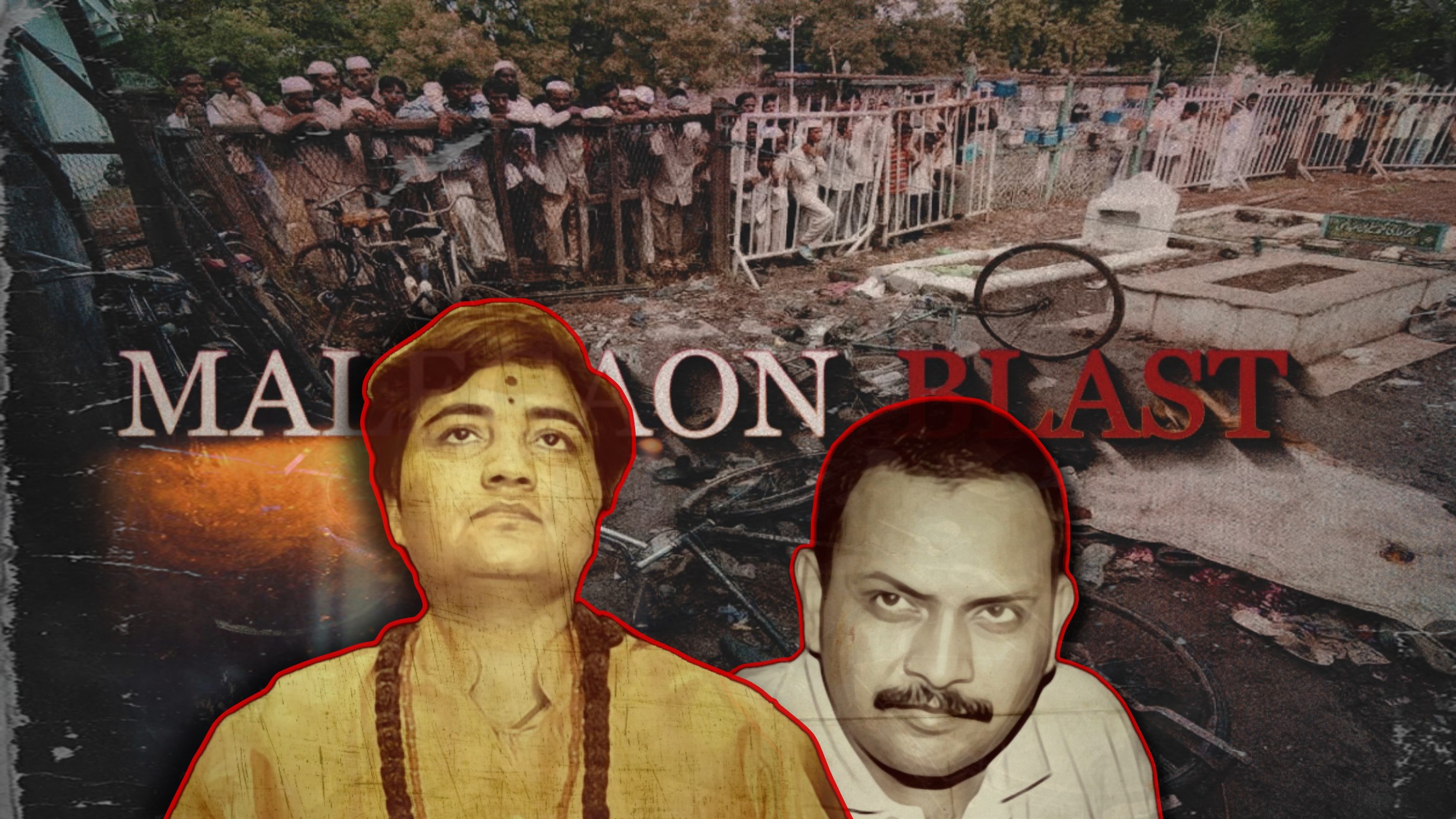
The acquittal of all seven accused in the 2008 Malegaon blast case, including Sadhvi Pragnya Singh Thakur and Lt. Col. Prasad Shrikant Purohit, did not come as a complete surprise to those who kept a close track of the proceedings of this case. The investigations and the trials saw many twists and turns from the very beginning.
Recalling the background
It may be recalled that in September 2008, when the month of Ramzan coincided with Navaratri, a bomb went off at Bhikku Chowk in Malegaon, Maharashtra. The Anti-Terrorist Squad (ATS) claimed that the improvised explosive device (IED) had been planted on an LML Freedom motorcycle during the time of namaz to cause communal tension. In all, six persons including a 10-year-old girl, Farheen, and a 19-year-old youth, Azhar, were killed and as many as 101 individuals suffered injuries. The Maharashtra ATS, acting hand-in-glove with the local police, promptly arrested nine Muslim men from Malegaon and Mumbai under MCOCA (Maharashtra Control of Organized Crime Act), alleging that they had links with a banned organization like SIMI and had committed the crime. Immediately, they were sent to jail custody. This Malegaon blast was followed by a series of incidents of planted explosions—one in the Pakistan-bound Samjhauta Express train at Panipat in February 2007, at Mecca Masjid in Hyderabad in May 2007, and at the Ajmer Dargah in October 2007. Everywhere there were heavy casualties, mostly from the minority community. A common pattern noticed in all the cases indicated that it might all be the handiwork of one particular group or outfit.
It is pertinent to note that a year before the Malegaon blasts, explosives were found at the homes of members of Hindu extremist groups in different parts of Maharashtra. In Nanded, two Bajrang Dal workers had died while assembling explosives. Some mysterious blasts had taken place in Parbhani, Purna, and Jalna, and there were murmurs that perhaps Hindutva activists were preparing for an action. But a decisive breakthrough did not come before late 2008, when, while chasing some clues on the Malegaon blasts, the Maharashtra ATS hit upon Sadhvi Pragnya Singh Thakur, an RSS leader; Sameer Kulkarni, a member of Abhinav Bharat, a Sangh Parivar affiliate; and Lt. Col. Shrikant Prasad Purohit, a serving army officer with Hindutva leanings. In 2009, the ATS filed a 4,528-page charge sheet that included extensive details of the real conspirators and of the planning and execution of the Malegaon blasts. Purohit was suspected to have provided the RDX for the bombs. On 8 January 2011, Swami Aseemanand, another Hindutva personality who had reportedly played a huge role in the 1998 attacks on Christians in southeastern Gujarat, was also arrested by the CBI from Haridwar as prime suspect of the Samjhauta Express blast. Aseemanand made a stunning 42-page confession wherein he admitted to having planned terror attacks in Ajmer Sharif, Mecca Masjid, Malegaon, and the Samjhauta Express. He further revealed that he, himself an RSS leader, along with other senior RSS and Hindutva leaders including Sadhvi Pragnya Singh Thakur, chalked out plans for orchestrating serial bomb attacks on Muslim religious places. Astonishingly, when the case was transferred to the NIA in 2011, the agency chose to reinvestigate rather than proceed with the already-filed charge sheet. Incidentally, as mentioned earlier, Maharashtra ATS led by Hemant Karkare, who was martyred in the 2008 Mumbai terror attacks, initially conducted the investigation and exposed the involvement of Sadhvi Pragnya, Colonel Purohit, Major Ramesh Upadhyay, and others in the Malegaon blasts. But before the investigation could proceed further, he was killed. Questions arose as to who gave him a substandard bulletproof jacket instead of his own one during the raid on the terrorists during Mumbai attack.
Changed direction of the investigation after BJP came to power
After the BJP, which had been crying foul since the day Hindutva activists were accused of the serial blasts and arrested, came to power in 2014, a changed direction of the investigation was noticed. Rohini Salian, Special Public Prosecutor, made these allegations openly before journalists. She further alleged that what began as a solid investigation by the Maharashtra ATS gradually fell apart, not because of weak evidence but due to an alleged collapse of institutional and political integrity. She elaborated by highlighting that the ATS had filed its charge sheet within 90 days, meeting the legal deadline to avoid bail for the accused. But ever since the BJP came to power, senior officials of the NIA began to pressure her to “go soft” on the accused. She refused to compromise and recused herself from the case. In 2016, the NIA filed a supplementary charge sheet criticizing the ATS probe, even while saying there was sufficient evidence to proceed against six of the accused. The NIA’s charge sheet stated clearly that it had not been able to collect any additional evidence from the scene of crime, blaming the time-lag in the transfer of the case. The NIA charge sheet did not include any new witnesses, but instead re-recorded statements of some witnesses who had given statements before the magistrate in 2008–09, who then denied their previous statements.
And then the inevitability happened: the NIA virtually gave Sadhvi Pragnya a clean chit, claiming that “sufficient evidence has not been found” against her. The ATS held that the LML motorcycle owned by Pragnya was used for the explosion.
The NIA’s decision to drop Thakur from the case eventually led to her release on bail from the Bombay High Court. But opposition by one of the victim’s families helped ensure she was not discharged from the case. The then special court judge S. D. Tekale, who denied the NIA’s application to discharge Thakur from the case, was eventually transferred. Even after the ATS filed its charge sheet within 90 days, the trial began only in 2018, after a long 10-year delay, examining 323 witnesses in all. Particularly, Pragya Thakur appeared only 34 times out of the 1,087 court hearings, with almost no objections raised by the NIA for her absence from the court.
Prolonged juridical process with frequent change of judges
In all, five judges have handled this case. The question of why there were so many transfers connected to this case doesn’t need to be answered. In his verdict, one of the judges stated that it was proven that the explosion was carried out with the intent to kill people. He even awarded a token compensation to the families of the dead and injured.
The investigation and subsequent legal proceedings were plagued by irregularities and procedural errors. Several reports pointed out flawed handling of evidence and lack of proper safeguards. Rohini Salian, while speaking to the press, alleged that “it was known that this would happen, and it was well expected if the true evidences were not laid out.” She said that she had presented plenty of evidence and the Supreme Court had upheld it all. She wondered how statements of thirteen key witnesses, which showed connection of the accused to conspiracy meetings, went missing, leaving the court with little solid evidence. Without those original statements, the prosecution struggled. The court refused to accept photocopies over authenticity concerns and attempts to find or replace the missing documents failed. Witnesses changed their stories or turned hostile, and claims from both sides could not be backed up. In the end, as the judge put it, the prosecution failed to prove its case beyond reasonable doubt, also referring to the recent acquittal of all 12 individuals by the Bombay High Court in the 2006 Mumbai train blasts case. Does it look anything less than a clear sabotage of the case?
In this context, it is worth recalling that the same was the fate of the Samjhauta Express and Mecca Masjid blast cases, where investigative agencies like the CBI, NIA, and STF failed to present any evidence, resulting in the acquittal of all accused—all of whom had links with RSS-BJP-Sangh Parivar. In the Mecca Masjid case, Judge Ravindra Reddy resigned in anger and grief after acquitting all accused due to lack of evidence.
Amit Shah said that a Hindu cannot be a terrorist
What is revealing of the covert handplay of the BJP government is what Union Home Minister Amit Shah said in Parliament: “A Hindu can never be a terrorist.” Although the judge, while delivering the Malegaon verdict, said that it is not appropriate to link any religion with terrorism, did not the Home Minister, by mentioning only the word “Hindu,” indirectly imply that people of other religions could only be terrorists? Incidentally, the BJP government has taken no step against BJP minister Vijay Shah of Madhya Pradesh who branded Colonel Sophia Qureshi, who was seen on TV to narrate India’s point of view on the 4-day Indo-Pak war after the Pahalgam killing, as “sister of the terrorists,” obviously pointing at her belonging to the Muslim community. Pertinent to point out that Amit Shah had not made any comment when the Bombay High Court recently acquitted 12 Muslim persons in the Mumbai local train blast case, stating that innocent people had been framed, thus overruling the lower court’s sentencing of five to death and seven to life imprisonment. These innocent Indians had already spent 18 years in jail. But then how can Amit Shah or other saffronized leaders disobey their ideologue M. S Golwalkar, who in his Bunch of Thoughts, mentioned that “…there was riot in Malegoan (1963) in Maharashtra. The idol of Ganesha was being taken in a procession for immersion. The Muslims attacked it. There was a skirmish. The Government (then of the Congress—Ed. P Era) … took into custody scores of leading Hindu gentlemen as though they were responsible for the outbreak of lawlessness.” Since then Malegaon was their target. So, perhaps a need was felt by the RSS-BJP-Sangh Parivar to undertake a retaliatory action.
Moreover, what would one call the hoodlums who demolished Babri Masjid? Saints? Similarly, were not those who killed Graham Stains terrorists? During the investigation, it came to light that a gang of like-minded people was involved in the killings of Narendra Dabholkar, Gauri Lankesh, Govind Pansare and M. M. Kalburgi—the rationalists who had links with the Sanatan Sanstha and its offshoot Hindu Jan Jagruti Samiti. During the interrogation, one of the arrested persons, Sharad Kalaskar, admitted his involvement in Dabholkar’s killing, police had said. Sharad Kalaskar and Sachin Andure allegedly shot dead Narendra Dabholkar with two pistols in Pune. The CBI, who arrested Virendrasing Tawade, confirmed that during investigation, he was proved to be the alleged ‘mastermind’ of all these killings. Bharat Kurne, Sujeet Kumar and one Praveen were wanted in connection with Kalburgi’s killing. During the Karnataka SIT’s investigation, it came to light that Kumar allegedly shot Kalburgi. What explanation or subterfuge Amit Shahji would provide for these lethal terror attacks?
That is, the blast happened, sabotage and murder happened — but there was no one who did it! So, terrorism is not the cup of tea for the RSS-BJP-Sangh Parivar. Their sole objective is to use the bogey of terrorism for precipitating religious division and pursuing communal politics.
Stating that Hindus are not terrorists or attributing terrorism to only the Muslims is but aimed at fuelling crass communal Hindutva. So, they have, as it appears, pulled the strings from behind, hushed up evidences with the help of pliant police-administration, purchased some of the witnesses with money or gave threat and managed to get those who killed innocent people in Malegaon, Hyderabad, and the Samjhauta Express come out with acquittal.
Let it be clear that terrorists are terrorists—they have no race, ethnicity or religion. They are mostly sponsored by ruling imperialism-capitalism to scare suffering millions through precipitation of mindless violence, create bad blood among communities, thwart crystallization of united movement of the toiling masses against ruthless oppression and repression. The real weapon to fight terrorism, whether it is by arch communal Hindu fundamentalist groups or motivated Islamic fundamentalist groups, lies in developing and accentuating the people’s movement under correct revolutionary leadership on the edifice of higher cultural values and ethics.