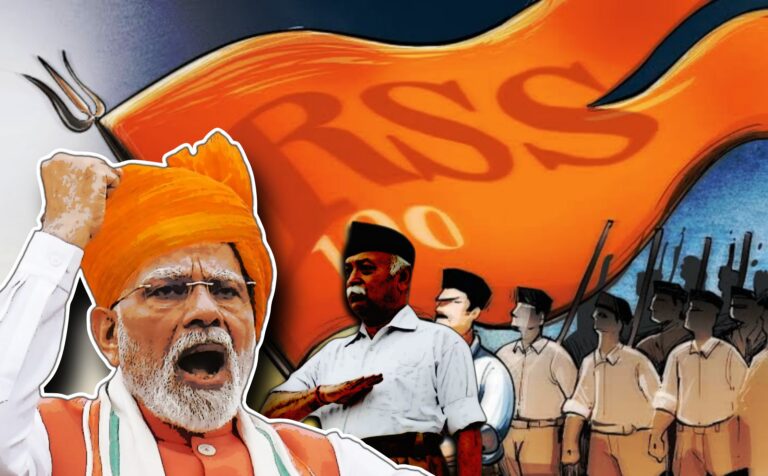
While addressing the nation from the rampart of Red Fort on 15 August last, PM Modi, inter alia, said that “…with great pride, I wish to mention one …institution. …the Rashtriya Swayamsevak Sangh …founded… With the resolve of nation-building, the swayamsevaks have, for a century, dedicated their lives to the welfare of the motherland. …the Rashtriya Swayamsevak Sangh is the world’s largest NGO, with a century-long history of devotion. …I salute all the swayamsevaks who have contributed to this century-long journey of national service, and the nation takes pride in this grand and dedicated journey of the Rashtriya Swayamsevak Sangh, which will continue to inspire us.” Then he reminded all that this year is “…the 125th birth anniversary of Dr. Syama Prasad Mukherjee. …the first great personality of the nation to sacrifice his life for the Constitution of Bharat… the removal of the wall of Article 370, and the realization of the mantra of ‘One Nation, One Constitution’.” Few days back, the National Council of Educational Research and Training (NCERT) has released a special module on the Partition, blaming Mohammad Ali Jinnah, Congress and Lord Mountbatten for the division of the nation. A poster with photo of Savarkar placed above Gandhiji, Netaji Subhas and Bhagat Singh is in circulation in the social media in connection with observance of Independence Day.
Four Issues
So, there are four issues. PM Modi has raised two. One, lauding the part played by the RSS in nation building, and the other praising the role of Syama Prasad Mukherjee as a personality of the nation. The third one is about partition of the country that the NCERT has raised obviously under the instruction of the RSS-BJP. And the fourth, ranking V D Savarkar, the founder of Hindu Mahasabha, and the first proponent of the two nation theory based on religion, not just pari passu with Netaji Subhas, Bhagat Singh and Gandhiji but above them. But as we have said earlier also on more than one occasions, neither of these claims is affirmed by authentic history, rather, corroborates just the reverse. Let us take up the issues one by one.
RSS—Hindu Mahasabha called freedom movement reactionary
PM Modi also said that “Countless people sacrificed their lives for freedom, they dedicated their entire youth, spent their lives in prisons, and embraced the gallows, not for personal gains but for the honour of Maa Bharati, for the freedom of crores of people, to break the chains of slavery, and with one emotion in their hearts—Dignity…., why? For an independent Bharat.” That means he recognizes the glory of Indian freedom struggle and also, by declaring entrance into Amritkal on 75th anniversary of independence, he acknowledged that India did achieve freedom on 15th August 1947. He also mentioned that “all the swayamsevaks who have contributed to this century-long journey of national service…” He himself was also a Swayamsevak.
First of all, both the RSS and Hindu Mahasabha (predecessor of the BJP) were founded at a time when the country was in ferment of nationalist movement against the British imperialist rulers. But the ideologues of the RSS-Hindu Mahasabha never supported Indian freedom struggle. As students of history and political economy know, a nation is a historically constituted, stable community of people in a particular geographical territory, formed on the basis of the common possession of four principal characteristics, namely: a common language, a common territory, a common economic life, and a common psychological make-up manifested in common specific features of national culture. Nation is a historical category belonging to the definite epoch of rising capitalism. No nation existed before advent of capitalism. Nationalism as an ideological creed is based on emergence of modern nations.
But M. S. Golwalkar, the RSS ideologue, opposed this historical view. According to him: “The theories of territorial nationalism and of common danger, which formed the basis for our concept of nation, had deprived us of the positive and inspiring content of our real Hindu Nationhood and made many of the ‘freedom movements’ virtually anti-British movements. Anti-Britishism was equated with patriotism and nationalism. This reactionary view has had disastrous effects upon the entire course of the freedom struggle, its leaders and the common people…Those only are nationalist patriots, who with the aspiration to glorify the Hindu race and Nation next to their heart, are prompted into activity and strive to achieve that goal. All others are either traitors and enemies to the National cause.” (We or Our Nationhood Defined) K. B. Hedgewar, the founder member of RSS, ridiculed the freedom fighters who were jailed by the British rulers, in the following language: “Patriotism is not only going to prison. It is not correct to be carried away by such superficial patriotism.” (CP Bhishikar, Sanghavariksh Ke Beej: Dr. Keshavrao Hedgewar, Suruchi, 1994, p. 21) So, according to the founders of the RSS, anti-British freedom movement was not spurred by “nationalism” or “patriotism.” All revered national leaders and martyrs starting from Netaji Subhas, Deshbandhu Chittaranjan, Bal Gangadhar Tilak, Lala Lajpat Rai, Kshudiram, Bhagat Singh, Surya Sen and even Gandhiji as well as the flowering youths who faced bullets, embraced gallows and spurned so-called comfort and security of conventional life to free their motherland, were all traitors and superficial martyrs? Ludicrousness par excellence! Fact is that in British India, due to definite socio-historic reasons, different communities speaking different languages and possessing different psychological mental makeup were in existence. Moreover, since the aspirant Indian national bourgeoisie had in the main provided leadership to the freedom movement by backing the dominant compromising political trend, it in its class interest, sought to mingle Hindu religious thoughts in that movement. So, ours had been a Hindu religion-oriented freedom movement which the RSS-BJP are taking advantage of today to advocate for Hindu Rashtra.
RSS-Hindu Sabha did not participate in the freedom struggle
Also fact is that the RSS and Hindu Mahasabha not only opposed the freedom movement but declared their support and allegiance to the Britishers. They opposed the ‘Quit India Movement’ of 1942. The RSS did not participate in the Non-cooperation movement, civil disobedience movement as well as ‘Quit India’ movement of 1942 as they did not see the movement as aligned with their objectives. So did Hindu Mahasabha. Golwalkar also wanted the Indians to respect the draconian and repressive laws of the inhuman British rulers! According to one report of the British Intelligence, “The Sangh has scrupulously kept itself within the law, and in particular, has refrained from taking part in the disturbances that broke out in August 1942” (Cited in Andersen, Walter K & Damle, Shridhar D “The Brotherhood in Saffron: the Rashtriya Swayamsevak Sangh and Hindu Revivalism”, Westview Press, 1987, p. 44). Curiously, Golwalkar admitted that this kind of negative attitude towards the Quit India Movement did not go well even with the RSS cadres. (MS Golwalkar, “Shri Guruji Samagra Darshan” Collected Works of Golwalkar in Hindi, Vol IV, Bhartiya Vichar Sadhna, Nagpur, p. 40.)
Responsive Cooperation with the British rulers
On the other hand, addressing the 24th session of the Hindu Mahasabha in Kanpur in 1942, V. D. Savarkar outlined the strategy of the Hindu Mahasabha of co-operating with the rulers in the following words: “The Hindu Mahasabha holds that the leading principle of all practical politics is the policy of Responsive Co-operation. And in virtue of it, it believes that all those Hindu Sangathanists who are working as councilors, ministers, legislators and conducting any municipal or any public bodies with a view to utilize those centres of government power to safeguard and even promote the legitimate interests of the Hindus without, of course, encroaching on the legitimate interests of others are rendering a highly patriotic service to our nation….The policy of ‘responsive cooperation’ which covers the whole gamut of patriotic activities from unconditional co-operation right up to active and even armed resistance, will also keep adapting itself to the exigencies of the time, resources at our disposal and dictates of our national interest.” (Cited in VD Savarkar, “Samagra Savarkar Wangmaya: Hindu Rashtra Darshan”, vol 6, Maharashtra Prantik Hindu Sabha, Poona, 1963, p. 474.)
The ‘Responsive Cooperation’ with the British masters was not only a theoretical commitment. The Hindu Mahasabha soon got concretized by ganging up with the Muslim League with whom they ran coalition governments in Bengal, Sind, and the North West Frontier Province (NWFP) in 1942. Moreover, when Netaji Subhas was trying to achieve freedom by moving his Indian National Army (INA), Savarkar, as is evident from the documents, was issuing circulars for the militarization of Hindus. “This was clearly to help the British against the advances of Subhas Chandra Bose’s Indian National Army,” he said. (The Week-24-01-16)
Despicable role of Syama Prasad Mukherjee
PM Modi eulogized Dr Syama Prasad Mukherjee to the core. But, the same Dr Mukherjee, as Deputy CM in the Bengal coalition government, assured the British masters through a letter dated 26 July 1942: “Let me now refer to the situation that may be created in the province as a result of any widespread movement launched by the Congress. Anybody, who during the war, plans to stir up mass feeling, resulting internal disturbances or insecurity, must be resisted by any Government that may function for the time being.” (Mukherjee, Syama Prasad, “Leaves from a Diary”, Oxford University Press, p. 179.) Syama Prasad also advised the British governor of Bengal item-wise the steps to be taken for dealing with the situation. “The question is how to combat this movement (Quit India) in Bengal? The administration of the province should be carried on in such a manner that in spite of the best efforts of the Congress, this movement will fail to take root in the province…It should be possible for us, especially responsible Ministers, to be able to tell the public that the freedom for which the Congress has started the movement, already belongs to the representatives of the people. In some spheres it might be limited during the emergency. Indians have to trust the British, not for the sake for Britain, not for any advantage that the British might gain, but for the maintenance of the defence and freedom of the province itself.” (Cited in A. G. Noorani, “The RSS and the BJP: A Division of Labour”, Left Word Books, p. 56–57) Hindu Mahasabha also boycotted the celebration of gaining independence on August 1947.
Two-nation theory and partition of India
Now we come to the third question—division of the country based on religion. We have already explained above the genesis of emergence of nation based on scientific theory of history. But the RSS-Hindu Mahasabha, as shown above, negate this historical truth of formation of a nation. As Golwalkar had said: “We must revert nationalism as an ancient fact and the Hindus being the national society of Bharat”. What he meant was that nationalism is an ancient concept and that there was a national society of the Hindus in Bharat (meaning Bharat during the time of the sages and seers). Incredible indeed! Has there been a single nation which is based solely on religion? If that were the case, there would have been one nation in Europe based on Christianity, one nation in Arabia based on Islam, or a singular nation in the entire continent of America. So, it is an utter falsification of history that the concept of nation was there in Bharat even in antiquity.
Now where did this concept of Hindu nationhood sprout from? It was Savarkar who, in his 1923 book Essentials of Hindutva, written under the pseudonym A Maratha, provided an outline of Hindutva or Hindu nationalism. Later, while addressing the 19th session of the Mahasabha in Ahmedabad in 1937, he declared: “There are two antagonistic nations living side by side in India. Several infantile politicians commit the serious mistake in supposing that India is already welded into a harmonious nation, or that it could be welded thus for the mere wish to do so…. India cannot be assumed today to be a unitarian and homogeneous nation. On the contrary, there are two nations in the main: the Hindus and the Muslims, in India.”
Thus, the theory of two nations, first proposed in Essentials of Hindutva, was passed as a resolution of the Hindu Mahasabha in 1937. After a meeting with Savarkar in Bombay on 9 October 1939, Lord Linlithgow, the then viceroy of India, in his report to Lord Zetland, the then Secretary of State for India, wrote that “The situation, he [Savarkar] said, was that His Majesty’s government must now turn to the Hindus and work with their support… Our interests were now the same and we must therefore work together… Our interests are so closely bound together, the essential thing is for Hinduism and Great Britain to be friends, and the old antagonism was no longer necessary.” Three years later, the All-India Muslim League led by Jinnah adopted the concept in its Lahore session. On 15 August 1943, Savarkar said in Nagpur, “I have no quarrel with Mr. Jinnah’s two-nation theory. We, Hindus, are a nation by ourselves and it is a historical fact that Hindus and Muslims are two nations.” Thus, Savarkar justified Hindu communalism as righteous and Hindu separatism as nationalist and supported the two-nation theory based on which the country was divided. Golwalkar endorsed the view of the Hindu Mahasabha of transforming India as “Hindu Rashtra” (Hindu theocratic state): “The Hindus are a nation or nationality by themselves… No sane man can question the proposition that Hindus are a nation… Our ‘Nation’ means, and independently of the question of majority always must mean, the Hindu Nation and nothing else.” (We or Our Nationhood Defined).
Patriotism (!) of Savarkar
It warrants mention of the nature of the “patriotism–nationalism” of Savarkar, particularly in view of the attempt of a vested quarter to place him above Netaji, Bhagat Singh, or Gandhiji. While in Cellular Jail in Andaman for taking part in the freedom struggle, Savarkar found that endorsing the freedom movement would not beget his release. It was instead better to fall in line with the British imperialist rulers, profess a queer theory of Hindutva, and be a servitor of reactionary imperialists-capitalists. So, he began to send one after another mercy petition to the British government seeking clemency. He assured the British rulers that he was “the staunchest advocate of constitutional progress and loyalty to the English government which is the foremost condition of that progress” and his “conversion to the constitutional line would bring back all those misled young men of India and abroad who were once looking up to me as their guide. I am ready to serve the Government in any capacity they like, for as my conversion is conscientious so I hope my future conduct would be.” (From Penal Settlements in Andaman by R. C. Mazumdar, published by the Department of Culture, Government of India, 1974).
And on release, he said: “The war (Second World War) which has now reached our shores directly constitutes at once a danger and an opportunity which both render it imperative that the militarization movement must be intensified and every branch of the Hindu Mahasabha in every town and village must actively engage itself in rousing the Hindu people to join the army, navy, the aerial forces and the different war-craft manufactories…. Hindu Mahasabhaits must, therefore, rouse Hindus especially in the provinces of Bengal and Assam as effectively as possible to enter the military forces of all arms without losing a single minute.”(ibid p.460-61.)
And then, providing a gist of their Hindu Rashtra, Golwalkar observed: “The foreign races in Hindustan … must entertain no idea but those of the glorification of … the Hindu nation and must lose their separate existence… or may stay in the country, wholly subordinated to the Hindu Nation, claiming nothing… not even citizen’s rights.” (We or Our Nationhood Defined). He was not far from the Nazi supremo Hitler when he said: “To keep up with the purity of the race and its culture, Germany shocked the world by her purging the country… Race pride at its highest… a good lesson for us in Hindustan to learn and profit by.” Hedgewar, like Savarkar, remained subservient to the British and pronounced that “this Hindustan is a Hindu state. We would organize the Hindu state.” In view of this, what property do the RSS-BJP-Sangh Parivar have to arrogate to themselves the sole epitome of nationalism-patriotism, the proud observer of national independence, as well as blame others for partition of the country?
Final Words
So, the very utterances of PM Modi, his effusive praise of Syama Prasad, his pompous celebration of Independence Day, the distortion of history by NCERT, and equating Savarkar with the revered leaders of the Indian freedom struggle contain nothing but tricks to mislead and misguide people, concealing the real design. They are nothing but a continuity of the history of organizations which betrayed the nation right from their inception, which thrived upon falsehood, deception, hatred, even ferocious animosity towards their perceived enemy defined on religion. It warrants once again recalling the brilliant analysis of Comrade Shibdas Ghosh: “In the course of the political movement against imperialism, the Indian people speaking different languages and professing different religions became a nation politically but for failure on the part of the leadership of our national liberation movement to accomplish, in the main, the tasks of social and cultural revolutions for democratization of the society against feudalism, feudal disunity and religious bondage, the Indian people remained socially and culturally divided into different communities disunited by religion, caste, language, race, etc.… It is no wonder that in the circumstances the slogan of Hindu revivalism is finding a strong foothold now.” (On Communal Problems, SW Vol. II). It is for power and serving the bourgeois class design of keeping the oppressed people disunited, ignorant of facts, confined in the blind alley of religious revivalism, fanaticism, obscurantism, and bigotry that the RSS-BJP-Sangh Parivar are championing Hindutva, the idea of a Hindu nation, and spewing venom against Muslims as well as Christians. But history teaches us that one can sell weird stories to some people for some time, but cannot make informed minds gulp such trash.