
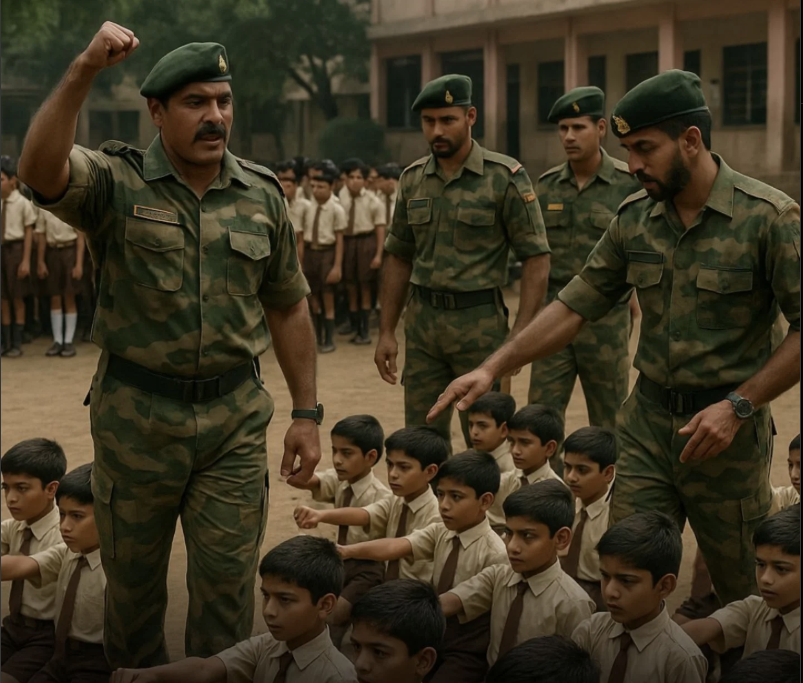
The BJP-led Maharashtra government has planned to introduce basic military training for children as young as six in the name of infusing patriotism, discipline and physical fitness among students. It is claimed that such training from Class I will enable the tiny children to receive structured training that includes physical exercises, basic drills, and lessons focused on national service and civic responsibility. The initiative, the Maharashtra government asserted, is intended to build leadership qualities, mental strength, and a sense of duty among children. The RSS has long been advocating “militarising Hindu society” to prepare it against imagined foes. The classroom, once a site for free thought, is now being co-opted into that ideological armoury.
Undoubtedly, in the aftermath of ‘Operation Sindoor’, this proposal will be able to gather enough eyeballs in the rest of the country and BJP-ruled states might implement similar schemes in education in no time. When the government education system is in the doldrums with abysmally poor infrastructure, acute shortages of teachers, non-availability of basic amenities like toilets, shrinking and even dilapidated classrooms, frequent change in syllabus, no detention policy, undervaluing examination system to objectively ascertain the development of the students, this move can further aggravate the crisis, as a portion of already scarce resources and time meant for studies would be devoted to this scheme.
Further, thousands of government schools have closed down during the past decade because of resource constraints as well as other policy changes—which has clearly led to violation of the Right to Education (RTE)—depriving children of proper education. The Annual Status of Education Report (ASER) has already presented a grim picture for Maharashtra, and this proposal seems to be an attempt to gloss over the basic malaise that afflicts school education. Evidently, this decision to roll out military-style drills for Class 1 students, backed by a force of 2,50,000 ex-servicemen, has entered India’s public discourse not with a bang, but a muffled shrug. This is no benign tweak to the school timetable. It is a structural reimagining of education, trading inquiry for obedience, voluntary discipline for mechanical submission, and empathy for hatred of the other in the name of nationalism. Such a plan would squarely defeat the very purpose of education, at these impressionable ages when such ideas leave a lasting influence. Pertinent to mention that Thomas Alva Edison, celebrated and renowned for inventions of the incandescent light bulb, the phonograph, and the motion picture camera, once observed: “The most necessary task of civilization is to teach people how to think. It should be the primary purpose of our public schools… The trouble with our way of educating is that it does not give elasticity to the mind. It casts the brain into a mold. It insists that the child must accept. It does not encourage original thought or reasoning, and it lays more stress on memory than observation.”
In other words, the aim of education is not to ‘produce soldiers or obedient subjects marching and saluting on parades’; it is meant and tasked with ‘producing informed, enquiring, and dissenting citizens.’ This is not education. This is indoctrination by stealth.
This very idea of imposing militarized discipline on kids at a younger age is just aimed to the contrary. It will not only crush creativity but would slowly get reduced to what Rabindranath Tagore had cautioned us about—“voluntary submission of the whole people to the trimming of their minds and clipping of their freedom by their government.” At six years old, children learn best through stories, songs, and play. But Maharashtra’s proposal transforms the classroom into a parade ground, training children to march, salute, and follow commands. What’s being embedded is not just physical drill—it’s ideological muscle memory.
It would also create unnecessary fear in the minds of children about the ‘unknown enemy,’ further stifling their impressionable minds and potentially culminating in various psychological problems. To valorise military norms at this stage is to suggest that strength lies in obedience, not imagination; that citizenship begins with conformity, not compassion. When children are taught to salute before they can read, the capitalist-imperialist state is not cultivating patriots—it is programming future foot soldiers obedient to its commands. Behind the camouflage of moulding the thinking process of children along the path of national jingoism, as against the desired rational mindset and imparting secular, scientific, democratic education, lies a deep ideological shift—one that could redefine education, childhood, and citizenship in India. It is more than just a misstep in education policy.
What has also been noticed is that before ushering in the field of school education such a qualitative leap of sorts, the Maharashtra government did not facilitate widespread conversation about it in society, nor did it look at the pros and cons of any such move, seek advice and opinion from educationists about the need and viability of this scheme, and then take a considered decision.
There has been no news in the public domain about any such dialogue or discussion at a broader level. The scheme seems to be basically an extension and implementation of the vision proposed by the Prime Minister’s Office (PMO) a few years ago to incorporate aspects of the Sainik School model into other schools, including Kendriya Vidyalayas and Jawahar Navodaya Vidyalayas, to promote “holistic development of students.”
It suggested integrating rigorous physical training, discipline, and patriotic values common in Sainik Schools into these other schools. In fact, it is a step further towards implementing the central government’s plan to hand over 67 per cent of Sainik Schools to the RSS-BJP-Sangh Parivar and their affiliates. It bears recall that once a former Vice-Chancellor of JNU had organized a political event in the university campus commemorating ‘Kargil Divas’ and requested two central ministers present there to procure a decommissioned Army tank for the university campus with a view to inculcating “love for the Army” among the students. This controversial proposal of installing a tank in JNU had received widespread condemnation from students, educationists, as well as broad masses of concerned citizens.
So, we are witnessing a seismic shift in the purpose of schooling. Where education once stood for liberation, curiosity, and critical thought, it is now being conscripted into nation-building. Mental regimentation in the name of knowledge, in this saffronized fascist autocratic regime, is not about asking questions but about memorising state-approved answers. A student who challenges injustice becomes a threat; a teacher who dissents risks erasure. The militarisation of young minds thus becomes a gatekeeping mechanism for a future where only one narrative survives—and all others are traitorous.
This move should not go unchallenged. Otherwise, its fallout will extend far beyond Maharashtra—or even India. The marching tots of Maharashtra may seem like a small step, but they represent a dangerous turn—toward indoctrination, surveillance, and social engineering. The classroom must remain a site of freedom, not fear; not a centre signalling the creeping rise of authoritarian pedagogy—and a silent war on pluralism, reason, and childhood itself.


