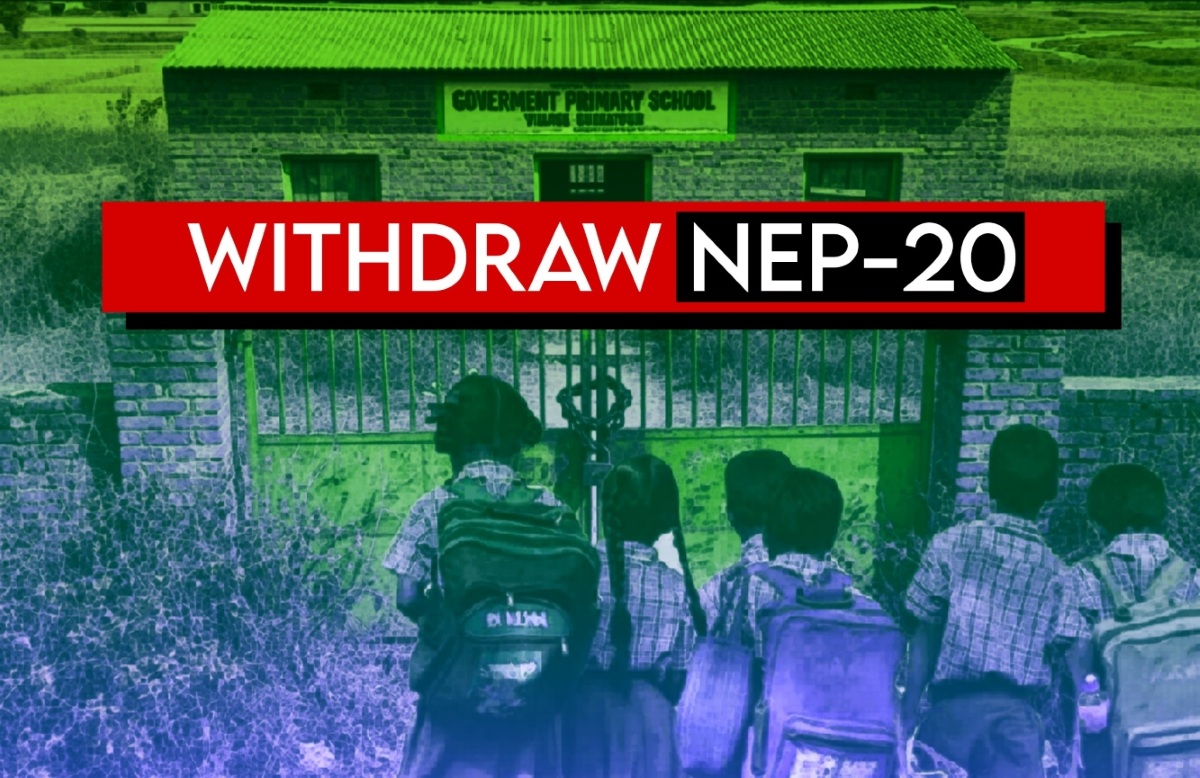
When National Education Policy 2020 (NEP-20) was rolled out by the BJP government as an updated and upgraded version of prescriptions of NEP-1986, Birla-Ambani Committee (1999), Yashpal Committee recommendations ( mainly replacing multiple bodies like the UGC and AICTE with a new “Commission for Higher Education and Research” to create a streamlined regulatory framework), the death sentence was pronounced for secular, scientific, democratic education as well as public system of schools, colleges, and universities managed and funded by government bodies to provide accessible education to all citizens. However, as a camouflage, the then Congress government promulgated the Right to Education (RTE) Act, 2009, which held that elementary education is a fundamental right for all children between the ages of 6 and 14 and mandated that the appropriate government provide free and compulsory elementary education. The act includes provisions for minimum school infrastructure, prohibits physical punishment and mental harassment, requires private schools to reserve 25% of seats for disadvantaged children, and prohibits unrecognised schools from operating. Before RTE, the right to education was a non-binding directive principle in India under Article 45, which aimed for free and compulsory education for children up to 14 years old within Constitution’s a decade of the commencement. In 2002, this became a fundamental right under Article 21A of the Constitution. So, the governments, whether of the Congress or the BJP, the two trusted representatives of the ruling Indian monopolists whose class design is to strip education of its essence, inhibit the process of generating a rational scientific thinking faculty among the students, facilitate easy and increasing entry of private sector into the academic arena and turn education into a commodity for selling at exorbitant price and maximize profit.
The number of public schools is steadily declining
Let us see what the spectacle of the public education system in India is. Over the last 10 years, more than 89,441 government schools have been closed down. In Uttar Pradesh alone, shutters have been downed on 25,126 schools. The number is 29,410 in Madhya Pradesh. Madhya Pradesh is followed by Jammu and Kashmir, which saw a decline of 21.4% in government schools from 23,874 in 2014-15 to 18,758 in 2023-24. In the same period, Odisha’s government schools declined by 17.1% from 58,697 to 48,671; Arunachal Pradesh’s schools declined by 16.4% from 3,408 to 2,847; Uttar Pradesh’s government schools declined by 15.5% from 1,62,228 to 1,37,102; Jharkhand saw a decline of 13.4% from 41,322 to 35,795; Nagaland witnessed a decline of 14.4% from 2,279 to 1,952; Goa’s schools declined by 12.9% from 906 to 789 and Uttarakhand’s government schools declined by 8.7% from 17,753 to 16,201. While the number of government schools has come down from 11,07,101 in 2014-15 to 10,17,660 in 2023-24, the number of private schools increased by 42,944 in the same period. The number of government schools has declined by 8%, while private schools increased by 14.9% in the past decade from 2014-15 to 2023-24, was admitted in the parliament by the Union minister of state for education, Jayant Chaudhary. (Source: Hindustan Times, 03-02-25)
Shortage of teachers
What other factors have been ailing the government schools? First of all, the schools are suffering from huge shortage of teachers. In December 2023, in reply to a question in Parliament, the government mentioned a shortage of 7,22,413 teachers at the elementary level and 1,24,262 teachers at the secondary level. Several lakhs of teaching posts are vacant throughout the country. It is also found that more than one lakh schools in the country are ‘one teacher’ schools. Andhra Pradesh topped with 12,912 such schools, followed by Uttar Pradesh (9508), Jharkhand (9172), Maharashtra (8512), Karnataka (7349), Madhya Pradesh (7217), West Bengal (6482), and others. According to recent Ministry of Education data for the 2024-25 academic year, there are 1,04,125 single-teacher schools in India, which serve approximately 3.3 million students. There are instances where one teacher simultaneously teaches in four classes.
And then corruption has creeped in the process of teacher recruitment as well. The Supreme Court of India in April 2025 annulled the appointments of approximately 26,000 teachers and non-teaching staff in West Bengal, who were recruited in 2016 through the West Bengal School Service Commission (WBSSC). The decision followed a CBI investigation that found widespread corruption in the hiring process. But the Apex Court admitted that there were about 19,000 non-tainted teachers. Still, they were sacked without any proper reason. Similar incidents occurred in UP, where about 69,000 teachers lost their jobs and in Tripura, where 10,223 teachers were removed. Prolonged litigation denied justice. But the worst sufferers are the students who did not get their teachers in the classrooms.
Lack of proper infrastructure
Moreover, in most of the government schools, there is no proper infrastructure, as revealed by a government report. Of 10.17 lakh government schools, only 3.37 lakh schools have disabled-friendly toilets, which accounts for 33.2% of schools. However, only 30.6% of them are functional. There is hardly any separate toilet for girls, which is a major deterrent for attendance of girl students. Of the over 14.71 lakh public schools in India, up to 1.52 lakh schools have no functional electricity. (source: The Hindu 03-01 25) Many schools do not have a reliable supply of clean drinking water, which is a fundamental health requirement. Issues such as poor ventilation, extreme temperatures, and a lack of natural light make it difficult for students to concentrate on their studies. An old survey showed that 25% public schools have no blackboards, chalks and dusters.
The lack of minimum infrastructure in public schools leads to significant negative impacts, including overcrowded and dilapidated classrooms, insufficient sanitation facilities, a lack of safe drinking water, and poor connectivity. These deficiencies create a negative learning environment that can demotivate students, increase dropout rates, and hinder academic performance.
Merger of schools
As per prescripts of NEP-2020, many public schools with low enrolment are merged with nearby institutions. However, this process is sparking protests from teachers, parents, and education-loving people who raise concerns about reduced accessibility, increased travel for students (especially girls), and a potential negative marginalised impact on communities. Some regions, like Uttar Pradesh, are implementing large-scale mergers. As per a report of 16 June last, UP has initiated combination of 10,000 schools which has been worrying the guardians because of covering more distance to school which include tough terrains as well and pose serious question about safety of the students, particularly girl students, which might force people with low income and mobility to take their children, especially the girls, out of school. Moreover, if private schools are merged with public schools (a provision for which exists in NEP 2020), public property would be grabbed by private operators virtually with legal sanction. In Delhi, it was found that a private school has constructed a huge school building on the site of a public school whose dilapidated structure is still visible behind the new construction.
Save Education Movement and alternative education policy
These facts clearly prove that the government is on a spree to dismantle public education to vacate the space for corporate sharks. If this is allowed, the government education system will succumb to die within a few years. No sensible person who views education as instrumental for man-making and producing due consciousness about the material world among the students can ill afford to acquiesce in such a move of any government to destroy education, a social treasure.
So, the teachers, students, guardians, academicians, intellectuals and well-meaning people were earnestly desiring to develop a serious movement to save education. So, they have combined themselves under the banner of The ‘All India Save Education Committee’ (AISEC), which spearheaded a united, sustained movement against NEP-2020 and annihilation of education in various forms like organising seminars, exchanging views and evolving opinions against this heinous design. It received spontaneous support from all sections of the population and was enthusiastically supported by the most senior academics, scientists, historians, physicians, and other intellectuals. The AISEC didn’t confine its activity to regular demonstrative programmes. It has, with the active help of eminent educationists and intellectuals, prepared a draft ‘Alternative People’s Education Policy-2025’ countering every malevolent argument of the proponents of the NEP-2020 and the concomitant disaster in education system.
Call for People’s Parliament
This draft ‘Alternative People’s Education Policy-2025’ is not an academic intercourse. It is being taken to the people for improvement through suggestions, opinions, recommendations, amendments, and alterations. The AISEC has taken upon itself this arduous task throughout the length and breadth of the country. After receiving all suggestions and amendments and duly examining them on the anvil of logic and rationality, it will finalise it in a ‘People’s Parliament’ convened on 24 January 2026 in Bengaluru. It is only through the assertion of people’s movement to save education that the government could be compelled to retrace from the ruinous path of killing education.