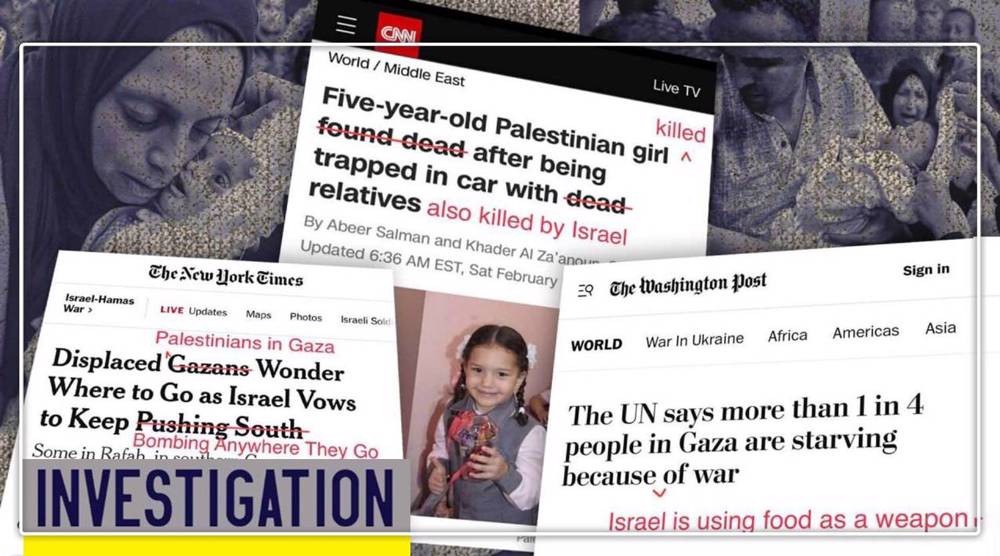
The skeletal children, their bellies grotesquely distended by hunger, stare blankly from photographs emerging from Gaza. The pulverized carcasses of hospitals and universities stand as grim monuments to methodical annihilation of both people and infrastructure of Gaza. Over 60,000 Palestinians have been killed. More than 17,400 children either shot dead or buried in rubble. A population deliberately starved, where health officials report Palestinians—including infants—succumbing not just to bombs but to famine engineered by the siege. This is the reality documented by the United Nations, affirmed as plausibly genocidal by the International Court of Justice (ICJ), and meticulously chronicled by human rights organizations worldwide. Yet, within the opulent pages of America’s most influential newspapers, a parallel reality is being constructed – a reality where genocide is not happening, where intent is erased, and where the slaughter is reframed as unfortunate necessity, collateral damage or even restraint. This is not mere bias; it is the birth of a chilling new genre: genocidal journalism.
Consider Bret Stephens’ column in ‘The New York Times’ of 31-07-25 with a blunt headline: “No, Israel Is Not Committing Genocide in Gaza.” His argument hinges on a perverse calculus of carnage. “If the Israeli government’s intentions and actions are truly genocidal,” Stephens writes, “…why hasn’t it been more methodical and vastly more deadly?” He dismisses the decimation of Gaza and the killing of tens of thousands of innocent Palestinians as insufficient proof, citing the Palestinian death toll of “nearly 60,000” and wondering aloud why the number isn’t “hundreds of thousands.” This grotesque logic – “genocide only counts if it meets an industrialized death quota” – ignores the ‘methodical’ nature of the destruction: over 70% of homes pulverized, every university flattened, and the healthcare system completely crushed.
It ignores the ‘Lancet’ study projecting over 1,86,000 indirect deaths from siege conditions by late 2024. Stephens concludes, “I am aware of no evidence of an Israeli plan to deliberately target and kill Gazan civilians,” a statement so divorced from observable reality it borders on the surreal. Israeli bombs rain down on designated safe zones, hospitals, ambulances, and refugee camps. The use of 2,000-pound “bunker buster” bombs in densely populated areas is inherently indiscriminate. Even the hungry people who have been desperately running to get whatever little food items they could manage to get from the relief camps are simply gunned down by the invading Israeli troops. And the intent?
It echoes from the highest Israeli offices: Defence Minister Yoav Gallant declaring a “complete siege” because “we are fighting human animals”; National Security Minister Itamar Ben-Gvir advocating for a “second Nakba”; Deputy Knesset Speaker Nissim Vaturi urging Gaza be turned into a “slaughterhouse”; President Isaac Herzog stating there are “no uninvolved civilians.” Stephens’ column is, therefore, no analysis; it is a masterclass in erasing intent and legitimizing massacre.
This denialism is not confined to the ‘NYTimes’, ‘The Wall Street Journal’s editorial board consistently frames the carnage solely through the lens of Israeli security needs, dismissing international law as biased and portraying any accusation of genocide as inherently antisemitic. Their narratives actively obscure the siege’s genocidal dimensions – the blocking of food, water, fuel, and medicine, destruction of bakeries and farmland, targeting of aid convoys documented by Human Rights Watch and Oxfam.
‘The Washington Post’ provides platforms for commentators who replicate Stephens’ tactics, demanding impossible thresholds of proof for genocide while amplifying Israeli government talking points. When the ‘Post’ does report on Palestinian suffering, it is often buried beneath headlines emphasizing Israeli perspectives or framed as the tragic but inevitable cost of rooting out Hamas. This pattern across the “papers of record” transcends individual columns; it constitutes a “systemic failure” – a deliberate refusal to apply the legal and moral frameworks used to judge other conflicts and atrocities.
This is genocidal journalism in practice: A genre defined by the “deliberate denial and obfuscation of ongoing atrocities” documented by unimpeachable international bodies. Its core tenets involve “distorting international law” (raising the bar for proving genocidal intent beyond its legal definition), “centering the perpetrator’s narrative” while marginalizing the victims’ humanity, “weaponizing charges of antisemitism” to silence legitimate critique, and ultimately, “manufacturing consent” for the continuation of atrocities by normalizing the extreme. Its function is to provide an intellectual and moral smokescreen, laundering the indefensible for the American political and policy elite.
“Who does this serve?” Look beyond the bylines to the ecosystem. Stephens, in a disclosure now hauntingly relevant, has previously written columns praising Boeing, a major defence contractor deeply entwined with supplying arms to Israel. The “Wall Street Journal” editorial board reliably champions maximalist US military spending and interventionism. Thinktanks funded by defence industry allies churn out reports and talking points eagerly amplified by these outlets. The connection is not always a direct quid pro quo; it’s a “deadly symbiosis”.
These newspapers, consciously or not, foster a climate where questioning the relentless flow of arms to Israel – arms demonstrably used to commit potential war crimes and genocide – is rendered illegitimate. Their genocidal journalism protects the political consensus enabling the military-industrial complex ruling the roost in US, the mentor and patron of Zionist Israeli rulers, to profit from the destruction. By denying the genocide, they implicitly endorse the weapons pipeline fueling it.
This represents a profound betrayal of the principles enshrined in the very figures these institutions invoke in their defence. Thomas Jefferson, a founding father of bourgeois democracy and the third president of the United States during rising period of capitalism, proclaimed, “The only security of all is in a free press,” envisioning it as a bulwark against tyranny. Abraham Lincoln grappled with the moral imperative to confront a nation’s original sin. Genocidal journalism does the opposite: it becomes a “servant to power”, actively obscuring tyranny and sanitizing sin. When “The New York Times” publishes Stephens’ demand for “more” dead Palestinians as proof of Israeli innocence, it is not exercising free speech; it is replicating the dehumanization that enables horrific carnage in Gaza. It abdicates its obligation towards the code of honest journalism which prescribes to bear witness and speak truth.
The stakes could not be higher. These newspapers shape the narratives consumed by the ruling oligarchs, their pliant policymakers and servitor academics to confuse and befool the public. Their denialism numbs conscience, paralyzes action, and justifies impunity to the war-criminals and maniacs. As Gaza starves under bombs and blockades, genocidal journalism in America’s premier papers are not just reporting on a catastrophe; they are active participants in its perpetuation. To silence the victims is bad journalism. To deny their annihilation as it unfolds is something far darker, far more complicit. It must be named, confronted, and stopped. Otherwise whatever little credibility the American journalism still enjoys will soon be over and the US people as well as the global readers would be ditched by utter falsehood and shameless sycophancy of the ruling US monopolists and multinationals.