
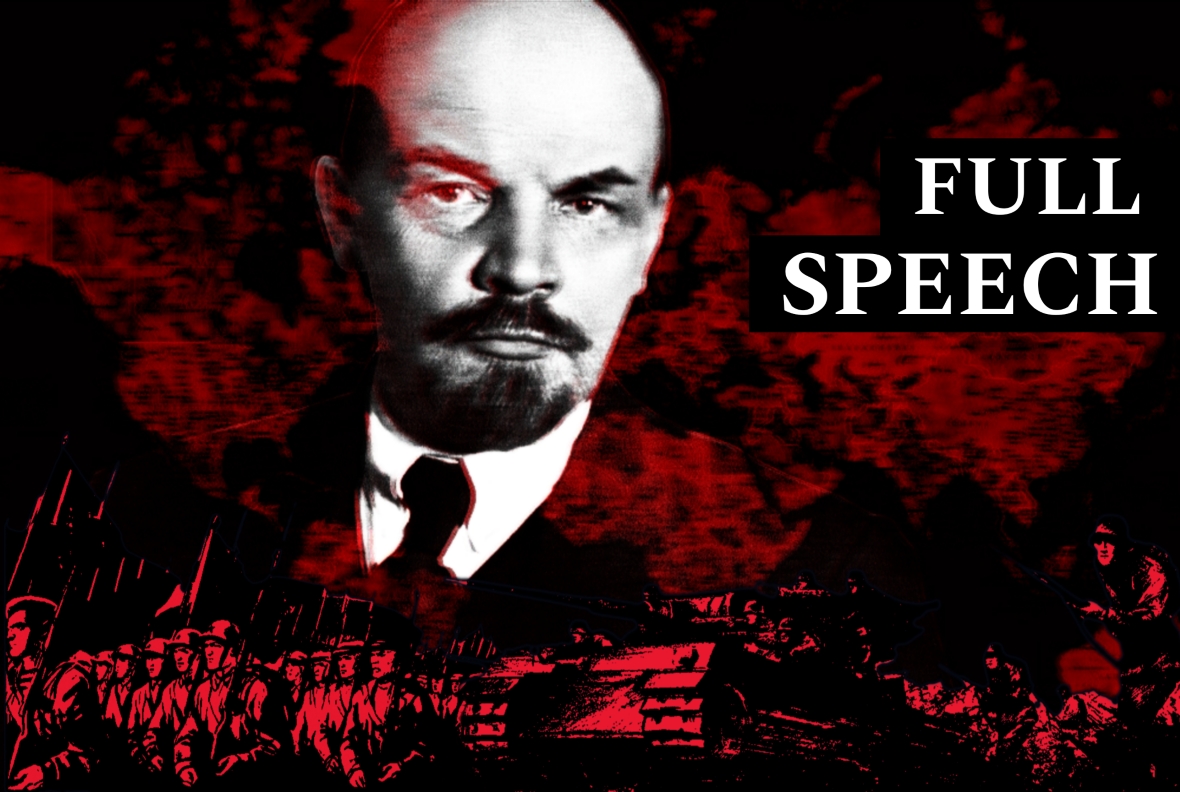
The following is a speech given by Provash Ghosh (General Secretary, Socialist Unity Centre of India (communist)), on the occasion of 102nd death anniversary of Great Lenin-the architect of the first proletarian revolution and socialist state on 21 January 2026, Kolkata. The speech, delivered in Bengali initially was edited thereafter by Provash Ghosh before publication. Responsibility of translation error or inadequate expression, if any, lies with the Editorial team of Proletarian Era.
Dear comrades and friends,
Today we have assembled here to pay homage to Great Lenin and recollect his invaluable revolutionary teachings.
As a student of leaders of world communist movement like Great Stalin, Mao Zedong and Shibdas Ghosh, based on whatever I could learn from them, I will say a few words about great Lenin. If one wants to understand Lenin, one must understand the essence of a historic observation of his. I am telling that in my own words.
Throughout history, those who strove for the liberation of humanity have been subjected to oppression, repression, torture and persecution by the exploiting classes. Some of them were even killed. The exploiting classes spread canards against them and distorted their views. But after the demise of those great leaders, when people were highly inspired by their life and teachings these very exploiters cunningly praised them, glorified them with a view to deceiving, confusing and distracting the masses. Lenin said that the same thing happened with great Marx also. During his lifetime, the bourgeoisie expelled Marx driving him away from one country to another country, and carried out malicious propaganda against him. But after Marx’s death, when the influence of Marxism began to spread increasingly among the working class, the bourgeois thinkers began to praise him. At the same time, they distorted Marx’s thoughts. Pseudo-Marxists also twisted Marx’s teachings and tried to strip Marxism of its essence. Lenin said that the essence, the inner kernel of Marxism has to be revived and re-established. Lenin not only wholly dedicated himself to perform that task, he further developed Marxism to fit with the times by correct as well as concrete application of Marxian science in the concrete obtaining situation, thereby developed and enriched Marxism with several new contributions in the theoretical field.
That is why his worthy successor, and great leader Stalin rightly said: “Leninism is Marxism in the era of imperialism and proletarian revolution. To be more exact, Leninism is the theory and tactics of the proletarian revolution in general, the theory and tactics of the dictatorship of the proletariat in particular”(Concerning questions of Leninism). Armed with the weapon of Marxism-Leninism, the workers and oppressed people established exploitation-free socialist societies in Russia, China and Eastern Europe, and a powerful communist movement surged forth round the globe.
Lenin Saved Marxism from Distortion
I am not entering into the details of Lenin’s life today. But I shall dwell on some of the theoretical developments that he contributed to the treasure house of Marxism. It was Marx who was first to bring to the fore what is the philosophical understanding of dialectical materialism by fighting Hegel’s dialectical idealism, agnosticism and Kant’s Feuerbach’s humanism. He showed that the idea of ‘utopian socialism’ propounded by Saint-Simon and Charles Fourier was flawed, whereas the concept of scientific socialism based on dialectical materialism was the correct one. Pointing out the limitations of Adam Smith and David Ricardo’s classical political economy, he proved that the capitalists earn profit only by depriving the worker of his legitimate due. The worker produces commodity by expending labour. But he is not paid wage equal to the value he so creates. The unpaid labour or the ‘surplus value’ i.e. the new value created by workers in excess of their own labour-cost is expropriated by the capitalist as profit. So, profit is ‘expropriation of surplus value’.
The worker, by giving his labour to produce commodities, creates surplus value; a small part of it he receives as wages, and the rest the capitalist appropriates as profit. Thus, great Marx and his comrade-in-arms great Engels had unravelled the ruthless character of capitalist exploitation. Marx also said that because of this exploitation, capitalism would inevitably be stricken with severe insolvable crisis. He also predicted that the working class would overthrow capitalism and establish a society free from exploitation. They also discovered the law of social development. Based on that, Marxism appeared in the history of development of mankind as the weapon to conduct struggle for establishing exploitation-free classless society.
After the demise of Marx, the influence of the Second International formed under the leadership of Engles spread extensively round the world. But at one point of time, Lenin found that the Second International was distorting Marxism. Lenin’s struggle all along was to spearhead intense ideological battle against such distortion and place before the world the correct understanding of Marxism. Had not Lenin conducted this struggle in right earnest, Soviet Revolution would not have achieved success. Soviet socialism would not have been established. We would not be able to have a glimpse of exploitation-free socialist society as an alternative to oppressive capitalism. And if Lenin had not done that, we would not have got great Stalin, Mao Zedong and Shibdas Ghosh as his worthy successors. They all understood Marxism being imbued with the teachings of Lenin and accordingly conducted proletarian revolutionary movement.
Lenin’s Initiation to Revolutionary Movement
As Kshudiram in our country had embraced martyrdom in course of his attempt to kill an oppressive British official, so was the aim of Sasha, Lenin’s elder brother to assassinate repressive ruler Czar. They had a group known as Narodniks. It was like the various revolutionary organizations which grew during the days of our freedom movement. In accordance with the plan of the Narodnik group, Lenin’s elder brother tried to kill the Russian emperor Second Czar. But he was unsuccessful, held in captivity by the Czar regime and hanged. Lenin then was in his teens. But this martyrdom of Sasha created a deep imprint on his mind. He could realize that this path of individual assassination would not beget the desired emancipation. Then what is the correct way? That was to be searched out. In course of that searching, he got some books of Marx and Engels. When he was a student of Kazan university, he was just 17 year old. At that time, he was arrested for taking part in an anti-Czar demonstration. He was detained in a small village for quite some time. During detention, he meticulously studied the books of Marx and Engels which he could manage to collect. Then he came to a town called Samara. There he formed first a Marxist study group. At that time, such small study groups had been started in many parts of Russia. Lenin could realize that if such study groups remained isolated, the desired goal would not be achieved. Those are to be integrated.

When he was 25, he united all these study groups and created “League of struggle for emancipation of the working class” in ST. Petersburg, the then capital of Russia. Later he said that this organization was an embryo of a proletarian revolutionary party. This was how he was initiated into revolutionary movement. In other words, this was how he took initiative in developing a revolutionary organization. Thereafter, he moved out of the country and published a paper titled Iskra to propagate Marxism amongst the various isolated groups engaged in cultivation of Marxism. Because such was not possible in the strict Czarist regime. His struggle then was to reach out to the masses and acquaint them with the ideology of Marxism. Such initiatives in his early life were the stepping stones towards his progress as a revolutionary leader in the later period.
Lenin Showed the Features of Capitalism in Agriculture
Narodniks were of the opinion that since the workers were few in numbers in the then underdeveloped country like Russia, it would the peasants who would organize anti-Czar revolution. Lenin refuted such a flawed understanding by conducting ideological struggle against them. There was another group known as ‘the economists’. They argued that the workers would not join politics but should focus primarily on improving their immediate economic conditions—such as higher wages, shorter hours, and better working conditions—through strikes and union activities. It would be the middle class who would be in politics. Lenin had fight them also theoretically. When he was conducting revolutionary movement in St Petersburg, he guided the workers’ strike ideologically and politically. At that time, he was once again arrested and jailed for a long time. Then he was sent into exile to Siberia for three years. During his exile in the villages, he came across the miserable life condition of the peasants. He mixed with them intimately and involved them in political discussions. In the same way, he mixed with the workers in St Petersburg, tried to understand their problems and bent of mind, and propagated revolutionary thoughts among them. His fundamental contribution to the treasure house of Marxism was the book “Development of Capitalism in Russia” which he authored during his exile in Siberia. In this book , he showed how capitalism was penetrating not only in industry but also in Russian agriculture. In this book, he also showed the features which indicate penetration of capitalism in agriculture.
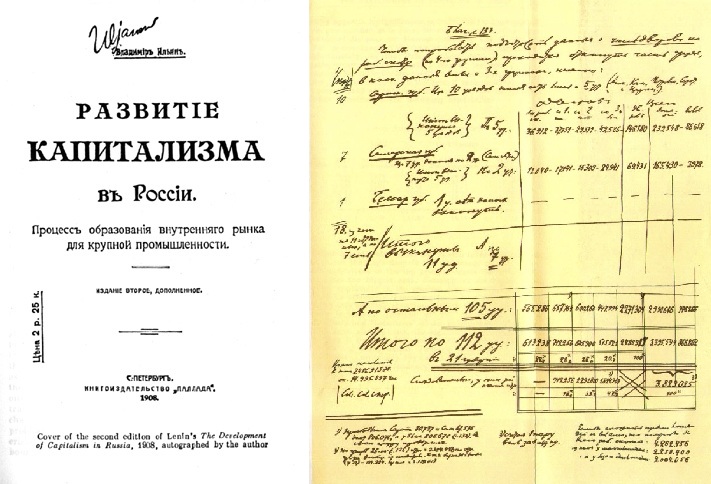
In feudalism, land was neither sold nor purchased. The very feature of land having assumed the character of a purchasable commodity denoted penetration of capitalism. He pointed out that earlier it was a self-sufficient rural economy meaning that the agricultural produce of a particular village was consumed there only. Similarly, agricultural produce has become a commodity of the national market. Also, a section of the people are working as labourers in agriculture. They are not serfs but agricultural workers who give their labour in exchange for wage.
The features of capitalism in agriculture are:
- Establishment of individual ownership on land and concentration of land more and more in the hands of a few super-rich
- Transformation of poor peasants into landless labourers because of loss of arable land they hitherto possessed and
- Agricultural produce as well as land are becoming commodities of the capitalist national market
No one could show this before Lenin. Later, he also showed that in developed capitalist economies like Germany, France and America, too, remnants of feudalism were still in existence.
His ideological struggle against the Narodniks, the Economists, the publication of Iskra for spreading Marxism in Russia, and the theory of development of capitalism in Russia all these prove how deep was his understanding of Marxist philosophy at that age.
Criteria for Becoming Party Member
Plekhanov was first to translate works of Marx and Engels in Russia and propagate Marxism in Russia. Lenin during the early days considered him as his teacher. At the initiative of Plekhanov, the Russian Social-democratic Labour Party (RSDLP) was formed, and its First Congress was held. Lenin could not attend the same as he was in exile in Siberia. The Second Congress of RSDLP was organized in London in 1903. There was a difference of opinion at this Congress between Lenin and others over the question of who should become party members. Based on this difference, the RSDLP was divided into two groups, the Bolsheviks and the Mensheviks. Lenin held only those who would abide by the principles of the Party, pay membership fee, abide by its discipline and undertake daily party activities by joining any organization of the Party. The Mensheviks agreed with the first two conditions but not the others. They said these conditions were not necessary. Lenin argued that no genuine disciplined revolutionary party of the proletariat can develop without those conditions. On this question, RSDLP was divided. Bolshevik meant majority and the Menshevik, minority. At that time Lenin outlined the condition of becoming a party member and continued his struggle for acceptance of that by others. RSDLP was like a platform in which both the Bolsheviks and the Mensheviks were present. Those who were followers of Lenin were called Bolsheviks whom he reared and steered as Marxist revolutionaries. On the other hand, the Mensheviks were compromising petty-bourgeois forces.
Lenin Identified the Imperialist Character of Capitalism
When the First World War had broken out, a serious difference of opinion arose between Lenin and other leaders of the Second International on what should be the role played by a working class party. On the eve of that World War, Lenin was first to present before the world, based on Marxist methodology of analysis, what was imperialism and at what stage of capitalism did it evolve. He pointed out that capitalism has two stages. The first stage was, the days of advent of capitalism by overthrowing feudalism and monarchy. At that stage, capitalism was progressive and conducive to social progress. At that stage, we find the widespread prevalence of small capital. There was free competition among them. Based on that, multi party democracy had been established. But at a particular phase of development of capitalism, a few capitalists beat the others in competition and turned into monopoly capitalists. Monopoly capitalism is the second stage of capitalism. For example, the Tata group which acquired monopoly character in India owned steel plants, industrial production units, coal mines and many such other industries. This is monopoly. Small capital being unable to cope with the competition has now turned marginal. Somehow it is holding on to its existence. Some of the small capitals are perishing. Some are trying to raise their heads in different forms. Thus, small capital is devastated by the attack of monopoly capital.
There is another feature observed at the monopoly stage. Earlier banks used to collect deposits from the people, gave that money to the capitalists on loan and paid interest to the depositors out of earning from those loans. The banking capital and industrial capital were separate. But at the stage of monopoly, there was coalescence of banking capital and monopoly capital to give rise to a financial oligarchy. Concentration of capital had taken place. Alongside was created finance capital. This is the second feature of monopoly. The third stage was export of capital, as against export of commodities, to foreign lands for exploitation of raw material and cheap labour in the destination countries. Fourth stage was of controlling the world market among the monopolists of different countries by way of creating international trusts and cartels. Fifth characteristic was of dividing the global market by the imperialist countries among them.
What will be the Role of Working Class during Imperialist War
While pointing out these characteristics of imperialism, Lenin showed that war today is nothing but a war of capturing market by the imperialist powers, a battle for seizing increased market share for loot and plunder. It was decided in the Congress of the Second International held in Basel city of Switzerland that if the imperialist countries are locked in war, the working class of the respective warring countries would fight against the rulers of the respective countries. The working class of one country would not take up guns against their brethren of another country. Workers of both the countries are wage slaves to respective imperialist rulers. They would not kill each other. This was known as Basel Manifesto. Decision of the Copenhagen (Denmark) summit of the Second International was also the same. While the imperialists were busy in waging war against each other for division and redivision of their domains of loot and plunder, the working class of each country would seize the opportunity to develop revolutionary movement against the imperialists-capitalists of their own respective countries, launch civil wars and accomplish revolution. Such was the decision.

But when the First World War had commenced, most of the leaders of the Second International opined that no, the workers of each country would stand by the bourgeois rulers of their respective countries and protect their own countries. In other words, they would take position in support of the ruling imperialists of their respective countries. Lenin strongly opposed this and said that they were violating the decisions of the previous conferences. This could not be allowed. But the supporters of Lenin were reduced to minority. So, Lenin called the leaders of the Second International traitors. He held that the leaders of the Second International had deviated from Marxism and had been treacherous towards the cause of the proletariats and proletarian internationalism. From the very outbreak of the war, Lenin began to muster forces for the creation of a new International, the Third International. In 1915 the first conference of internationalists was held in Zimmerwald in Switzerland. Even though many of Lenin’s demands were not accepted, Lenin called this conference the “first step” in the development of an international movement against the war.
What was the cause behind such a degeneration of the leaders of the Second International? The imperialists were then plundering the colonies and semi-colonies to the hilt. Out of that plundered wealth, they were giving away a portion to the working class of their respective countries as increased wage, and so purchasing the vulnerable working class and also their leaders by bribing them and thereby dampening their resentment and protest. Lenin said that the leaders of the Second International were representatives of such working class leaders who had been purchased with bribes against revolution. This was how Lenin had to fight to uphold the revolutionary line both in and outside the country.
Formation of the Soviets
Prior to all these, in 1905, a popular uprising against the Czarist government began under the leadership of the proletariat with the aim of achieving a democratic republic. That uprising was propelled by a protest movement by the working class. Gapon, a Christian priest, played a treacherous role. He misdirected the workers with the assurance that the Czar was noble and if the workers appealed to him, he would accede to all their demands. Gapon said he would take the workers to him. The workers fell into this trap and proceeded towards the Czar’s palace in a rally. But the soldiers of the Czar opened indiscriminate fire, raining bullets on them. Several thousand people fell to the Czar’s bullet. That particular day, 9 January 1905, is known in history as ‘Bloody Sunday’. It created a wave of protests in Russia. There was an upsurge of strikes, with strikes after strikes organized in countless places. The workers constituted struggle committees in various factories.

These committees were known as Soviets. Such Soviets spread across the entire country. Some Soviets were formed even among the armed forces. But the Bolsheviks then did not have enough organizational strength to provide leadership to these soviets. This revolution continued throughout 1905-06. It spread to many provinces. The Czar ruthlessly suppressed the uprising with the help of military. Lenin said that necessary lessons were to be drawn from this failed revolution, which he called a dress rehearsal of ensuing proletarian revolution. In course of this upheaval, the Russian workers and people received training for accomplishing revolution in the coming days. On the other hand, the oppression and repression of the Czarist regime assumed a most ruthless character. Being terrified and out of frustration, many within the RSDLP disassociated themselves from the mass struggles. Regarding this, there is famous observation of Lenin. He said that when there is a tide of revolution, many come forward and join the struggle for earning name, fame and building political career. But the real test arises when the revolutionary movement faces a serious crisis, at that time it becomes clear who is a genuine revolutionary and who is a fake. Thus, he left a valuable teachings for all of us. When the party is progressing and enjoying a position of prestige and influence, many flock around it. But when the party falls into a crisis situation, and is faced with danger, those who hold the fort are the genuine revolutionaries. That is the test of the revolutionaries.
In Reply to some Philosophical Muddles
When Russia was passing through a state of despondency, a new attack against Marxism ensued. Bazarov, Bogdanov, Mach, Avenarius and some others began to propagate empirio-criticism and positivism. They held that what human beings experience through the sense organs is alone real or reality, effectively questioning or denying the existence of an objective reality independent of human perception. Refuting them, Lenin showed that the “material world exists independent of human consciousness”. Sensation is not the origin of knowledge but the medium between the human consciousness and the external world, produced by the action of matter in motion upon our sense organs.
Origin of knowledge is the material world. As an example, he said that Alizarin was inherently embedded in coal tar before we discovered it through our sense organs. In his celebrated work, Materialism and Empirio-Criticism, he rebutted many other wrong philosophical propositions and established the correctness of Marxism. After the discovery of the electron and development of electronic theory, some scientists prevalent in Lenin’s time—and Lenin referred to these in his book Materialism and Empirio-Criticism—from confusion started saying that mass has disappeared means matter has disappeared.
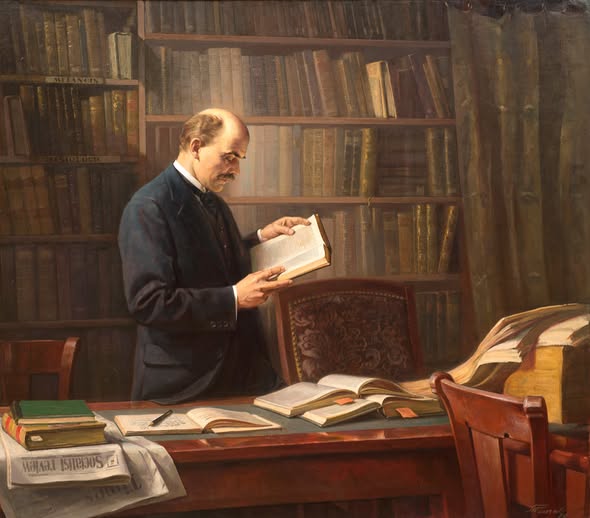
Scientists like Henri Poincare and J.J. Thomson put forth the hypothesis that the actual mass of electron is determined by the energy of the electromagnetic field. From this arose the idea of electromagnetic mass of electron, and this depends on the velocity of the electron. The mechanical mass of electron was regarded as unchanging, as for any other matter particle.
Later experiments by Walter Kaufman unexpectedly showed that the electron was behaving as if all its mass was of an electromagnetic nature. From this the conclusion was drawn that in the case of electron the mechanical mass which was formerly regarded as an inalienable property of matter is zero. In other words, mass has disappeared.
Countering these ideas, Lenin said that “…matter is disappearing means that the limit within which we have hitherto known matter is vanishing and that our knowledge is penetrating deeper; properties of matter are likewise disappearing which formerly seemed absolute, immutable and primary, and which are now revealed to be relative and characteristic only of certain states of matter.” (Materialism and Empirio-Criticism)
Later, Scientific Discoveries Confirmed Lenin’s Understanding
Earlier Lenin had considered Plekhanov as his leader. He used to say that “Plekhanov is the father of Marxism in Russia. For, Plekhanov had introduced the works and teachings of Marxism in Russia”. In the international sphere, Lenin also considered Kautsky as his teacher. Yet in the interest of safeguarding the inner-kernel of Marxism and proletarian revolutionary movement, he had the courage and revolutionary audacity to firmly conduct ideological struggle against those even whom he had looked upon as teachers. And in the process, he presented humanity with the correct understanding of Marxism. What a great revolutionary this achievement proved him to be! At that time only, Lenin said that in the name of reforming Marxism, they were distorting it. From then onwards, the word revisionism featured in the lexicon.
Lenin was a Creative Marxist
We need to know the difference between Lenin and those leaders. They all had read the works of Marx-Engels, memorized them and could quote from those at ease. But they were all Marxist scholars, whereas Lenin was a creative Marxist. Through practice and cultivation of the science of Marxism he understood how and in what way this science has to be applied in a given concrete situation. Whereas those leaders during any discussion or debate simply referred to what Marx or Engels had said in which book. Quite a few of the observations of Marx made in the pre-imperialist period were no more applicable in the era of imperialism and proletarian revolution. Lenin said: “We do not regard Marx’s theory as something completed and inviolable”. (Our Programme) It cannot be that the last word on Marxism has been said and the Marxist science would not develop any more. It is not that whatever Marx had said in the obtaining socio-economic condition is still applicable and hence inviolable. Marx Engels have “…only laid the foundation stone of the science which socialists must develop in all directions if they wish to keep pace with life”. (ibid) And this is exactly what Lenin had done. Here lay the difference between Lenin and Plekhanov-Kautsky. Plekhanov, Kautsky and their ilk were scholars. And Lenin, as a creative Marxist, assimilated the essence of Marxism or Dialectical Materialism and based on that, concretely analysed the given situation and determined the line of action. So, he said: “…Marx’s theory…provides only general guiding principles, which, in particular, are applied in England differently than in France, in France differently than in Germany, and in Germany differently than in Russia.” (ibid) Every country has some special economic, political and social features. So, by proletarian revolution we mean a general line. The particular line of revolution in any country is to be deduced based on the particular economic, political, social and cultural condition of that country. This is called concretization of Marxism. This is a historic expression of Lenin.
During the First World War, Britain, France and Czarist Russia were on one side while the rival group comprised Austria, Germany and Hungary. During that war, Lenin was trying to make the Russian workers aware about the true purport of Czarist Russia’s candestine agreement with British and French imperialists. He explained to the Russian workers that they would have to conduct revolution against the rule of the Czar. The Bolshevik Party led by Lenin was preparing the workers for that in this way. It is at this point that a serious difference of opinion occurred between Lenin and Plekhanov, Kautsky, other leaders of the Second International and the Mensheviks. Lenin’s opponents were of the view that revolution would first break out in the most developed countries simultaneously. This was the understanding of pre imperialist period. Lenin said such would not be possible in the era of imperialism and proletarian revolution. The imperialist era is the era of uneven development of capitalism. Moreover, these leaders were overwhelmed by bourgeois parliamentary illusion. He said now in any country, even if backward, where the crisis is most acute and people’s protest most strong it will be possible to accomplish revolution. And revolution can take place in one single country also. Those leaders were of the opinion that since Russia was then at the stage of bourgeois democratic revolution, revolution would take place under the leadership of the bourgeoisie. Lenin said, no. In the present era, the bourgeois leadership can not even lead the bourgeois democratic revolution to its conclusion, it is the working class who has to take the leading role in that revolution.
Stage of Revolution Determined Based on Who is in State Power
During the last phase of the First World War, there was tremendous grievance among the Russian people. Russian Czar was losing the war. So, the Russian people raised the slogan—No war, but Peace. On the other hand, the country was in the grip of a horrific famine. Hence, demands were raised for bread and individual freedom. The poor peasants in the rural areas were demanding arable land. Based on all these demands, the first revolution had occurred in Russia in February 1917. During this revolution also, many Soviets were formed including among the army. In various parts of the country, peasants also formed Soviets. But the members of the Bolshevik party were then engaged in street battle with the Czar. So, they could not work much within the Soviets. Seizing that opportunity, the Mensheviks and the Socialist Revolutionaries, another political party, established their dominance within the Soviets. Moreover, the old factory workers had been sent as soldiers to the war. The new batch of workers were mostly from the peasant families. Among the peasants, a petty-bourgeois mindset and compromising attitude is often found to be prevailing. For these two reasons, the Bolsheviks were initially a minority in the Soviets whereas the Mensheviks and the Socialist Revolutionaries constituted the majority. Through the February revolution, the Russian bourgeoisie assumed state power. In that revolution, it was mainly the workers and soldiers who had fought. But the peasants were also involved in the battle. Lenin emphasized at this point that preparations should be made for accomplishing anti-capitalist socialist revolution. Lenin could realize that the prevailing condition was conducive to socialist revolution. At that time, the opponents questioned that when capitalism had yet to reach stability in the country, how could it be stage of anti-capitalist socialist revolution? They were of the opinion that let capitalism first gain strength and then only anti capitalist socialist revolution could take place. When the Mensheviks argued like that, Plekhanov and the leaders of the Second International agreed with them. In this regard, there is a famous observation of Lenin. He said: “The basic question of every revolution is that of state power”. (Dual Power)What is to be understood is who is in state power. The extent of development of capitalism or how many vestiges of old feudal system are in existence—such are not the main determining factors. “State power in Russia has passed into the hands of a new class, namely, the bourgeoisie and landowners who had become bourgeois. To this extent the bourgeois democratic revolution in Russia is completed.”(April Thesis). Such was his concrete analysis of the concrete situation based on Marxist methodology. The unaccomplished tasks of bourgeois democratic revolution in the economic-social-cultural sphere would be fulfilled by the socialist state.
On Dictatorship of the Proletariat
At that time, there were two forces operating in Russia. On the one hand was the bourgeois provincial government, while on the other hand, there were armed Soviets in which Bolsheviks were a minority. Thus arose the dual power. The Mensheviks wanted to hand over all power to the provincial government and dismantle the Soviets. But Lenin raised the demand for handing over all power to the Soviets. He first discussed it within the Bolshevik party and reached unanimity. Thereafter the Bolshevik party leaders and cadres carried on widespread discussions among the workers and soldiers and in the Soviets. After extensive discussions and debates for quite a few months, Lenin succeeded in defeating the Mensheviks and socialist revolutionaries, establish majority of the Bolsheviks within the Soviets and accomplished successfully revolution in November. Had not Lenin realized the revolutionary significance of the prevailing situation and taken initiative to bring about the revolution, history would not have witnessed the successful November socialist revolution in Russia. The leaders of the Second International had opposed the strategy of armed revolution and had held that peaceful transition to socialism could be achieved through the route of parliamentary election. Lenin replied: “To decide once every few years which members of the ruling class is to repress and crush the people through parliament – this is the real essence of bourgeois parliamentarism, not only in parliamentary constitutional monarchies, but also in the most democratic republics.” (The State and Revolution). The struggle of the revolutionary working class is against the bourgeois state. The bourgeois state consists of three wings—Bureaucracy, Military and Judiciary. These wings are not changed by election. Thus, the bourgeois state does not get changed through elections. Based on the experience of Paris Commune, Marx and Engels, in the preface to the new German edition of the Communist Manifesto, on 24 June 1872, mentioned that “One thing especially was proved by the Commune, viz., that ‘the working class cannot simply lay hold of the readymade state machinery, and wield it for its own purposes.” By conducting fierce ideological battle with the leaders of the Second International, Lenin established the importance of this theory. He emphasized that the bourgeois state overthrown. His has to be opponents advocated a flawed theory of peaceful transition. Lenin said that could never happen. The bourgeois state is armed. So, an armed struggle has to be conducted against it. Thus, Lenin fought against the Mensheviks and leaders like Kautsky over these theoretical questions.
Lenin also had a serious difference of opinion with Plekhanov, Kautsky and the others on the question of the dictatorship of the proletariat. According to those leaders, if such dictatorship was established, democracy would cease to exist. Lenin countered by referring to Marx who said: “Between capitalist and communist society there lies the period of the revolutionary transformation of the one into the other. Corresponding to this is also a political transition period in which the state can be nothing but the revolutionary dictatorship of the proletariat.” (Critique of the Gotha Programme) Lenin also showed that bourgeois democracy is nothing but bourgeois dictatorship. He explained: “the …resistance (of the bourgeoisie) is increased tenfold by their overthrow …and whose power lies, not only in the strength of international capital, the strength and durability of their international connections, but also in the force of habit, in the strength of small scale production … . small production engenders capitalism and the bourgeoisie continuously, daily, hourly, spontaneously, and on a mass scale…For all these reasons the dictatorship of the proletariat is essential…”(Left Wing Communism – An Infantile Disorder) Now this democracy is in the interest of the proletariat.
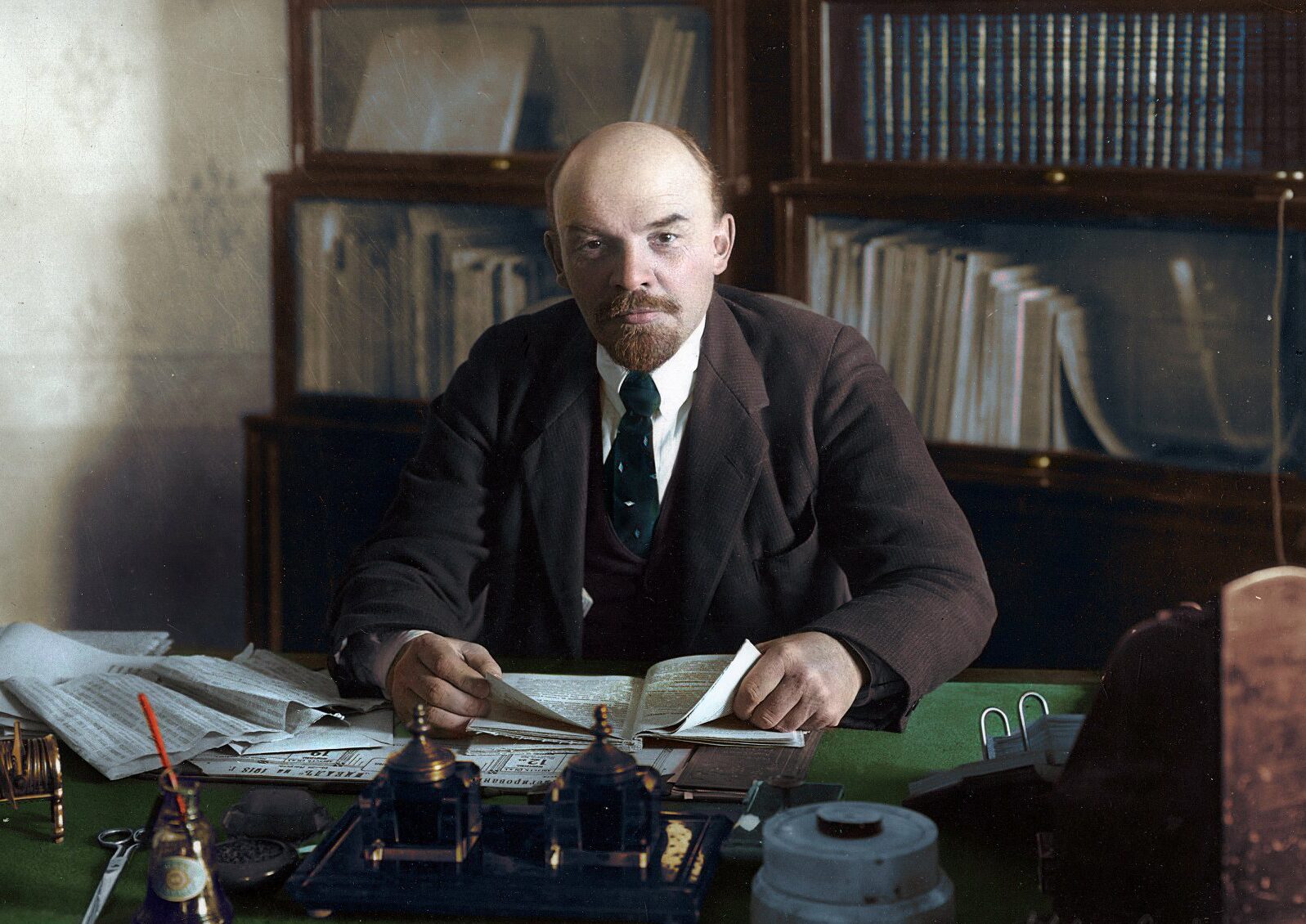
Panicked at the success of the Soviet revolution, 16 imperialist capitalist states simultaneously attacked Russia. The dethroned bourgeoisie also organized revolt in many places of the country. In such a crisis situation, the Russian working class, revolutionary army and the peasants conducted a valorous battle to defeat the imperialist attack and counter revolutionary conspiracies. Imbued with the ideology of proletarian internationalism, the workers of the imperialist countries also stood by the first working class state. So, it was possible to thwart the imperialist attack. The role played by Stalin in the preparation for revolution, in repelling the imperialist attack and foiling counter revolutionary onslaught under Lenin’s leadership, is also worth-mentioning. After this, to overcome the economic crisis in post-war Soviet Russia, Lenin implemented first the policy of ‘War Communism’ and then the ‘New Economic Policy’. Once this phase was over, a historic five year plan to build up socialist economy was rolled out. There are some more important contributions left behind by Lenin.
One of them was delineation of the process of development of a modern nation. He showed that the modern nations had evolved based on emergence of a national market, a national language and a national culture following advent of capitalism. He also upheld freedom of the various nationalities hitherto under the Czarist regime. He also said that the working class as well as the working class parties of the imperialist countries must support the national liberation struggles of various colonies and semi-colonies notwithstanding those struggles being conducted under the leadership of the bourgeoise. At the same time, they must take initiative to develop communist parties on those soils.
Guideline Towards Formation of Proletarian Revolutionary Party
Another historic contribution of Lenin has been to provide the guideline of building up a genuine communist party. And he was the first to found such a communist party. Marx -Engels did not provide any such guideline. Such a necessity also did not arise at their time. The parties affiliated to the Second International were not that compact in character. It was Lenin who first showed how a well-knit disciplined party with a monolithic character like human body could be developed. Earlier, Lenin formed a ‘League of struggle for the emancipation of the working class’. He called it an embryonic stage of formation of a revolutionary party. Later, he had enriched the concept much more theoretically.
Lenin said without a revolutionary theory, there cannot be any revolution. Elaborating that, Comrade Shibdas Ghosh taught us that “By revolutionary theory Lenin never meant the political, economic theory or only the stage of revolution. The socialist movement covering all aspects of life is to be released for building a revolutionary party. That is the lesson we have understood from Lenin and for that we have given so much stress on morality, ethics and characterbuilding.” (Revolutionary Life is the Most Dignified One) This is the correct and comprehensive understanding of revolutionary theory. Lenin also observed that some isolated groups cannot form a communist party by suddenly convening a meeting and passing a resolution. Those who would come forward to build up a revolutionary party must first develop a unity of thought. In order to do that, everyone must openly express their respective thoughts. Then in the process of conducting an intense ideological struggle, it would come out who is right and who is wrong. This how a communist party is to be formed based on correct thought.
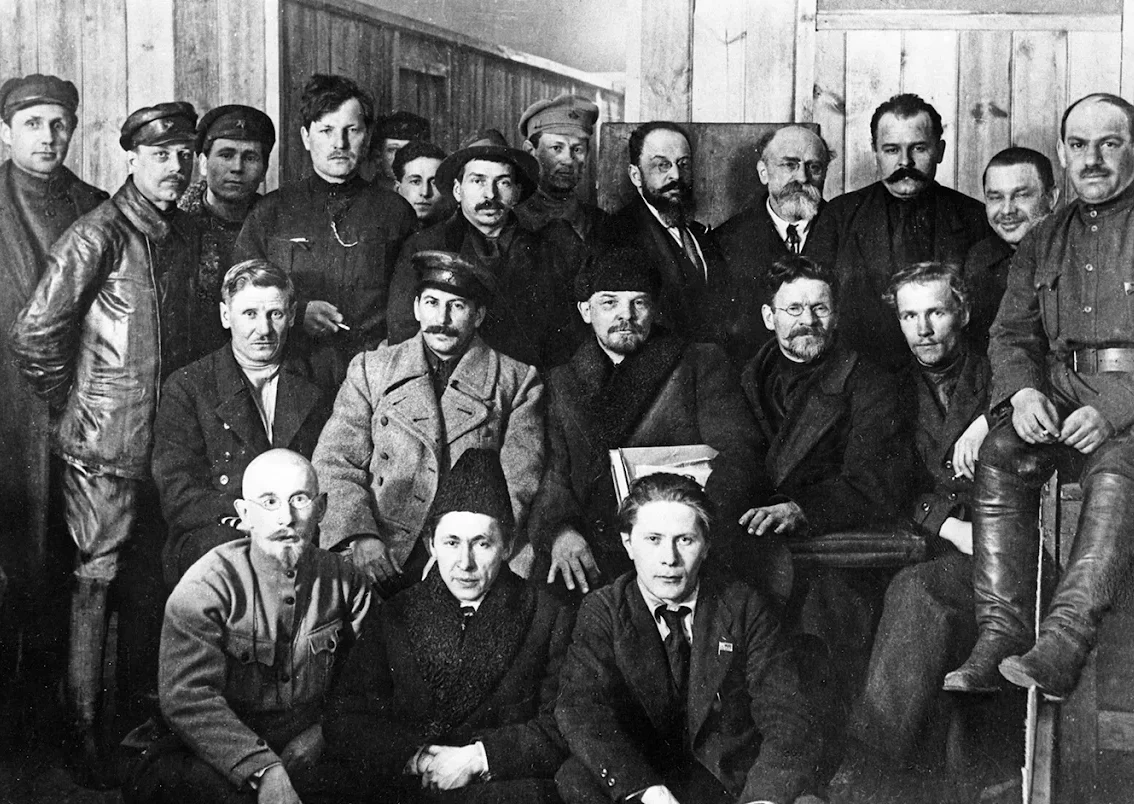
Lenin highlighted the need for a band of professional revolutionaries in a revolutionary party. Professional revolutionary means one whose sole responsibility is to develop party organization. Elaborating, developing and enriching this Leninist concept, Comrade Shibdas Ghosh had shown that professional revolutionaries are those who have not only abandoned all material private properties but are free from private property mental complex and have attained a stage where one’s personal interest and the interest of revolution, working class and working class party are identified. This is how Comrade Ghosh brought the understanding of the Leninist concept to a new height.
Communist Party is the Vanguard of the Working Class
Lenin said the communist party will be the vanguard of the working class. Trade Union and the party are not one and the same. The task of the Trade Unions is to fight with the capitalist owners for increasing the wages of the workers, bargain for lowering working hours and develop movements for legislating pro-working-class acts. He said that trade unionism without revolutionary politics is a bourgeois politics. So, trade unions ipso facto would not germinate revolutionary consciousness among the workers. Lenin further observed that trade unions would exist, but the party is the vanguard detachment of the working class. The responsibility of the party is to provide revolutionary leadership to the working class. Lenin argued that workers on their own can only develop “trade union consciousness”—the realization of the need for unions, better wages, and lowering working hours. Simply by that, the workers would not understand revolutionary politics. The revolutionary politics will be carried to the workers by those intellectuals who have imbibed the revolutionary teachings. Because the theory of Marxism has arisen on the basis of various theories in philosophy, history, economics and politics. So, the revolutionary theory does not come from within. It means that revolutionary theory does not arise in course of trade union activities of the workers. “Revolutionary thought comes from without”, said Lenin. Who will bring that thought to them? The intellectuals who have been detached from petty-bourgeois life and identified themselves with working class revolution. And the party will detachment be of the vanguard the various organizations of the workers.
Communist Party Functions Based on Collective Leadership
Lenin showed that a proletarian revolutionary party would develop based on democratic centralism. Clarifying further, said: “Democratic centralization in the Communist Party organization must be a real synthesis, a fusion of centralism and proletarian democracy. This fusion can be achieved only on the basis of constant common activity, constant common struggle of the entire Party organization. ….” (Principles of Party Organization). This centralization does not mean formal and mechanical centralization which gives rise to bureaucracy domineering over the cadres. If democratic centralism develops in the party, there would be no power conflict or aspiration for capturing leadership position. On the other hand, if there is a bureaucratic leadership, the mindset for undisciplined conduct and anarchism would develop as a reaction to that. In his arduous effort to build up the SUCI(C) based on Leninist principles, Comrade Shibdas Ghosh had further developed and enriched the concept. He said: “First, those who have taken the lead in forming the party would have to lay the foundation of ideological centralism first among themselves through a socialist movement based on dialectical materialism covering all aspects, including the minutest details, of their personal lives.” [Why SUCI(C) is the only Genuine Communist Party in India] In course of conducting that all-embracing struggle, when the best expression of the collective leadership will be personified in an individual, he will emerge as the supreme leader of the party. After Marx and Engels, the emergence of Lenin’s leadership in the Russian Bolshevik Party, or that of Mao Zedong in the Communist Party of China, were nothing but the emergence of the collective leadership in its concrete form in those parties. Comrade Shibdas Ghosh has further explained that since formal democracy or bourgeois democracy is based on individual ownership, leadership of one or several individuals operates there in the name of democracy. Whereas struggle for establishing proletarian democracy is the struggle for establishing collective ownership.
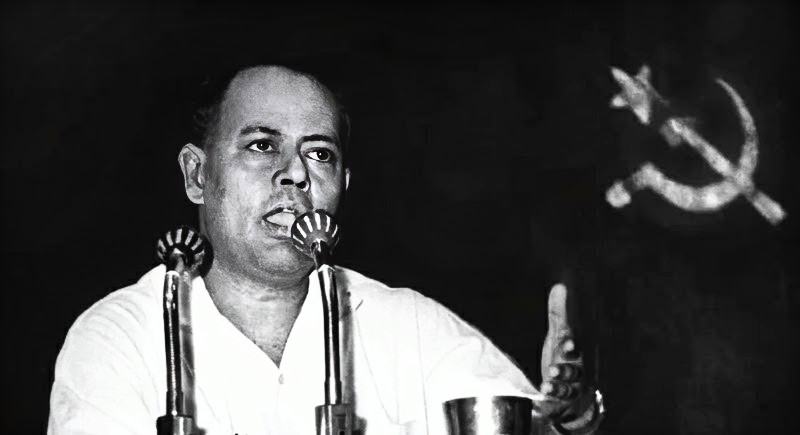
So, it is a collective leadership. When that leadership is best expressed in a personified form in a leader, that is the concrete expression of collective leadership. “…ideological centralism grows out of the struggle to develop one process of thinking, uniformity of thinking, oneness in approach and singleness of purpose on the basis of Marxism-Leninism and dialectical materialism not only on the economic and political questions but on all questions covering all aspects of life”, showed Comrade Shibdas Ghosh. (ibid) And when organizational centralism from the lowest to the highest level is built up on the basis of this ideological centralism, that is called democratic centralism. Thus, Comrade Shibdas Ghosh defined both ideological centralism and organizational centralism and showed that fusion of ideological centralism and organizational centralism is democratic centralism. Thus, he elaborated and enriched Leninist concept of ideological centralism based on which he founded the SUCI(C).
A Marxist must Understand How the Bourgeoisie Confuse the People
There are some other teachings of Lenin which even today have to be applied by us. Lenin taught that a revolutionary must stand up in protest against any injustice, any act of oppression and repression. It is incumbent on a Marxist revolutionary to analyse whatever happens in the country any kind of political event based on Marxist methodology. And in course of analysing a particular political event or incident, a Marxist needs to examine which class is playing what political and ethical role in it. A revolutionary must be able to identify the socio-political role of the bourgeoisie in a specific context. Also, he or she should understand where lies the strength or weakness of the bourgeoisie, with what trickery or sweet-coated words it is deceiving people, what is the turn of events, what laws are being framed in the interest of which class and so forth. Moreover, a revolutionary must also keep himself or herself abreast of what the people are thinking, the kind of public talks going around, sometimes in whispers and sometimes in a loud and clear way. This art cannot be learnt by reading books. It is to be acquired in real-life situations through examination of and probing into these. This is the learning process of a revolutionary.
Lenin said the revolutionaries must work within the institutions, trade unions, clubs or societies wherever the masses are involved, even if those organizations are led by reactionary groups. Howsoever difficult that work might be, revolutionaries must take that up braving all odds and overcoming all hindrances created by the reactionaries. He was categorical in saying: “To refuse to work in the reactionary trade unions means leaving the insufficiently developed or backward masses of workers under the influence of the reactionary leaders, the agents of the bourgeoisie, aristocrats…” (Left-wing Communism an Infantile Disorder) Revolutionaries must work within the reactionary trade unions, win over the workers and isolate the reactionary leadership.
On Parliamentary Election
On the other hand, the ultra leftists are giving call for boycotting parliament. According to them, parliament has become useless, historically obsolete. Lenin pointed out: “Parliamentarism is ‘historically obsolete’ from the standpoint of world history, that is to say, the era of bourgeois parliamentarism has come to an end and the era of the proletarian dictatorship has begun. That is incontestable… But precisely for that reason it is a howling theoretical blunder to apply the scale of world history to practical politics… How can one say that “parliamentarism is politically obsolete,” when “millions” and “legions” of proletarians are not only still in favour of parliamentarism in general… we must not regard what obsolete for us as is being obsolete for the class, as being obsolete for the masses.” (ibid) Till the time, the revolutionaries are able to convince the masses that no problem can be resolved through parliamentary way, they will have to participate in election. He said that the Bolsheviks took part in the elections to the Russian bourgeois parliament, the Constituent Assembly, in September 1917 and kept it functioning till 1918 because among a minority section of people, parliamentary illusion had still persisted. So, it is not enough if the majority of the masses are free from parliamentary illusion. Even if such illusion exists among a minority section of people, participation in parliamentary election cannot be dispensed with.
Lenin has also taught that if there is a contradiction within the enemy camp, even if it be of minute nature, the revolutionaries must try to take advantage of that with patience, dexterity and vigilance. Similarly, if at any point of time, there is any scope for using any forces of the masses which might be undependable, vacillating and of an ephemeral nature, to advance revolutionary movement that must be availed of.
Attitude Towards Mistake
Lenin said that it is not enough if the strategy and tactics of a revolution is correct. What has to be taken care of is that the masses themselves can understand through their experiences that this strategy and tactics are correct. The workers of a revolutionary party must connect with the proletariat, semi proletariat and other sections of the oppressed masses, build up a close relationship with them and in the process, become merged with them. Then, those masses are to be educated and organized. And the workers of a revolutionary party must be ready for any sacrifice. They need to be brave and firm in their resolve. He taught that whether a party is a genuine revolutionary party or not can be judged from its attitude towards mistakes. If a genuine communist party makes a mistake, it publicly admits that also says what had caused that mistake and how it proposes to rectify that mistake. All these are candidly placed before the people by it. By this, one could make out if the party is a genuine communist party or not and whether it does discharge its obligation to the people.
Lenin taught one more thing. Marxism has been the logical development of the store of knowledge mankind has accumulated over the ages through struggle in history and taking lesson from these. So, it is the most advanced ideology in the history of social development. Hence, the revolutionaries must be acquainted with the treasure-house of human knowledge.
He also sounded a caution: “If I know that I know little, I shall strive to learn more; but if a man says that he is a Communist and that he need not know anything thoroughly, he will never become anything like a Communist.” (The Tasks of the Youth Leagues) From the treasure house of Lenin’s teachings, I have referred to only a few aspects in this discussion so that all of us could learn from those and play our due role in the revolutionary movement.
Lenin Unmasked the Monstrous Character of Imperialism
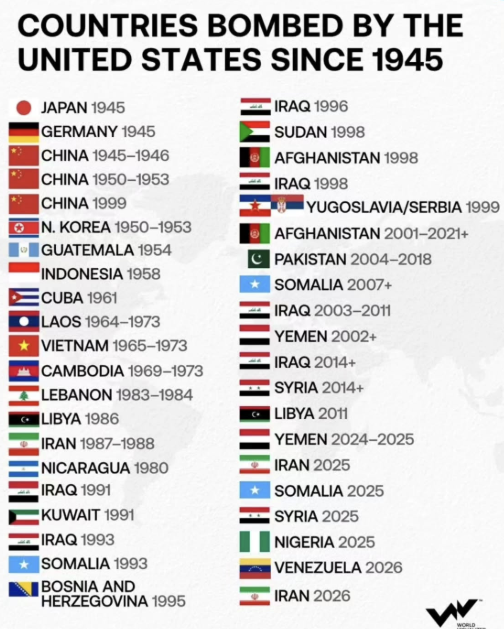
Right now, the US imperialists are carrying out one after another wars of destruction. A few years back, they destroyed and occupied Iraq, accusing President Saddam Hussein of manufacturing weapons of mass destruction. On verification, the International Atomic Energy Commission had confirmed that no evidence was found in support of the allegation. But the US imperialists paid no heed to that and went on destroying Iraq. After Iraq was completely destroyed, the world had come to know how baseless had been that claim. This was nothing but a false pretext to capture Iraq. The British imperialists were accomplices to US imperialism in this crime. Thereafter, among others, US had attacked and destroyed Libya. Zionist Israel with the backing of US imperialism is massacring innocent Palestinians in Gaza with savage cruelty. Thousands of people including children are being killed mercilessly. The entire area has been razed to the ground. All residential buildings, hospitals, schools and universities have been demolished. A few days back, US had abducted the President of Venezuela, a sovereign country, in a covert military operation. The Venezuelan guards on duty at the Presidential residence were all gunned down. Now Cuba, Columbia, Mexico and some other Latin American states are on the US radar. US is threatening them that unless they submit to the dictates of US President Trump, their fate will also be like that of Venezuelan President. Why was the Venezuelan President kidnapped? US rulers are openly saying that the oil fields of that country were to be brought under their control. Earlier the oil fields were owned by the US capitalists. Later the Venezuelan government nationalized them. Again, the US imperialists have now established their control over those oil fields at gunpoint. This monstrous character of imperialism was first exposed by great Lenin. Today, US imperialism has virtually established its domination over almost all the countries of the Middle East. Again, it is establishing its dominance in Latin America as well. Those who are refusing to bend before it are threatened with dire consequences. In order to force Iran to submission, the Pentagon rulers have sent a massive fleet of warships to the Gulf waters.
Imperialism is Unbriddled in Absence of Socialist Camp
Today, the mighty socialist camp under the leadership of Soviet Union is absent. When newly resurgent Egyptian government nationalized the Suez Canal in 1956, Britain and France along with Israel launched military attack on Egypt. At that time, the Soviet Union issued a 12-hour ultimatum to stop that attack on Egypt. Both the British and French imperialists were left with no other option than to retreat within 6 hours. Today, neither that Soviet Union nor the socialist camp is in existence. Unbriddled in their absence, the imperialist powers are wantonly subverting all prescripts of UNO, trampling under foot all canons of international laws and codes, launching indiscriminate military assault here and there to satiate their imperialist lust for power, posing immense threat to independence and sovereignty of other countries.
On the other hand, after counter-revolution and destruction of socialism China has emerged as a mighty imperialist country and a powerful rival of US imperialism. In comparison to US or China, British-French or German imperialism is less powerful. India has also acquired imperialist character and is exporting finance capital to other countries, investing capital in industries and mines abroad. Indian imperialists are moving in an understanding with the US, Chinese, European and Russin imperialists. Today regional conflicts and partial wars have flared up in various parts of the globe. The air is surcharged with war tension. Various imperialists powers are involved in these wars, directly or indirectly. Alongside, trade and tariff wars are at their peaks. These wars are also aimed at grabbing others’ markets. As mentioned above, China and US are now two main competitors in the global economy. All imperialist countries are putting more and more emphasis on militarization of economy. So, the whole world is faced with a great danger.
Anti-Capitalist Movements are Sweeping Across the World
The entire imperialist-capitalist world including US is ridden with growing, acute and insolvable crisis. The capitalist market is getting further squeezed with every passing hour. Lock-out, unemployment, closure, priceline and inflation are on a steep rise. No remedy is forthcoming. Protest demonstrations of toiling people are sweeping across US, Britain, France, Germany and Japan. A few years back, ‘Occupy Wall Street’ movement had erupted in US. Wall Street is the business hub of US. The movement continued for several months. Thousands of students and youths had encircled the area. A few days back, a ‘no kings’ movement had stirred that country. It meant that Trump, the ‘king’, is not wanted. Trump being an agent of imperialism, so is the slogan against him. Similar agitations are surging forth in many countries against their respective regimes. In developed imperialist countries, the objective condition is ripe for revolution. But the subjective condition has not yet matured, meaning revolutionary ideology or revolutionary party is either absent or weak.
Socialism is the Saviour of Human Civilization
Lenin established the first socialist country in the world. Great Stalin, as worthy disciple of Lenin had played an epochal role as the builder of Soviet socialism. During Second World War, the leading lights of the then world, like Romain Rolland, Bernard Shaw, Rabindranath Tagore, Einstein and others were eagerly looking up to Soviet Union for saving human civilization from the fascist axis of Germany-Italy-Japan. They reposed immense faith in the Soviet Union’s ability to inflict defeat on the fascist forces and save mankind. And the Soviet Union did not disappoint them. It defeated the fascist axis and liberated entire East Europe. Socialism was established in many East European countries. On the other hand, China under the stewardship of Mao Zedong established New Democracy in the country, advancing towards socialism. Thus, a socialist bloc came into existence. At that juncture, imperialists were trembling in fear. During our teenage days and in our youth, we had witnessed this world situation. On the one side were the socialist countries—Soviet Union, China, North Korea, East Europe. On the other side, national liberation struggles against imperialist occupation were developing in the colonies and semi-colonies of Asia and Africa with the help of the socialist camp. So, the world situation was then favourable for revolution.
But within the Soviet Union, the defeated bourgeoisie orchestrated had counter-revolution, about which possibility Lenin had repeatedly warned. Similarly, socialism in China and East European countries had also been destroyed. In a discussion a few days back, I had explained, based on the teachings of Marx-Engels-Lenin Stalin-Mao Zedong and particularly of Comrade Shibdas Ghosh, how such counter-revolutions could take place. I do not want to dwell on that today because then my speech would become much longer. With a view to apprising every one of the reasons behind such a sad debacle, a booklet has been published. Please go through it.
SUCI(C) Represents Revolutionary Leftism
What I have been trying to emphasize is that people of various countries are ready for revolutionary battle. And are engaged in battle. Three years back, 700 peasants had embraced martyrdom during the historic Peasants’ movement in Delhi. We had participated in this movement with all our might. You are aware that the CPI (M), CPI are not in the midst of movement in the country for quite a long time. Now they have only one objective –whose hands need to be held for gaining a few seats. This is their sole politics. In the 1950s and ‘60s, they were in the vortex of left movement. There used to be conflicts-contradictions between their reformist line and our revolutionary line. But after ascending to governmental power, they have lost whatever little fighting mindset they had earlier. Today they are averse to participating in class or mass struggle and have turned into vote-based parties. It is to be noted that there is a distinct difference within the ambit of leftism. The CPI (M), CPI are reformist leftists while we represent revolutionary leftism. We have been making all efforts to develop movements in various provinces based organizational strength.
Strengthen SUCI(C) While Realizing the Significance of Lenin’s Revolutionary Teachings
So, we must increase the strength of our Party. It is true that our Party is growing in various parts of India. Party organizations are developing in various states. But mere numerical strength would not suffice. Comrade Shibdas Ghosh wanted a band of revolutionary leaders and workers who would give up the life of so called comfort, leave home, abandon private property, conduct all-embracing struggle for identifying their individual interest with the class, Party and revolution and thereby assimilate the essence of the Party’s ideology. They will mix with people in different localities and emerge as their leaders.
As living embodiment of higher proletarian character and based on scientific reason and logic, they would carry the revolutionary thoughts to the workers, peasants, agricultural workers, students, youths and women in various rural and urban belts, develop movements on the burning problems of life and build up people’s committees and volunteer corps as instruments of struggle. Likewise, they would prepare the ground for anti-capitalist socialist revolution in the country.
Please keep in mind that increasing the strength of the Party based on Marxism-Leninism-Shibdas Ghosh Thought is not only imperative for Indian revolution but also for invigorating world revolutionary movement. This is our international responsibility. Showing proper respect for Great Lenin lies in shouldering this responsibility history has enjoined on us. Realizing the teachings of Lenin and imbibing Comrade Shibdas Ghosh Thought, strengthen the Party, build up class and mass struggles in right earnest, build up revolutionary movement. With these words I conclude today.
Long Live Revolution!
Long Live Great Marxism Leninism-Shibdas Ghosh Thought!
Red Salute to Great Lenin!
A really inspiring article which in a nutshell enumerates the origin development, maturing of the International Communist movement since the days of Federic Engel.
The salient & striking feature of the write up is that it enthuses the reader to assimilate the issues haunting humanity & play his historical role in the revolutionary transformation of the contemporary society.. The article needs to be published as a booklet for the benefit of an international audience, after mandatory corrections of the minor error which has inadvertently crept in.