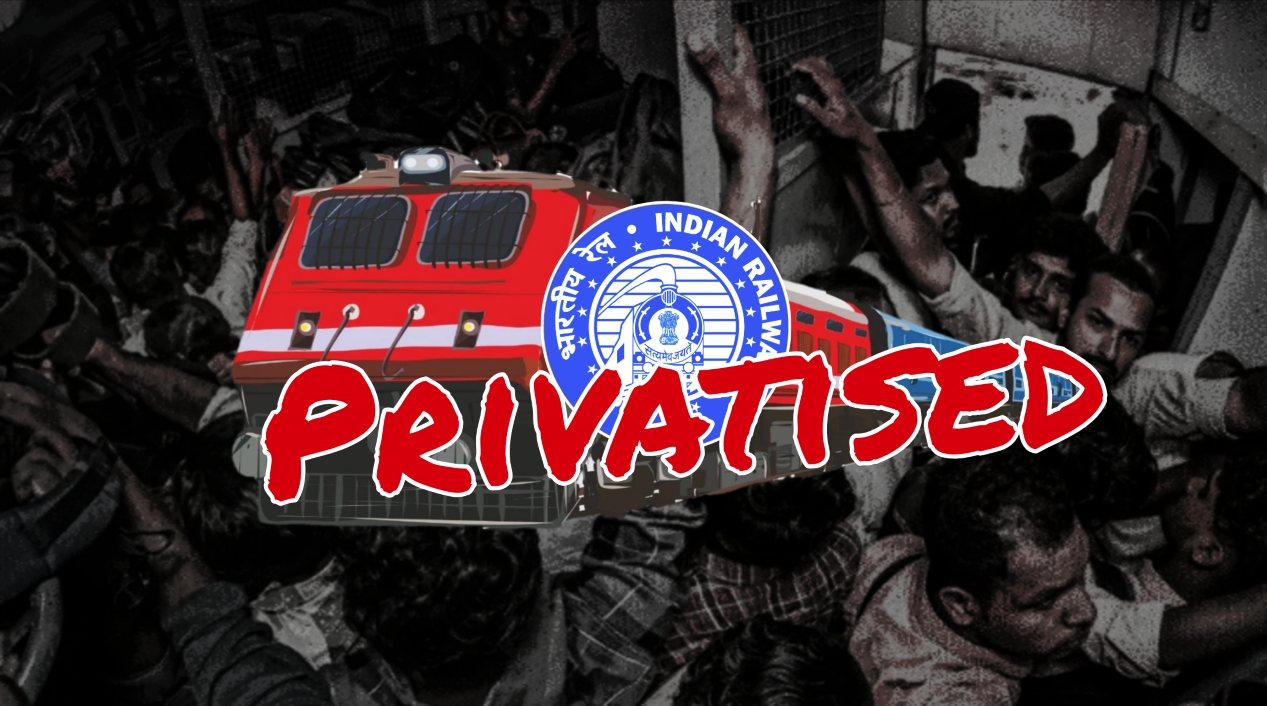
When a poor migrant worker from the far North-East wants to travel to the South, where he envisages scope for relatively more income generation, he does not have any option but to opt for a train journey. Likewise, an elderly devotee, with his hard-earned savings, plans a pilgrimage and surely prefers to travel by train. Similarly, an unemployed youth or a student appearing for competitive examinations dares to board a crowded compartment, facing many hardships. Middle-class family members of many patients recommended for treatment at a better-equipped hospital in another state, prefer to travel by train. Hence, for an affordable, accessible, and safe journey, the only option left for millions of common people in our country is to undertake a train journey.
But this very mode of travel is increasingly becoming not only prohibitive but also out of reach. This is a reality—a hard reality—in a country where two-thirds of the population are living below the poverty line. The single reason for such a development can be traced to the anti-people policies adopted by successive bourgeois governments at the Centre—more aptly, the policy of privatization or corporatization of a large-scale public sector undertaking like Indian Railways.
Before dealing with the disastrous steps taken by various governments in this sector, particularly under the present BJP regime, let us have a glimpse of the length and magnitude of the operations of Indian Railways, built with the sweat and blood of the Indian people.
Life-Line of the Nation built with Public Exchequer
It is no exaggeration to say that India cannot be imagined or visualized without taking into consideration the wide network of Indian Railways. Even before Independence, the railways not only helped link the people of various disconnected feudal provinces but also served the cause of national unity and the struggle for freedom. Certainly, in independent India, the role the railways played in the country’s economic and industrial growth cannot be ignored. Railways, as it is said, is the artery of the country.
During the last seven or eight decades, rail connectivity has increased enormously, and it has become one of the largest railway systems in the world. At present, Indian Railways operates 13,000 to 13,500 passenger trains and over 11,000 to 11,500 freight trains, connecting more than 7,000 stations across the country. Approximately 23- 25 million passengers travel by train every day. In addition, through a vast over 68,000 kilometer route length, Indian Railways transports over 1.6 billion tonnes of freight annually. Across the railway system, nearly 1,300 goods sheds are operational. Around 3,00,000 loading workers are employed on a contract basis.
It is known to all that such a huge operational network could become a reality only with the investment of an enormous amount of public money and the hard labour rendered by lakhs of railway workers over the years. The Indian people’s money has been used to create assets valued at around Rs. 60 lakh crores over the years.
In fact, just after Independence, when the country’s industrialization drive was initiated along a capitalist path, no individual capitalist was interested in establishing core and key sectors like coal, power, roads, railways, and telecommunications, where immediate profit maximization were not assured due to long gestation periods. Moreover, a large amount of capital was required to be invested. But without establishing such key sectors, no capitalist would have been in a position to produce and market consumer goods for reaping immediate profits.
Under such circumstances, the Indian government, subserving the class interest of the ruling monopolists, came forward to open key and core sectors with funding from the public exchequer collected through taxes. Thus, the idea of the public sector was conceived, and the building of the railways, as one of the essential key sectors, was undertaken. Although it was termed a so-called mixed economy, the development of Indian capitalism was the core content of Nehruvian economic policy, and the same continued for quite some time, building various public sector units, including the railways. The public sector in a capitalist set up, it bears mentioning, is also aimed at serving bourgeois class interest. In fact, in the course of developing Indian capitalism, the state monopoly capital also lays an important part. We avoid elaboration for brevity’s sake.
Globalization Marked the Policy Shift
At the turn of significant international events in the 1990s, when the erstwhile Soviet Union and other socialist countries faced counter-revolutions and the restoration of capitalist systems, an imperialist-dominated unipolar world order had emerged. The slogan of capitalist globalization, along with neo-colonial prescriptions, was imposed worldwide.
The Indian ruling class, as a relatively junior partner of the imperialist alliances, adopted the policy of privatization in all fields, including key and core sectors, to the delight of Indian monopolists who had by then amassed huge wealth by exploiting millions of Indian people. The surplus capital in their hands was in search of lucrative fields of investment. Naturally, Indian Railways became an attractive avenue for corporates to mint maximum profits at the cost of providing safe, affordable, and accessible travel to the general public.
The programme of privatizing Indian Railways was initiated by the Congress-led coalition government headed by P. V. Narasimha Rao in 1994, as part of the overall globalization scheme. Subsequently, a slew of measures was adopted by the Ministry of Railways. During the last 25 to 30 years, all Central governments—irrespective of hue—have carried forward the agenda of privatization of Indian Railways in the name of “restructuring,” “rationalization,” and “improvement of efficiency,” and so on.
Since Indian Railways is the biggest public entity, it is difficult to hand it over entirely to the private players at a single stroke. So, the various segments of Railway operation—maintenance, catering, cleaning, safety devices, and upkeep of the station were first segregated. Then each segment was brought under separate corporations. And then those corporations are now being corporatized part by part. Significant steps toward breaking up and privatizing Indian Railways were first taken by the BJP-led coalition government under the Prime Ministership of late Atal Bihari Vajpayee.
Many committees were set up from time to time to justify each phase of privatization. Among these, the Rakesh Mohan Committee (2001), set up by the BJP-led NDA government, Sam Pitroda Committee(2011) constituted by Congress-led UPA government and the Bibek Debroy Committee (2014), set up by the present Modi-led BJP government, are the most prominent ones in pushing forward privatization spree.
Privatization in a Planned Manner
As stated earlier, under the guise of terms like rationalization, restructuring, and efficiency improvement, different segments traditionally supervised under one roof by Indian Railways are being opened to private capital, while less profit-generating segments are still left to be run by the government. The Rakesh Mohan Committee (2001) recommended that Indian Railways should engage only in activities directly related to its “core activity” of goods and passenger transport, while all “non-core activities” should be outsourced or corporatized. The Sam Pitroda Committee (2011) further pushed privatization under the name of Public-Private Partnership (PPP). Although termed a partnership, PPP is, in reality, an unequal arrangement where the private company is assured of profits while the government bears the risks. The State guarantees a rate of return on private capital. If losses are incurred, they are ultimately borne by the people, while profits go into private hands. The Bibek Debroy Committee (2014) recommended major steps toward near-complete privatization. As part of these recommendations, the separate Railway Budget was abolished, thereby removing the special status of such an important transport sector like Indian Railways.
It also recommended separating Indian Railways into a track-holding company and train-operating companies competing with private operators. This effectively opened even the “core activities” of running passenger and goods trains to privatization, leaving only track maintenance with the government. And, even this track maintenance is majorly outsourced to private operators.
About two dozen public sector corporations have been formed to separate activities that were previously performed by Indian Railways, and these include: 1. IRCON International Ltd., 2. Indian Railway Catering and Tourism Corporation Ltd. (IRCTC), 3. Indian Railway Finance Corporation (IRFC), 4. Container Corporation of India Ltd. (CONCOR), 5. Mumbai Railway Vikas Corporation (MRVC), 6. Rail Vikas Nigam Ltd. (RVNL), 7. Konkan Railway Corporation (KRCL), 8. Dedicated Freight Corridor Corporation Ltd. (DFCCIL), 9. High Speed Rail Corporation Ltd. (HSRCL), 10. RAILTEL Corporation of India Ltd., 11. RITES Ltd., 12. Rail Land Development Authority (RLDA), 13. Indian Railway Stations Development Corporation Ltd. (IRSDC), etc. These are being privatized in a phased manner, as planned.
When the privatization of the core activity of running passenger and freight trains began in 2021, the process of introducing 150 private passenger trains on 109 selected profitable routes was initiated. Revenue-earning routes are being handed over to private operators, while loss-making sections remain with the Railways. The Railway Ministry had also announced plans to hand over 30% of goods traffic and 30% of railway stations to private operators, including the iconic World Heritage like Mumbai CSMT station.
Another recommendation was that investments should not be made in projects that do not have traffic and do not generate revenue. This implies that investments would be made only in profit-guaranteeing projects, abandoning the social objective of providing rail connectivity to remote areas. Also, the cost of tickets are being periodically raised, passenger trains renamed as express trains for being charged higher, price of platform tickets hiked substantially—all based on recommendation for profit maximization.
Modi-Led BJP Government Vouches for Total Privatization
The policies of the present BJP-led central government have fundamentally altered the very purpose of railway transport. Instead of prioritizing the needs of the common people, public funds are being diverted towards luxury, high-speed trains such as Vande Bharat, Amrit Bharat, Duronto, Tejas, and Shatabdi, catering largely to a handful of privileged minority. The cost of a Vande Bharat coach is nearly three times higher than that of the Linke-Hofmann-Busch (LHB) coaches used in regular express trains. Passenger trains, which are affordable and widely used by ordinary citizens, are being systematically reduced. Second-class sleeper coaches are being removed and replaced with AC sleeper coaches to fetch more money through escalation of fares. Nearly 90% of sleeper coaches have now been converted into AC coaches. Ordinary compartments have become things of the distant past. As a result, rail travel is becoming unaffordable for a large section of people. Our hon’ble PM often parrots the bullet train project between Mumbai and Ahmedabad at a cost of Rs 1.98 lakh crore ($17-24 billion) as of early 2026, rising from an initial Rs 1.1 lakh crore estimate due to delays and cost escalations. Whom is this project for? Common toiling masses or the elites like Ambani-Adani and their ilk?
The model for privatized train operation is being tested on the two private Tejas trains started in 2019 through the IRCTC. The fare varies from day to day based on demand, as is the case with airfares now. Railway workers have been advised to give priority to private trains at the cost of other trains to ensure punctuality. The operating staff, such as station managers, train controllers, loco pilots, guards, signalling staff, etc., are being asked to ensure success of private trains.
Earlier, parcel services at railway stations were easily accessible and highly convenient for the common public. Today, these services have been leased out, leading to irregularities, exploitation by private brokers, and fraudulent practices. Facilities such as waiting halls, public toilets, drinking water supply, and parking places, developed with public funds, are being modernized by way of handing over to private contractors. These contractors extract profits by charging the public heavily—without investing a single rupee of their own. Thus, infrastructure built with people’s money is being systematically transferred into the hands of large corporate contractors. Prior to privatization, the railway catering department operated base kitchens across the country, providing relatively better quality food at affordable prices and generating employment for over one lakh workers. But after the introduction of Indian Railway Catering and Tourism Corporation Ltd. (IRCTC), this system has been dismantled. Catering profits are now being appropriated by private contractors. The IRCTC alone sells around 1.5 million meals every day, earning enormous profits, while workers’ rights are ignored. Also, meal quality has deteriorated considerably. Even insects and dead lizards are found in the meal items. Contract workers in pantry cars are forced to work continuously for days in blatant violation of labour laws.
Staff Reduced, Safety Compromised
The number of regular employees has steadily declined after the introduction of privatization measures. Indian Railways had 13,61,519 sanctioned posts. By 2024, this number had been reduced to 12,52,180. Since 2010, 1,67,633 workshop artisan posts—amounting to 57.7% of sanctioned positions—have been abolished. These jobs are now outsourced or assigned to contract workers.
Similarly, the strength of the Railway Protection Force (RPF) has been reduced significantly. Vacancies persist in the signaling, operations, engineering, and electrical departments. Critical posts such as loco pilots, track maintainers, and train managers remain unfilled.
Staff Shortage and Rise in Accidents
Due to staff shortages, employees are forced to work 12 to 20 hours continuously. Lack of adequate rest, mental stress, and exhaustion are contributing factors to accidents. Permanent jobs are being replaced with contract labour, while the government claims that employee salaries are responsible for financial strain. Reports indicate that fatigue and work pressure contribute significantly to accidents.
Recently, 72 Mail train loco pilots have written to the Divisional Railway Managers, seeking voluntary retirement as they are unable to continue in service due to excessive physical and mental stress and strain, irregular working conditions, and pressure from the administrative high ups. Contract workers deployed in safety-related tasks are often not provided with proper training or protective equipment, putting passengers’ lives at risk. Moreover, railway accidents have now become a periodic affair. The Coromandel Express accident in June 2023 at Balasore, Odisha, which claimed 288 lives and injured over 1,000 passengers, exposed serious loopholes in maintenance and safety mechanisms despite all tall claims of installation of ‘Kavach’ technology.
Unity of Railway Workers and Passengers is Imperative
In essence, the privatization of Indian Railways has been going on systematically for over 25 years and the government washing of its hands though a railway minister with fabulous salary and perks exists for namesake. International experience shows that privatization often harms both workers and passengers. Private operators focus on profitable routes and neglect less busy ones. Fares tend to increase, restricting access for common people.
The future of Indian Railways cannot be allowed to be determined solely by profit considerations. Needs and interest of the common people back-broken by rising price line and depleting income people ought to be not only priority but sole objective. It calls for a broad public debate and collective action against the policy of privatization. To defend affordable and safe rail transport, unity between railway workers and passengers is essential. The massive railway strike of 1974 demonstrated the power of organized unity. When workers and the general public get united by forming people’s committees as instruments of struggle and develop a sustained movement throughout the country, it would surely pressure the government to refrain from implementing unabated privatization of Indian Railways.