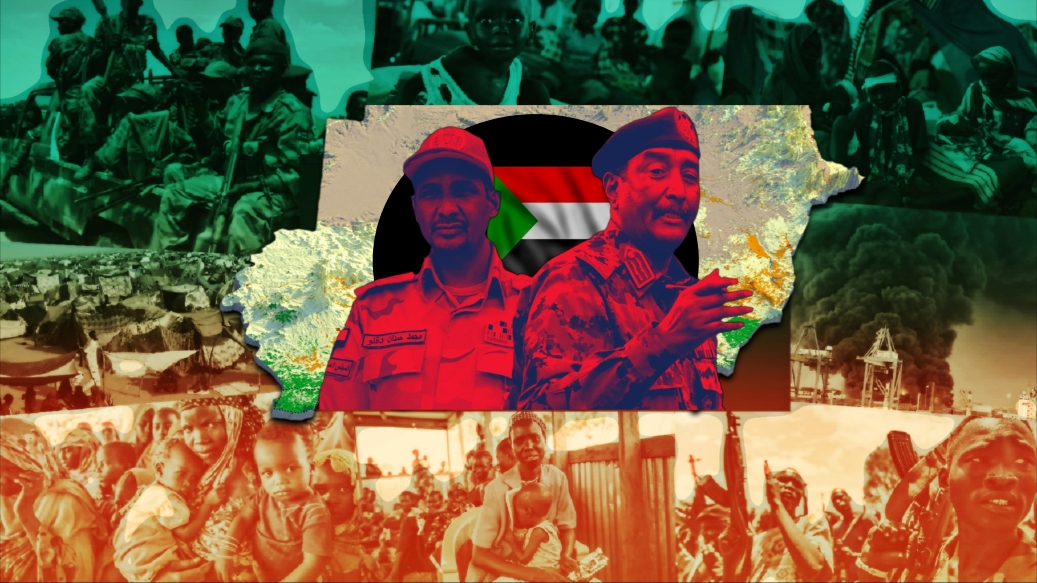
Sudan, an East African country rich in oil, natural gas, gold and other minerals has been embroiled afresh in a civil war between the army (SAF) and the Paramilitary Rapid Support Forces (RSF), which grew out of the Janjaweed militias accused of genocidal acts of murder and rape in Darfur in South Sudan since April 2023, sparked by a power struggle between the two figures in Sudan’s military government: General Abdel Fattah al-Burhan, Sudan’s de facto leader since a coup in 2019 and Muhammad Hamdan Dagalo, a warlord and the leader of the RSF. More than 1,50,000 people have died in the conflict across the country, and about 14 million have fled their homes. 3 million are reported to have fled to neighbouring countries like Chad, Ethiopia and South Sudan. Over half the population of about 50 million is facing acute levels of hunger. Health and education systems have collapsed. Further, more than 12 million girls and women have been facing sexual violence. Once a vibrant capital city, Khartoum is now a “burnt-out shell”. Alongside Gaza, Sudan is also facing a severe humanitarian crisis caused by imperialist machination overlordism and brigandage.
Sudan: A Target of the Imperialist Sharks
Sudan was a British colony from 1899 to 1956. It gained independence on 1 January 1956. It warrants mentioning that the country has been of great ethnic diversity, with people having lived in harmony over centuries, intermarrying and sharing common cultural and religious traits. But, long under the yoke of the British imperialist rule, it remained undeveloped and poor, despite its abundant resources, which were plundered by the alien rulers. Moreover, famine, drought, and other calamities caused acute food shortage, followed by rampant starvation and malnutrition. Sovereign Sudan, fostered by a nationalist fervour, had long been trying to follow a policy of development of its economic resources independently. But, in order to frustrate that effort, the US, UK imperialist powers and their associates, in pursuit of their age-old policy of divide and rule to keep control over the resources as well as politics of the erstwhile colony, went on fomenting mistrust and division among the different ethnic groups and stoking the accumulated grievances among the poverty stricken hungry Sudanese people, particularly the tribal communities of southern Sudan seething to break out in revolt, so that they are locked in internecine clashes, and remain ever poor, less developed and weak. The imperialist sharks also continued intensifying rebellions, communal and ethnic conflicts in Sudan, through underhand financial and military assistance to different rebel groups. As a result, the Muslim and Arab dominated North Sudan and the African Christian-dominated South Sudan, in spite of being one nation, remained virtually separated. Thus, Sudan remained a hotbed of sinister imperialist intrigues and was torn apart by sustained ethnic conflicts and clashes, shattering normal life.
Former Sudan President Bashir Invited Red Eyes of US Imperialists
In such a tumultuous situation, former Sudanese President Omar Hassan al-Bashir, who assumed power in 1989, was unbending despite the pressure of both US and UK imperialism. He did not grant the US access to his country’s oil resources, nor did he support the US war of occupation on Iraq. So, he incurred the infuriated displeasure of the US imperialist regime, which in order to destabilize the country in 1998, had even launched a missile attack on one of the largest pharmaceutical plants of Sudan, producing 60% of medicines needed for its domestic consumption, on the plea that chemical weapons were being manufactured there. Also, as a retaliatory action, the Pentagon rulers, just the way they had attacked and occupied independent sovereign Iraq under the fraudulent pretext that President Saddam Hussein possessed Weapons of Mass Destruction (WMDs), had also brought fabricated charges against the Sudan President in 2008, pointing at the large scale killing at Darfur in Western Sudan and falsely indicted him of war crimes and crimes against humanity by requisitioning the intervention of the International Criminal Court (ICC), pliable to their dictates. The US, it is reiterated, had focused on destabilizing and dividing Sudan, with more than 30 years of sanctions that have strangled the country. The UN which has virtually become a rubber stamp of the US imperialists also imposed an arms embargo, asset freezes, and travel bans on Sudan in response to acts of violence in Darfur.
On the other hand, China (now a formidable imperialist power after completion of the counter-revolution in 2004) and Russia, from their respective imperialist aspirations to keep Sudan under their control, opposed US sanctions against Sudan and ICC arrest warrant against Omar al Bashir on the charge of war crimes in Darfur. Most notably, Russia, China, and Iran have attempted to establish a presence in Port Sudan. China has invested heavily in infrastructure and “expressed interest” in the creation of its own presence in Port Sudan. Russia has put even more effort into establishing a military base there. In February, Sudanese Foreign Minister Ali Youssef stated there were no obstacles to the establishment of a Russian naval base in Port Sudan, worrying many Western imperialist powers. Under the deal, Russia could establish a naval base with 300 personnel plus warships, and potentially submarines stationed there that would give Russia the ability to project its power in the region, counter Western interests, threaten global maritime trade routes, and even threaten NATO’s southern flank.
It bears recall that to counter the US-UK move, President Bashir had established close ties with China and India to play an important role in developing the country’s oil sector in the 1990s. When Russia became an imperialist country after counter revolution and gradually started to challenge the unchallenged global domination of US imperialism, particularly as a military power, Omar al Bashir quickly built up close ties with Putin’s Russia, also for technological and military support. In spite of his pro-capitalist military dictatorial rule, by 2010, Bashir emerged as a hero within the Arab world and Africa for his staunch anti US imperialist stance.
Division of the Country
Then, subverting the inalienable right of the local populace to decide the nature of governance of their country, at the instance of the Pentagon rulers, Sudan was bifurcated into North and South Sudan in 2011. US efforts to partition the country include backing various separatist breakaway attempts, as had happened in Darfur in West Sudan. The country was divided, but the precipitated disunity among people, the fratricidal bloodbath went on unabated, much to the glee and instigation of the US imperialists and their allies. Bashir ruled Northern Sudan after the bifurcation. To prevent military intervention of the US, Bashir signed an agreement with Russia in 2019 to allow it to build a naval base in Port Sudan, on the Red Sea, the much to the chagrin of the US imperialist rulers. US military envoys met some of the officers of SAF (Sudan’s Armed Forces), and immediately after that, the SAF, led by General Burhan and the paramilitary Rapid Support Forces (RSF), led by Hemedti, jointly organized a Coup on 11 April 2019 to oust President Omar Al Bashir. After the ouster of Bashir, military rule was clamped again on Sudan. The interim military council in Sudan, backed by the US imperialists, seized power and cracked down on peaceful pro democracy protesters in Khartoum who were demanding the promised civilian rule. But the US supported the demand of secession by the African Christian-dominated South Sudanese political forces against the Muslim and Arab dominated Khartoum based North Sudan. At the same time, it continued fanning up both Christian and Islamic fundamentalism and all sorts of ethnic and racial fanaticism, drew on its vast financial leverage, global military reach, intelligence agencies, pliant bourgeois media and a web of NGOs and other well funded organizations, to fish in troubled waters and forestall any kind of anti-imperialist, anti-establishment upsurge of the right-thinking Sudanese people. After vivisection, in North Sudan, Abdalla Hamdok, backed by US, became the Prime Minister, while South Sudan became a federal presidential republic headed by Salva Kiir Mayardit, with Juba as the capital.
US Wanted a Pliant Regime in Sudan
It was evident that, like many other countries, the Pentagon rulers were out to establish a pliant regime in Sudan camouflaged as democracy. Besides plenty of natural resources, Sudan’s geographical location was also of immense strategic value to the US imperialists as its access to 500 miles of coastline along the Red Sea facilitates nearly 12% of global maritime trade, would potentially give US imperialism immediate economic, political, and military influence over the broader Middle East and global trade.
But the US imperialists and their allies have kept alive the ethnic violence by playing off one group against the other. In order to woo North Sudan, the US had backed the return of the depredations of the International Monetary Fund on Sudan’s battered economy. The IMF demanded that Sudan of to end fuel and food subsidies to the population in June, doubling the cost of gasoline and diesel overnight, raising the cost of food and essential supplies and sending inflation soaring. The brunt of both ethnic violence and economic devastation is borne by common, innocent Sudanese citizens.
Current Situation
The current war between SAF and RSF broke out on 15 April 2023. Since its outbreak, the Sudan war has become one of the most disastrous ongoing conflicts in the world. Many contend that there is an ongoing genocide in the western Sudanese region of Darfur.
Furthermore, the conflict has been rife with several categories of war crimes. The SAF and RSF have perpetrated massacres, conscripted child soldiers, tortured civilians and prisoners, and arrested journalists. Civilians are subject to frequent attacks and human rights violations, while the country’s health care system has collapsed as life threatening famine sets in. Attacks on humanitarian aid workers have made it difficult to deliver life-saving aid to some of the most fragile and vulnerable communities in the world. The way people in huge numbers are displaced here and trapped there, Sudan now represents the largest recorded and fastest displacement crisis in the world—the largest humanitarian crisis ever recorded. Needs are acute in Darfur: thousands of families are fleeing El Fasher, the state’s largest city, to join nearly 400,000 displaced persons who have been seeking safety and humanitarian services in neighbouring Tawila. ‘‘The sight of these small children arriving alone, without knowing the whereabouts or the fate of the rest of their family, is harrowing,” says ‘International Rescue Committee’ (IRC). ‘‘Extremely disturbing reports and satellite imagery confirm that people are not able to flee El Fasher to safe places like Tawila. Which means they are trapped, detained or worse”, he added. More than 70% of Sudan’s hospitals have been destroyed, leaving millions without access to essential medical care as disease outbreaks surge. With health care access severely limited, a cholera outbreak has spread across Sudan, resulting in more than 120,000 confirmed cases and over 3,000 deaths. Even before the war erupted in April 2023, Sudan was already experiencing a severe humanitarian crisis that left 15.8 million people in need of aid. More than two years of civil war have decimated Sudan, displacing over 12 million people and leaving 30.4 million people—more than half of Sudan’s population—in need of humanitarian support.
While neighbouring countries— such as Chad and South Sudan— have accommodated Sudanese refugees fleeing conflict, they lack the resources to meet the urgent humanitarian needs of those arriving across the border without international support. Meanwhile, US aid cuts under President Trump have deepened the crisis, forcing organizations to scale back some essential services to refugees, particularly in South Sudan.
Who is Arming the Warring Groups
It goes without saying that a strife-torn, hunger-stricken country like Sudan cannot manufacture arms for sustaining an ethnic conflict over decades. Then who are arming them? It is reported that SAF is receiving weapons from countries such as Iran, Egypt, and Turkey. On the other hand, the United Arab Emirates (UAE), which has been buying an array of arsenal from UK, is stated to be arming the RSF. UK-made military equipment has reportedly been found in Sudan. UAE and RSF have longstanding military ties and Emirati interests in Darfuri gold mines. Although the Emirati government has issued official denials, the UAE has greatly increased the force capability of the RSF by supplying it with drones, weapons, and medical support via logistics routes through Chad and South Sudan. Amnesty International confirmed that many of the bombs and howitzers the UAE has provided to the RSF were manufactured in China. Also notable is the fact that several US lawmakers have repeatedly tried to block US arms sales to the UAE over the allegations.
Imperialist Powers are Generating War and Creating a Humanitarian Crisis
Every imperialist power and its allies have their own goals and intervene to pursue their respective economic-political interests. Controlling (Sudan) means holding influence over the entire sub-Saharan region. So, Sudan has turned into a proxy conflict that reflects the interests of various imperialist powers who, ridden with acute insolvable market crisis, have no other choice but to bank on militarization of economy, release the stockpiles of arms by fuelling local, partial and even full-fledged wars in different parts of the world and plunder others’ resources by exerting economic-political pressure in the form of sanctions, gunboat diplomacy, bullying relatively weaker countries into submission and so forth. The years of horrific violence have weakened Sudan, pushing its institutions into chaos and plunging its population into a much more vulnerable and miserable condition.
There can be no second opinion to the fact that, however grave the situation in Sudan may be, it is for the Sudanese people to decide their own fate. They are the sole custodians of their country. They only have the exclusive right to decide the fate of their own motherland. It is incumbent on all democratic minded anti imperialist people, forces and organizations to come out in protest against imperialist interference, intervention or political blackmailed, especially by US and UK imperialists, and to stand by the peace-loving Sudanese people, determined to protect the honour and dignity of their motherland. It enjoins upon the fighting working people to extend their solidarity to the Sudanese people, who need to imbibe the truth that their sustained hardship could be ameliorated only under correct revolutionary leadership spearheading an intense anti imperialist struggle along the revolutionary road for ultimate emancipation from the scourge of war and capitalist-imperialist exploitation.