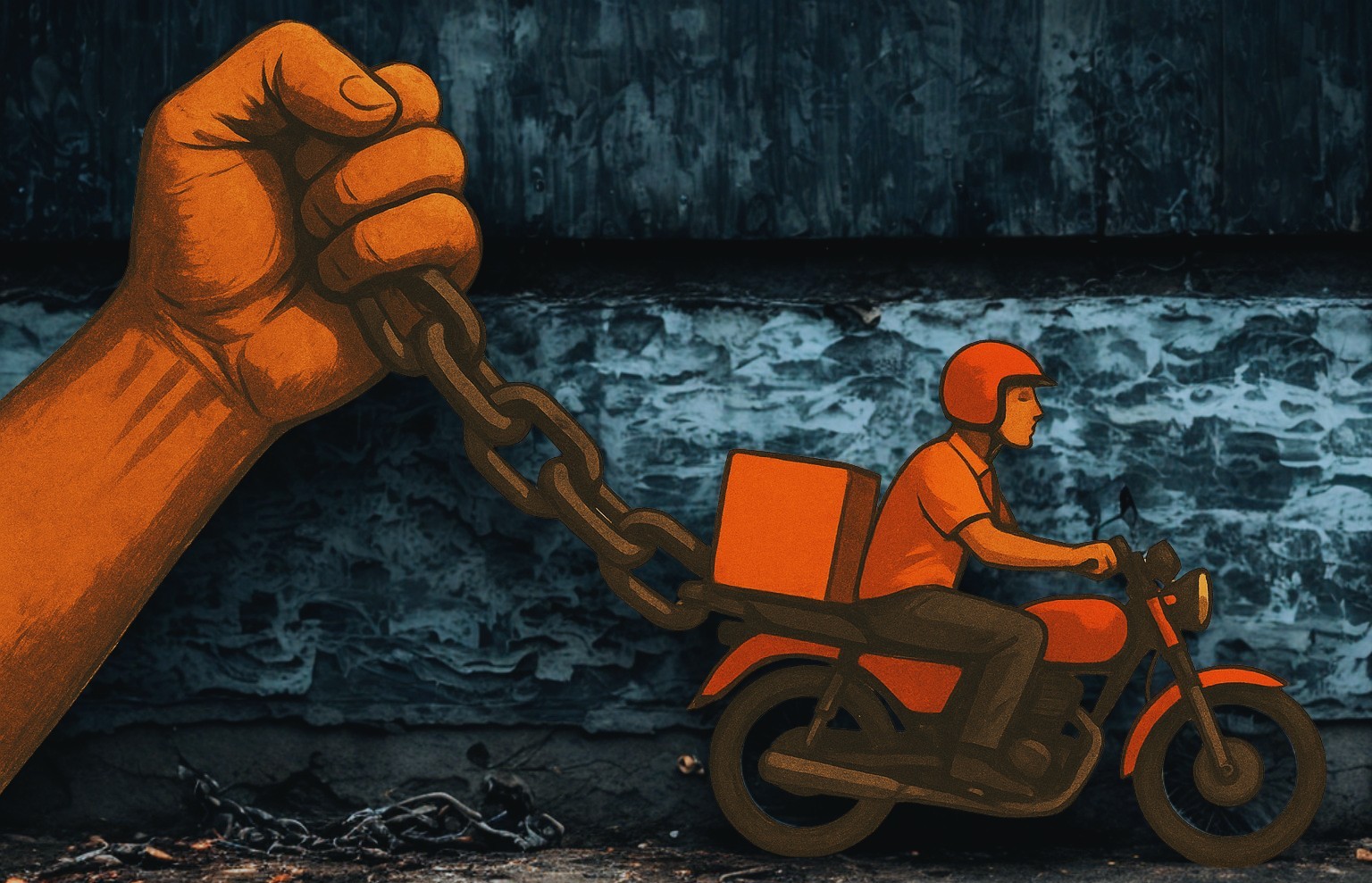
Gone are the days of permanency of employment, job security, timescale pay, 8-hours working day, health insurance and retirement benefits. Earlier, at least by law, there were certain trade union rights protecting the interests of the workers/employees against the whimsical actions of managements. But with the onset of capitalist globalization, the condition of labouring masses has become catastrophic. Even where the nature of work is of regular perennial, the owners merrily employ work force on contractual basis, or as daily wagers or even based on payment for piece work on hourly basis. Let alone providing decent living standards, minimum wages are not being assured to millions of people working in the vast unorganized sector in our country. Anganwadi, ASHA, mid-day-meal workers, construction site labourers, hapless migrant labourers and even casual workers employed in the government offices—all belong to the same category, subjected to a wretched form of wage slavery. The recently brought four black labour codes have further worsened the situation. With the advent of digital era which enabled online commercial connectivity with the platforms like Zomato, Swiggy, Uber, Ola, Porter, Zepto etc., a new category called gig workers has been added to the list. The nature of employment here is governed by the atrocious “hire and fire” policy. According to a NITI Aayog report, number of the gig workers mostly engaged in delivery services, online order supply or as cab drivers, bike riders and freelancers, is expected to grow to 23.5 million (2.35 crores) by 2029-30. The Oxford Internet Institute’s online labour Index indicates that India provides 24% of the entire online outsourced work force in the world, becoming the largest overall supplier.
Growth of gig workers—Why?
With accentuation of capitalist crisis endemic of the system as motive of profit maximization that drives capitalist economy continues to pauperize the working masses and decimate their purchasing power, the ruling financial oligarchs, plagued by ongoing squeeze of market, are cutting production cost primarily by shedding permanent workforce and installing sophisticated technology. Still, some physical labourer is needed and that necessity is met by switching to contract or casual worker system with paltry wage and no stipulation of any condition of service like duration of service, working hours, social benefits. And their exact time of entrance, exit at a delivery spot and completion of each delivery—in other words tracking of their movement and location—are under constant surveillance through digital process. It is nothing else but spying on their own workers to ensure desired output of their service. The capitalist class knows that with aggravation of unemployment problem, the job-seekers would be forced to agree to accept any kind of job just to eke out a bare living for themselves as well as their families. So, scope for ruthless exploitation is wide and open. The Oxford Internet Institute’s Fair Work Research Project-2022 studied 11 such Indian platforms and concluded that not a single one provides their gig workers anything sort of minimum wages or local living wages. Further, the ruling class is aware that the hapless wretched gig workers could be coaxed to stretch their labour time if a carrot of extra payment is dangled before them. ‘More number of customers you reach out with deliverables, more you would earn’—this allurement would make the gig workers toil harder overlooking health hazards, inclement weather and other odds. Moreover, to camouflage their hideous design, the employers refer the gig workers as partners, associates, agents, independent contractors, tech aggregators, facilitators, digital intermediaries and so forth. The reason behind this is also to deprive the gig workers of any rights or protections from the existing laws. In many cases, as the gig workers are paid based on the number of gigs/deliveries/rides they undertake, the law pertaining to minimum wage is not made applicable to them.
Flexibility of employment—a mirage
But then the wicked is never starved of subterfuge. The ruling capitalist class has floated an impression that the gig economy offers many benefits in creating viable opportunities for the employees as the gig workers have the flexibility in performing the job or choosing their employer. They need not go to an office or a working place daily at scheduled time but are free to work remotely whenever they find free time. Moreover, they can work for multiple companies at the same time and earn extra money or take it up as a side job.
Outwardly, the arguments look so sound. Fact is, for 88% of gig workers it is no supplementary job but the main source of income. As they are unable to find any other decent employment, they are therefore forced to take up these types of odd jobs. A study conducted by a credit markets rating agency, India Ratings, pointed out that 63 lakh informal sector enterprises were shut down in the country resulting in a loss of 1.6 crore jobs between 2015-16 and 2022-23 due to demonetization, introduction of GST and the Covid-19 pandemic. This had added to the already prevailing huge number of unemployed, continuing the spiralling growth of joblessness. Hence, the question of flexibility does not stand given the magnitude of competition among unemployed youth prevailing in our country.
Untold misery sans legal protection
As said above, the gig economy provides easy ways and means to exploit workers by the capitalist owners and multinationals. Although much is said about removing middlemen with the growth of online gig platforms, in reality the tech companies involved in this business are acting as the middlemen by way of charging 15 to 25% commission for every delivery or ride. At the end of the day, many of the gig workers are finding it difficult to make ends meet. One such worker lamented that, “Some of us toil for 16 hours a day but the commission for each order, when deducted, leaves us with Rs. 20 from the earning of Rs. 50, amounting to a daily earning of Rs. 300 only, which seems impossible to sustain. Earning Rs. 9,000 per month will leave us only with Rs. 6,500 after deducting the vehicle maintenance of Rs. 3,500. This does not even buy our daily bread, let alone providing for the entire family.” These very words are self-explanatory of the nature of inhuman exploitation.
An incident that occurred recently in Hyderabad is indicative of the risks involved in the gig workers’ jobs vis-a-vis the attitude of the management of Zomato. A delivery worker fell into an open drain during heavy rain while on an active order. His bike and mobile phone were swept away in the flood water. Fortunately, he managed to survive. But the company refused to take any responsibility for rehabilitating the worker. Reacting to it, Shaik Salauddin, the founder President of the Telangana Gig and Platform Workers’ Union, said: “This is not an accident – it is a direct consequence of platforms prioritizing profits over workers’ safety.” In another incident, a Swiggy delivery boy was attacked by a pet dog during a delivery in an apartment. In an attempt to escape, he jumped from the third floor and later succumbed to his injuries in the hospital. In this case, the customer paid 5 lakh rupees as compensation in an out-of-court settlement, but no compensation was paid by Swiggy. Yet, our lawmakers are not paying any heed to the miseries of these poor workers, other than harping on the projected growth of the gig economy.
Gig workers on path of struggle
But the silver lining is that gig workers are not accepting this exploitation by lying low. They are gradually organizing themselves and raising their voices in different states. In Karnataka, Telangana, Uttar Pradesh, and other states, gig and platform workers have held dharnas, strikes, and protest programmes to press their demands. In April last year, around 150 Blinkit gig workers went on strike in Varanasi demanding fair pay, better working conditions, and cotton uniforms. The management of Blinkit, a grocery platform owned by Zomato, blocked the IDs of 150 workers, citing the strike as the reason, and even threatened them with police action. But the workers remained resolute in their demands. Finally, under public pressure and before the struggling unity of the workers, the company had to unblock their IDs. Similarly, in May 2025, hundreds of Zepto delivery workers in Hyderabad went on an indefinite strike under the aegis of the Telangana Gig and Platform Workers’ Union against unfair pay and exploitative practices of the company. In a memorandum submitted to the labour department, the union alleged that “speed is rewarded, but safety is ignored.” Their other grievances included unilateral penalties based on customer ratings, opaque account suspensions, absence of ESI and PF coverage, and unavailability of restrooms during long shifts.
It is also pertinent to note that because of the sustained struggle of gig workers in different parts of the country, state governments like Rajasthan and Karnataka have adopted certain laws intended to provide them social security, occupational health and safety, along with a dispute resolution mechanism. The state government of Telangana has also prepared a bill to be placed in the Assembly. But the provisions contained in all these legislations have remained only on paper. Even on the national legislative plane, the Indian Code on Social Security-2020 recognizes gig workers as a separate category but defines “platform workers” as being “outside of a traditional employer-employee relationship.” The law has been criticized for lacking legal mandates, universal coverage, and accountability mechanisms.
So, there is an urgent need for enacting a robust and comprehensive legislation to address all the problems and concerns of gig workers. Simultaneously, there is an obligation on the part of different cross sections of the society to stand with the gig workers, who knock our door to render various services no matter be the nature hurdles in their life and the weather outside—beating through the biting cold or scorching heat or torrential rain. Finally, the gig workers need to cement their struggling unity under correct revolutionary leadership to take their legitimate movement to its logical end.